
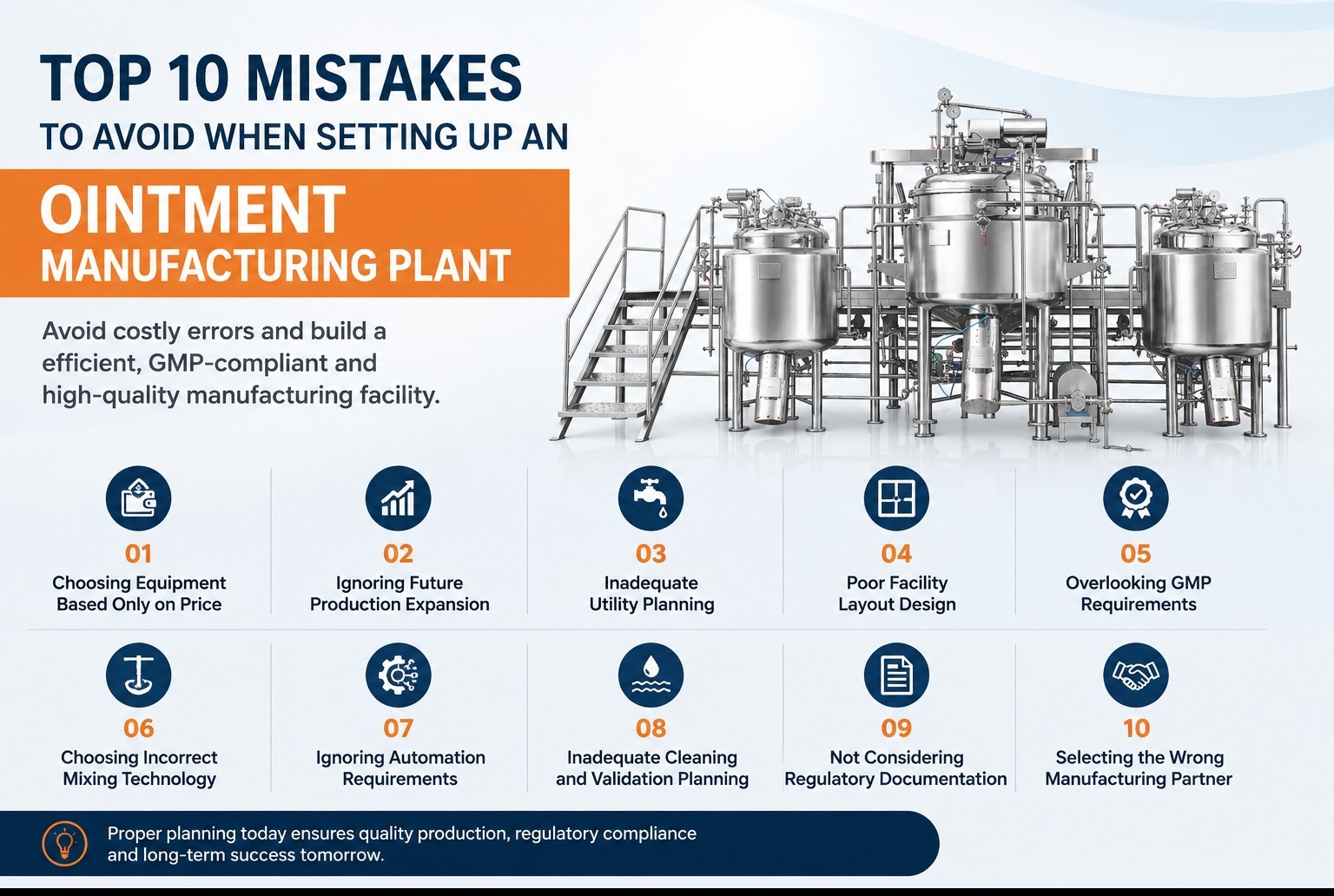
The demand for ointments, creams, gels, and topical pharmaceutical products continues to grow worldwide. As pharmaceutical companies expand their manufacturing capabilities, setting up a modern and GMP-compliant Ointment Manufacturing Plant has become a critical investment.
However, many companies make costly mistakes during the planning and installation phase. These mistakes can lead to production inefficiencies, regulatory challenges, quality issues, and increased operational expenses.
Understanding these common pitfalls can help manufacturers establish a reliable, efficient, and future-ready production facility.
Why Proper Planning is Essential for an Ointment Manufacturing Plant
An ointment manufacturing facility is much more than a mixing vessel. It requires careful planning of:
- Production capacity
- Equipment selection
- Utility requirements
- GMP compliance
- Quality assurance
- Automation systems
- Future expansion possibilities
Poor planning often results in expensive modifications after installation.
Mistake 1: Choosing Equipment Based Only on Price
One of the most common mistakes is selecting equipment solely based on initial purchase cost.
Lower-cost equipment may result in:
- Higher maintenance expenses
- Reduced production efficiency
- Frequent downtime
- Inconsistent product quality
Instead, manufacturers should evaluate equipment performance, reliability, automation features, and long-term operating costs.
Mistake 2: Ignoring Future Production Expansion
Many companies design plants only for current production needs.
As demand increases, manufacturers often face:
- Space limitations
- Utility constraints
- Equipment capacity shortages
Planning for future expansion from the beginning helps avoid costly facility modifications later.
Mistake 3: Inadequate Utility Planning
An ointment manufacturing plant depends heavily on utilities such as:
- Purified water systems
- Steam systems
- Compressed air
- Electrical supply
- HVAC systems
Insufficient utility capacity can directly impact production efficiency and product quality.
Mistake 4: Poor Facility Layout Design
An inefficient layout can create operational bottlenecks and increase contamination risks.
A well-designed facility should ensure:
- Smooth material flow
- Proper personnel movement
- Easy equipment access
- Regulatory compliance
- Efficient cleaning procedures
Mistake 5: Overlooking GMP Requirements
GMP compliance is essential for pharmaceutical manufacturing.
Failure to comply with GMP standards can result in:
- Regulatory observations
- Product recalls
- Approval delays
- Market restrictions
Manufacturers should ensure that the facility, equipment, and processes meet current GMP requirements from the beginning.
Mistake 6: Choosing Incorrect Mixing Technology
Different ointments require different processing conditions.
Selecting the wrong mixing technology can cause:
- Product instability
- Inconsistent viscosity
- Poor texture
- Inadequate homogenization
Modern ointment manufacturing plants typically utilize advanced vacuum emulsifying systems for superior product quality.
Mistake 7: Ignoring Automation Requirements
Manual operations increase the risk of:
- Human errors
- Batch inconsistencies
- Documentation issues
Automation improves:
- Process control
- Product consistency
- Production efficiency
- Data recording
Mistake 8: Inadequate Cleaning and Validation Planning
Cleaning validation is a critical regulatory requirement.
Poor cleaning design can lead to:
- Cross-contamination
- Regulatory non-compliance
- Product quality issues
Equipment should be designed for easy cleaning and validation procedures.
Mistake 9: Not Considering Regulatory Documentation
Modern pharmaceutical manufacturing requires extensive documentation.
Essential documents include:
- DQ (Design Qualification)
- IQ (Installation Qualification)
- OQ (Operational Qualification)
- PQ (Performance Qualification)
Proper documentation supports compliance and inspection readiness.
Mistake 10: Selecting the Wrong Manufacturing Partner
The success of a project often depends on the equipment supplier.
An experienced manufacturer can provide:
- Technical guidance
- Custom design support
- Validation assistance
- Installation support
- After-sales service
Choosing a trusted partner helps ensure long-term operational success.
Key Features of a Modern Ointment Manufacturing Plant
A modern system should include:
- Vacuum emulsification technology
- High-shear homogenization
- PLC-based automation
- GMP-compliant design
- CIP/SIP compatibility
- Efficient batch processing
- Reliable temperature control
These features contribute to consistent product quality and regulatory compliance.
Benefits of Proper Plant Planning
Companies that invest in proper planning benefit from:
- Higher production efficiency
- Improved product quality
- Reduced operating costs
- Better GMP compliance
- Faster project execution
- Increased return on investment
Why Choose Mediclave Industries?
Mediclave Industries Private Limited specializes in advanced pharmaceutical process equipment and complete manufacturing solutions.
Our ointment manufacturing plants are designed to deliver:
- GMP-compliant production
- Reliable process performance
- Efficient batch processing
- Long-term operational reliability
- Custom-built solutions
We help pharmaceutical manufacturers achieve high-quality production while meeting modern regulatory requirements.
Conclusion
Setting up an Ointment Manufacturing Plant requires careful planning, technical expertise, and a clear understanding of regulatory requirements. Avoiding common mistakes during the design and implementation phase can significantly improve operational efficiency, product quality, and long-term business success.
By selecting the right equipment, planning for future growth, and partnering with an experienced manufacturer, companies can establish a robust and compliant pharmaceutical manufacturing facility.
FAQs
What is an Ointment Manufacturing Plant?
An Ointment Manufacturing Plant is a pharmaceutical processing system used for producing ointments, creams, gels, and topical formulations.
Why is GMP compliance important in ointment manufacturing?
GMP compliance ensures product quality, safety, consistency, and regulatory acceptance.
What equipment is used in an ointment manufacturing plant?
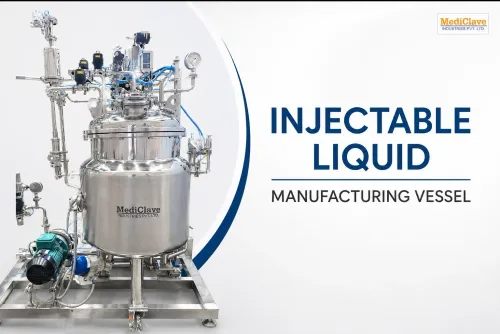
Typical equipment includes manufacturing vessels, vacuum emulsifiers, homogenizers, storage tanks, transfer systems, and filling machines.
How can automation improve ointment production?
Automation improves process control, consistency, efficiency, and documentation accuracy.
What is the most common mistake during plant setup?
Choosing equipment based solely on price rather than long-term performance and reliability is one of the most common mistakes.