

Introduction
Sterilization
is one of the most important processes in hospitals, pharmaceutical industries,
laboratories, research centers, and healthcare facilities. Maintaining a
contamination-free environment is essential for ensuring product quality,
patient safety, and laboratory accuracy. A Vertical Autoclave is a widely used
steam sterilization system designed to sterilize suitable instruments,
laboratory equipment, glassware, and other heat-resistant materials.
Mediclave
Industries Private Limited is a Vertical Autoclave Manufacturer in India,
offering steam sterilization equipment for hospitals, pharmaceutical
laboratories, research institutions, and industrial applications.
Our
vertical autoclaves are designed to deliver reliable sterilization performance,
convenient operation, efficient space utilization, and dependable functionality
for different sterilization requirements.
What Is a Vertical Autoclave?
A
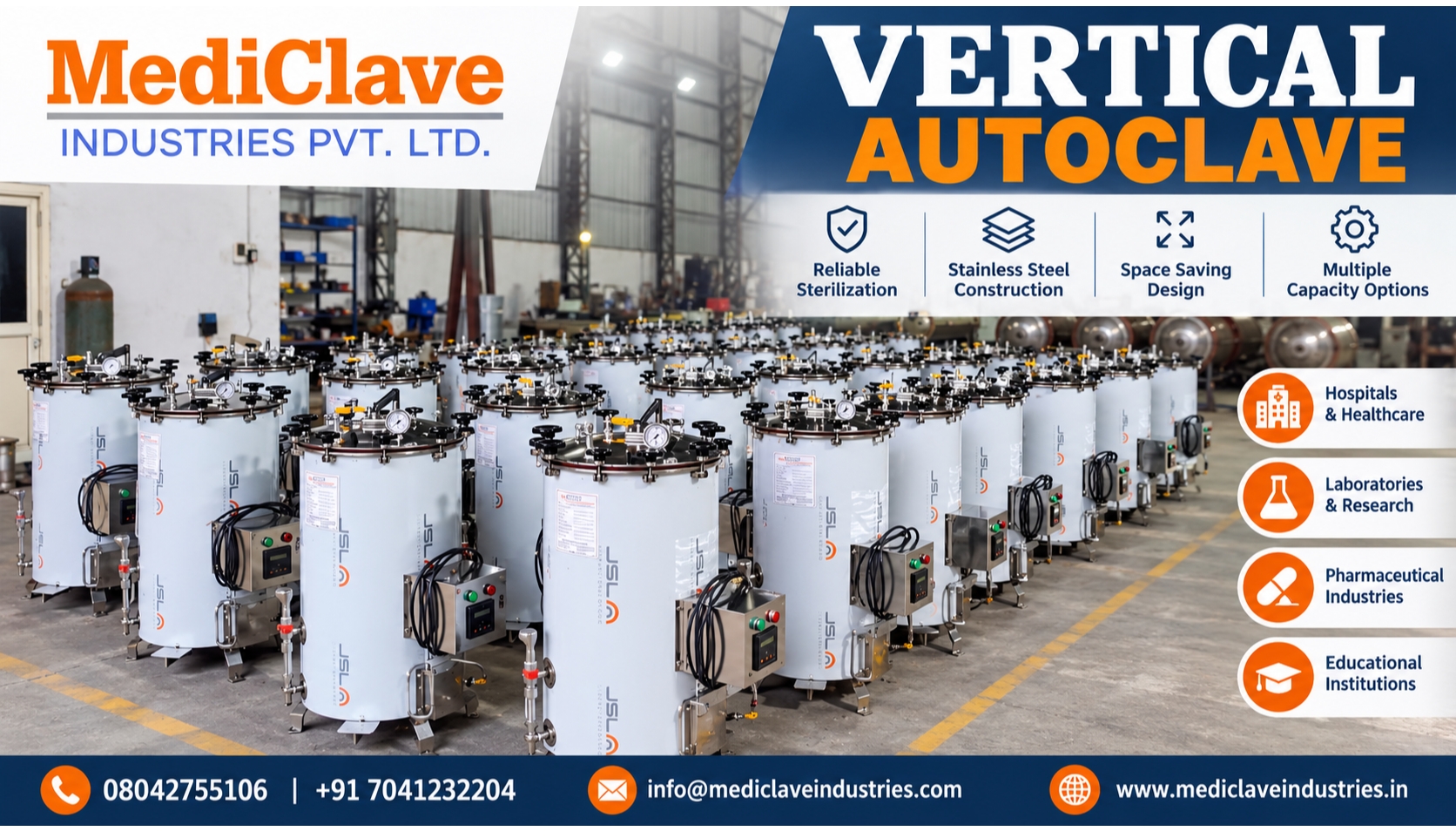
Vertical Autoclave is a steam sterilization machine featuring a vertically
oriented cylindrical chamber with a top-loading arrangement. It uses saturated
steam under pressure to achieve the temperatures required for sterilization.
Vertical
autoclaves are commonly used for sterilizing laboratory glassware, surgical
instruments, microbiological media, stainless steel accessories, and other
compatible materials.
Unlike
horizontal autoclaves, vertical autoclaves generally require less floor space,
making them suitable for laboratories, hospitals, clinics, educational
institutions, and facilities where installation space is limited.
As a
manufacturer of sterilization equipment in India,
Mediclave Industries focuses on practical equipment designs for different
healthcare and pharmaceutical applications.
Key Features of Vertical Autoclave
Our
vertical autoclave solutions can be configured with features according to the
selected model and customer requirements.
1. Stainless Steel Construction
Vertical
autoclaves are available with stainless steel chamber construction for
corrosion resistance, durability, and easier cleaning. Stainless steel is
suitable for demanding sterilization environments.
2. Space-Saving Vertical Design
The
top-loading cylindrical chamber helps optimize floor space, making the
equipment suitable for compact laboratories and healthcare facilities.
3. High-Pressure Steam Sterilization
Vertical
autoclaves use pressurized saturated steam to achieve effective sterilization
conditions for compatible loads when validated operating parameters are
followed.
4. Temperature and Pressure Monitoring
Depending
on the model, the equipment may include temperature indication, pressure
gauges, and control systems to help operators monitor the sterilization
process.
5. Safety Protection Systems
Safety
features may include pressure relief arrangements, pressure monitoring,
lid-locking mechanisms, and other protective components depending on the
equipment configuration.
6. User-Friendly Operation
Vertical
autoclaves are designed for convenient loading, operation, and unloading.
Manual, semi-automatic, or automatic control options may be available depending
on the model.
7. Multiple Capacity Options
Different
chamber capacities can be offered to suit laboratory workloads, healthcare
applications, and specific customer requirements.
How Does a Vertical Autoclave Work?
A
vertical autoclave uses saturated steam to transfer heat into the sterilization
load. The sterilization process generally involves the following stages:
- Water
Filling: The required quantity of water is supplied to the
steam-generation system according to the manufacturer's instructions.
- Loading:
Instruments or other compatible materials are placed inside the
sterilization chamber with adequate space for steam circulation.
- Heating:
The heating system generates steam, increasing the chamber temperature and
pressure.
- Air
Removal: Air is displaced or removed according to the autoclave's design
to support effective steam contact.
- Sterilization
Holding: The load is exposed to the validated sterilization temperature
for the required holding time.
- Pressure
Reduction: Following the cycle, chamber pressure is reduced safely
according to the equipment's operating procedure.
- Unloading:
The sterilized load is removed after appropriate cooling and safe handling
precautions.
Common
steam sterilization temperatures include 121°C and 134°C, but the correct
cycle, exposure time, and drying requirements depend on the load, packaging,
equipment capability, and validated process.
Applications of Vertical Autoclave
1.
Hospitals and Healthcare Centers
Used for
sterilizing compatible surgical instruments, stainless steel accessories, and
selected reusable medical equipment where the validated process is appropriate.
2.
Pharmaceutical Industries
Used in
quality control laboratories, microbiology departments, and research facilities
for suitable sterilization applications.
3.
Research and Micobiology Laboratories
Suitable
for sterilizing laboratory glassware, compatible culture media, and
microbiological equipment under appropriate validated cycles.
4.
Educational and Research Institutions
Used in
universities, colleges, biotechnology laboratories, and scientific research
facilities.
Advantages of Using a Vertical Autoclave
Vertical
autoclaves provide several operational advantages for facilities requiring
steam sterilization.
- Compact
installation: Vertical chamber design reduces floor-space requirements.
- Effective
sterilization: Saturated steam can inactivate microorganisms, including
resistant bacterial spores, when a validated cycle is correctly performed.
- Versatile
applications: Suitable for a range of compatible laboratory and medical
loads.
- Durable
construction: Stainless steel chamber options support long-term use.
- Convenient
maintenance: Accessible components and straightforward construction can
simplify routine maintenance.
- Flexible
configurations: Different capacities and control options support various
applications.
Vertical Autoclave vs. Horizontal Autoclave
|
Feature |
Vertical Autoclave |
Horizontal Autoclave |
|
Chamber orientation |
Vertical |
Horizontal |
|
Loading method |
Top loading |
Front loading |
|
Floor space |
Generally smaller |
Generally larger |
|
Typical application |
Laboratories, small facilities |
Hospitals, CSSD, pharmaceutical production |
|
Load handling |
Smaller or moderate loads |
Often suited to larger loads |
|
Capacity |
Model-dependent |
Model-dependent |
Both
designs can provide effective sterilization when properly specified, operated,
and validated. The correct choice depends on load type, throughput, workflow,
and regulatory requirements.
Why Choose Mediclave Industries for Vertical
Autoclave?
Mediclave
Industries Private Limited provides sterilization equipment solutions for
pharmaceutical, healthcare, laboratory, and industrial customers.
Our focus
includes:
- Quality-oriented
equipment manufacturing
- Practical
stainless steel construction
- Customer-specific
equipment configurations
- Reliable
and convenient operating arrangements
- Technical
consultation for equipment selection
- Sterilization
equipment solutions for different industries
We
understand that sterilization requirements vary between hospitals,
pharmaceutical facilities, and research laboratories. Our objective is to help
customers select equipment suitable for their operating requirements.
Explore
our range of pharmaceutical and hospital
sterilization equipment to learn more about Mediclave Industries.
Factors to Consider Before Buying a Vertical
Autoclave
Before
selecting a vertical autoclave, buyers should evaluate several important
parameters.
Chamber
Capacity: Select a suitable chamber volume based on the quantity, dimensions,
and type of materials to be sterilized.
Material
of Construction: Verify the chamber material, construction quality, and
compatibility with the intended operating environment.
Temperature
and Pressure Control: Evaluate the available control systems, monitoring
instruments, and required sterilization cycles.
Safety
Features: Confirm the availability of suitable pressure protection, lid
interlocks, and operating safeguards.
Validation
Requirements: Determine whether the equipment supports the required process
qualification, cycle monitoring, and documentation.
Maintenance
and Service: Consider spare-part availability, routine maintenance
requirements, and technical support.
Choosing
the correct autoclave helps improve workflow efficiency and supports consistent
sterilization performance.
Conclusion
A
Vertical Autoclave is an important sterilization solution for hospitals,
laboratories, pharmaceutical facilities, and research institutions. Its compact
design, steam sterilization capability, and flexible chamber capacities make it
a practical choice for many applications.
Mediclave
Industries Private Limited offers vertical autoclave solutions designed for
dependable performance and diverse customer requirements.
If you
are looking for a Vertical Autoclave Manufacturer in India, contact Mediclave
Industries to discuss suitable chamber capacities, technical configurations,
and quotation requirements.
Contact Mediclave Industries Private Limited
08042755106
| +91 7041232204
info@mediclaveindustries.com



