

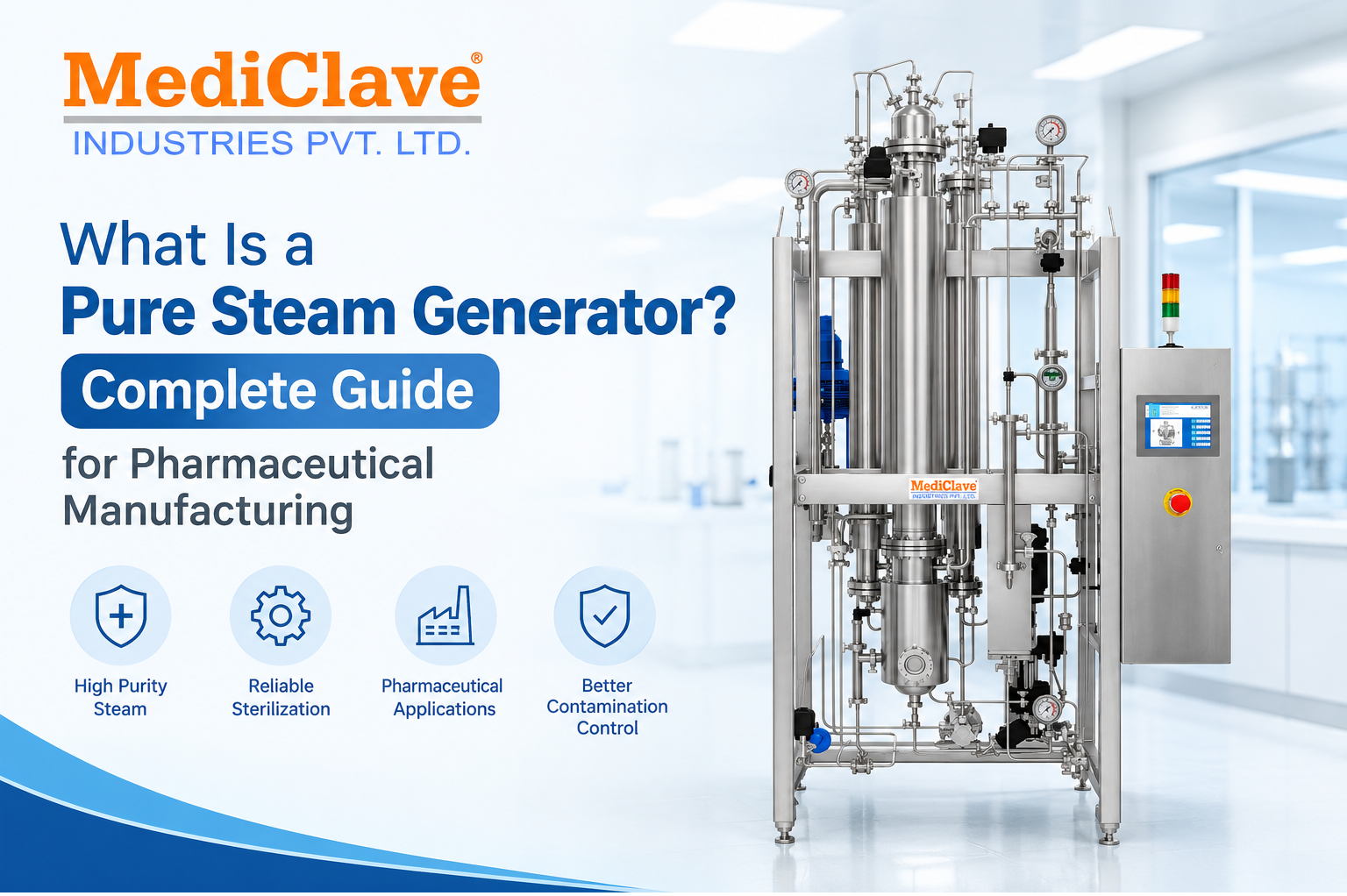
In pharmaceutical manufacturing, maintaining cleanliness, sterility, and contamination control is essential. From injectable medicines and vaccines to biotechnology products and sterile process equipment, every stage of production requires carefully controlled utilities.
One of the most important utilities used in sterile pharmaceutical facilities is a Pure Steam Generator (PSG). It produces high-quality steam from appropriately purified feed water and supplies steam for critical applications such as Sterilization-in-Place (SIP), equipment sterilization, vessel sterilization, pipeline sterilization, autoclaves, and other pharmaceutical processes.
Unlike conventional plant steam, pure steam is specifically intended for applications where steam quality is critical. WHO guidance states that feed water for a pure-steam generator should be appropriately purified and that the generator should be designed, qualified, and operated so the resulting steam meets defined chemical and endotoxin requirements.
In this complete guide, we will explain what a Pure Steam Generator is, how it works, its components, applications, benefits, selection factors, maintenance requirements, and its importance in pharmaceutical manufacturing.
What Is a Pure Steam Generator?
A Pure Steam Generator is a pharmaceutical utility system designed to generate high-purity steam from purified water or another appropriately specified pharmaceutical-grade feed water.
The generated steam is used for applications where contamination control is important, particularly where steam comes into contact with pharmaceutical equipment or product-contact surfaces.
Pure steam is commonly used for:
Sterilization-in-Place (SIP)
Pharmaceutical equipment sterilization
Process vessel sterilization
Pipeline and transfer-line sterilization
Autoclave sterilization
Filter sterilization
Bioreactor sterilization
Filling equipment sterilization
Cleanroom applications
Pharmaceutical process systems
The exact feed-water specification and steam-quality requirements should be established according to the intended application and applicable pharmacopoeial and regulatory requirements.
Why Is Pure Steam Important in Pharmaceutical Manufacturing?
Pharmaceutical products must be manufactured under controlled conditions because contamination can affect product quality and patient safety.
Pure steam provides an effective thermal medium for sterilization because steam releases significant heat when it condenses on a cooler surface. This makes steam particularly useful for sterilizing suitable equipment and product-contact surfaces.
A pharmaceutical facility may use pure steam to sterilize:
Manufacturing vessels
Storage tanks
Process pipelines
Transfer lines
Filters
Filling machines
Bioreactors
Fermenters
Autoclaves
Other suitable product-contact equipment
For direct sterilization applications, steam quality is important. WHO guidance specifically identifies parameters such as non-condensable gases, dryness fraction, and superheat as factors that should be assessed periodically unless otherwise justified.
This is why selecting a properly designed Pure Steam Generator is more important than simply selecting a system based on steam-generation capacity.
Pure Steam vs. Industrial Steam
Industrial or plant steam is generally produced for heating and utility applications. It may contain substances associated with the boiler and steam-generation system, making it unsuitable for certain direct pharmaceutical-contact applications.
Pure steam is generated using appropriately controlled pharmaceutical-grade feed water and a hygienically designed generation system.
| Parameter | Pure Steam | Industrial/Plant Steam |
|---|---|---|
| Primary purpose | Sterilization and critical pharmaceutical applications | Heating and general utilities |
| Feed water | Appropriately purified pharmaceutical feed water | Typically boiler/utility water |
| Direct product-contact suitability | Application-dependent and subject to quality requirements | Generally unsuitable for direct pharmaceutical contact |
| Contamination control | High | Depends on plant-steam system |
| Typical applications | SIP, sterilization, pharmaceutical equipment | Heating, HVAC, non-critical utilities |
| Steam quality control | Strict and application-specific | Usually less stringent |
The distinction is important because not every steam application requires pure steam. ISPE guidance, for example, distinguishes steam grades according to the point of use and whether steam may directly contact product or product-contact surfaces.
How Does a Pure Steam Generator Work?
The basic working principle of a Pure Steam Generator is controlled evaporation and separation.
Step 1: Feed Water Supply
Appropriately purified water is supplied to the Pure Steam Generator.
Depending on the facility design and intended application, the feed water may be Purified Water or Water for Injection.
Feed-water quality is critical because the quality of the generated steam depends heavily on the quality and control of the feed-water system.
Step 2: Heating
The feed water is heated through an appropriate heat-transfer arrangement.
In many pharmaceutical Pure Steam Generator designs, an external heating medium transfers heat indirectly to the pharmaceutical-grade feed water.
This arrangement helps maintain separation between the heating medium and the pharmaceutical feed water.
Step 3: Evaporation
As the feed water receives sufficient thermal energy, it evaporates and produces steam.
The generator is designed to maintain controlled operating conditions for pressure, temperature, water level, and steam production.
Step 4: Steam Separation
The generated vapor passes through separation arrangements designed to minimize moisture carryover.
Effective separation helps produce steam with the required quality characteristics for the intended application.
Step 5: Pure Steam Distribution
The generated steam is then transferred through a suitable sanitary distribution system to the required points of use.
Typical points of use include:
SIP systems
Sterilizers
Autoclaves
Pharmaceutical vessels
Storage tanks
Process pipelines
Filters
Bioreactors
The distribution system is equally important because maintaining steam quality after generation is essential.
Major Components of a Pure Steam Generator
A pharmaceutical Pure Steam Generator generally consists of several important components.
1. Feed Water System
The feed-water system supplies appropriately purified water to the generator.
2. Heat Exchanger
The heat exchanger transfers thermal energy to the feed water while maintaining separation between the heating and pharmaceutical water sides.
3. Evaporator
The evaporator is the main section where feed water is converted into steam.
4. Steam Separator
The separator helps reduce water-droplet carryover and supports consistent steam quality.
5. Demister
A demister or similar moisture-separation arrangement may be incorporated to improve separation of entrained droplets.
6. Instrumentation
Depending on the design, instrumentation may monitor:
Pressure
Temperature
Water level
Flow
Conductivity
Other critical process parameters
7. PLC and HMI Control
Modern systems may incorporate PLC-based automation and an HMI for monitoring, alarms, interlocks, process control, and operating-status display.
8. Safety Devices
Safety arrangements may include suitable pressure-relief devices, alarms, interlocks, and other controls appropriate to the system design.
9. Sanitary Piping
Product-contact and pharmaceutical utility piping should be designed with hygienic principles appropriate to the application.
Applications of Pure Steam Generators
Pure Steam Generators have applications across pharmaceutical, biotechnology, healthcare, and research facilities.
Pharmaceutical Manufacturing
Pure steam is used for sterilizing process equipment, vessels, pipelines, filters, and other critical systems.
Sterilization-in-Place (SIP)
One of the most important applications is SIP.
SIP allows suitable equipment to be sterilized without dismantling it. Pure steam can be introduced into vessels, pipelines, and other equipment under controlled conditions.
CIP and SIP are often integrated into pharmaceutical process systems. CIP removes residues and contaminants, while SIP provides thermal sterilization.
Autoclave and Sterilizer Systems
Pure steam may be used as the sterilizing medium for pharmaceutical sterilizers and other suitable sterilization equipment.
For direct sterilization applications, steam condensate quality and steam characteristics need to meet the applicable requirements.
Pharmaceutical Tanks and Vessels
Manufacturing and storage vessels can require sterilization before production.
A Pure Steam Generator can supply steam to the vessel's SIP system for controlled thermal sterilization.
Pipeline Sterilization
Product-contact pipelines and transfer lines may also require sterilization.
Pure steam can be distributed through suitable sanitary piping to sterilize internal surfaces.
Biotechnology Applications
Biotechnology facilities may use pure steam for sterilizing:
Bioreactors
Fermenters
Process vessels
Transfer lines
Filters
Product-contact components
Vaccine Manufacturing
Vaccine manufacturing requires stringent contamination control. Pure steam can support sterilization of suitable equipment and systems used during production.
Cleanroom Applications
Depending on the facility design, pure steam can also be used for certain cleanroom humidification applications where steam quality requirements justify its use. ISPE guidance distinguishes such applications from indirect humidification where other steam grades may be appropriate.
Benefits of a Pure Steam Generator
1. Improved Contamination Control
A properly designed pure-steam system supports controlled sterilization applications and helps reduce contamination risks.
2. Reliable Sterilization Support
Pure steam provides an efficient thermal medium for suitable sterilization processes.
3. Suitable for SIP Applications
Pure Steam Generators are commonly integrated with SIP systems for sterilizing process equipment without dismantling it.
4. Consistent Steam Supply
A correctly sized and controlled generator can provide a dependable steam supply for connected pharmaceutical processes.
5. Hygienic Operation
Pharmaceutical-oriented design focuses on hygienic construction and controlled product-contact surfaces.
6. Automation
PLC and HMI systems can provide automated operation, monitoring, alarms, and safety interlocks.
7. Integration with Pharmaceutical Utilities
A Pure Steam Generator can be integrated with pharmaceutical water systems, CIP/SIP systems, sterilizers, process vessels, and other utility equipment.
Pure Steam Generator and CIP & SIP System
Pure Steam Generation and SIP are closely connected in pharmaceutical manufacturing.
CIP – Cleaning-in-Place is used to clean suitable process equipment without dismantling it.
SIP – Sterilization-in-Place is used to sterilize suitable equipment after cleaning.
A typical process may look like:
Production → CIP → Rinsing → SIP → Sterile Manufacturing
The Pure Steam Generator supplies the steam required for the SIP stage.
This combination can reduce manual intervention, improve process consistency, and support a more controlled pharmaceutical manufacturing environment when properly engineered, validated, and operated.
Pure Steam Generator for Injectable Manufacturing
Injectable manufacturing requires particularly strong contamination-control measures because injectable products are administered directly into the body.
Equipment used in injectable manufacturing may include:
Manufacturing vessels
Mixing systems
Storage tanks
Transfer pipelines
Filters
Filling systems
Sterilization systems
Pure steam can support sterilization of suitable product-contact equipment and process systems.
For facilities manufacturing injectable products, the Pure Steam Generator should therefore be considered as part of the overall pharmaceutical utility and contamination-control strategy rather than as an isolated machine.
Key Factors to Consider When Selecting a Pure Steam Generator
Choosing the correct system requires consideration of both process and utility requirements.
1. Required Steam Capacity
Determine the maximum steam demand from all connected users.
The generator should be sized according to actual demand rather than only average consumption.
2. Feed-Water Quality
The feed-water specification should be defined according to the intended application and applicable standards.
3. Required Steam Pressure
The operating pressure should be selected based on the requirements of connected equipment and the distribution system.
4. Steam Quality
Consider the required quality characteristics, including:
Condensate quality
Dryness
Non-condensable gases
Superheat
Microbiological/endotoxin requirements
WHO guidance highlights these parameters for pure steam used as a direct sterilizing agent.
5. Material of Construction
Pharmaceutical systems commonly use hygienic stainless-steel construction for product-contact areas. The exact material grade and surface-finish requirements should be specified according to the application.
6. Automation Level
Consider whether the facility requires:
Manual operation
Semi-automatic operation
Fully automatic PLC control
HMI monitoring
Data recording
Alarm management
7. Validation and Qualification
Pharmaceutical equipment should be designed with qualification and validation requirements in mind.
The system may need documentation and testing appropriate to the facility's quality-management system and regulatory requirements.
8. Maintenance and Service
Select a manufacturer capable of providing technical support, spare parts, preventive-maintenance guidance, and after-sales service.
Maintenance of a Pure Steam Generator
Regular maintenance helps maintain reliable operation and consistent steam quality.
Important maintenance activities may include:
Inspecting valves and instruments
Checking pressure and temperature sensors
Inspecting sanitary connections
Checking water quality
Monitoring operating parameters
Inspecting heat-transfer surfaces
Checking safety devices
Reviewing alarms and interlocks
Inspecting steam distribution lines
Performing periodic steam-quality testing
Maintenance intervals should be established according to the manufacturer's recommendations, operating conditions, facility procedures, and applicable regulatory requirements.
Pure Steam Quality Testing
Steam quality should be verified according to the intended application and applicable standards.
Important characteristics may include:
Non-Condensable Gases
Excessive non-condensable gases can interfere with steam contact and heat transfer.
Dryness Fraction
Steam should have an appropriate dryness characteristic for the intended sterilization process.
Superheat
Excessive superheat can influence condensation and therefore the effectiveness of steam-based heat transfer.
Condensate Quality
Where pure steam is used for direct sterilization, condensate quality is an important indicator.
WHO guidance states that condensate from pure steam used for direct sterilization of materials or product-contact surfaces should meet the applicable WFI monograph requirements, with an appropriate sampling schedule.
Why Choose a Reliable Pure Steam Generator Manufacturer?
The quality of the generator directly influences the reliability of the pharmaceutical utility system.
A reliable manufacturer should understand:
Pharmaceutical hygienic design
Steam-generation principles
Water-quality requirements
SIP applications
Sterilization requirements
Automation
Process integration
Qualification and documentation
Service and maintenance
Mediclave Industries Pvt. Ltd. manufactures pharmaceutical process and utility equipment, including Pure Steam Generator systems for applications where controlled steam quality is required.
Explore the Mediclave Industries Pure Steam Generator range and related pharmaceutical process solutions.
You can also explore related systems such as:
CIP & SIP Systems
Multi Column Distillation Plant
WFI Storage & Distribution System
Injectable Liquid Manufacturing Vessel
Pharmaceutical Sterilizers
Ointment Manufacturing Plant
These systems can be integrated into a broader pharmaceutical manufacturing and utility infrastructure depending on the process requirements.
Conclusion
A Pure Steam Generator is a critical pharmaceutical utility system used to produce high-quality steam for sterilization, SIP, equipment sanitation, and other controlled applications.
The performance of a Pure Steam Generator depends on much more than steam-generation capacity. Feed-water quality, hygienic construction, steam separation, steam quality, automation, distribution, qualification, maintenance, and proper system integration all contribute to reliable operation.
For pharmaceutical manufacturers, biotechnology companies, vaccine manufacturers, injectable-product facilities, and other sterile manufacturing environments, selecting the correct Pure Steam Generator can help establish a dependable foundation for contamination control and sterilization processes.
When choosing a system, evaluate the complete requirement—including capacity, pressure, feed-water quality, steam-quality parameters, materials, automation, validation documentation, service, and future expansion.
With the right engineering approach and appropriate qualification, a Pure Steam Generator can become an important part of a reliable pharmaceutical utility system.
Frequently Asked Questions About Pure Steam Generators
1. What is a Pure Steam Generator?
A Pure Steam Generator is a pharmaceutical utility system designed to produce high-quality steam from appropriately purified feed water for applications such as SIP and sterilization.
2. What is pure steam used for?
Pure steam is commonly used for pharmaceutical equipment sterilization, SIP, vessel sterilization, pipeline sterilization, autoclaves, filters, bioreactors, and other critical applications.
3. What is the difference between pure steam and plant steam?
Pure steam is generated using appropriately purified feed water and is intended for applications requiring controlled steam quality. Plant steam is generally used for heating and non-critical utility applications.
4. Can a Pure Steam Generator be used for SIP?
Yes. Pure steam generators are commonly used as the steam source for Sterilization-in-Place systems.
5. What water is used in a Pure Steam Generator?
The required feed-water specification depends on the application and applicable standards. Pharmaceutical pure-steam systems commonly use appropriately purified water, including Purified Water or WFI where required.
6. Why is steam quality important?
Steam quality affects sterilization performance and contamination control. Parameters such as dryness, non-condensable gases, superheat, and condensate quality can be important for direct sterilization applications.
7. What industries use Pure Steam Generators?
They are commonly used in pharmaceutical manufacturing, biotechnology, vaccine production, sterile manufacturing, healthcare, and research applications.
8. Is a Pure Steam Generator required in every pharmaceutical plant?
Not necessarily. The required steam grade depends on the application, points of use, product-contact requirements, facility design, and applicable regulations.
9. What is SIP?
SIP stands for Sterilization-in-Place. It is a process used to sterilize suitable process equipment, vessels, and pipelines without dismantling them.
10. How do I choose the right Pure Steam Generator?
Consider steam capacity, pressure, feed-water quality, steam-quality requirements, material of construction, automation, points of use, validation requirements, maintenance, and future expansion.
11. What is the role of a Pure Steam Generator in injectable manufacturing?
It can provide pure steam for sterilizing suitable manufacturing vessels, pipelines, filters, and other product-contact equipment used in injectable production.
12. Why should pharmaceutical manufacturers choose a specialized manufacturer?
A specialized manufacturer can design the system around pharmaceutical requirements, hygienic construction, steam quality, automation, qualification, integration, and long-term service.
Contact Mediclave Industries
If you are planning a new pharmaceutical plant, expanding an existing facility, or upgrading your pharmaceutical utility system, consult a qualified equipment manufacturer to determine the appropriate Pure Steam Generator capacity and configuration.
Mediclave Industries Pvt. Ltd.
Website: https://www.mediclaveindustries.in/
For Pure Steam Generator requirements, pharmaceutical water systems, CIP/SIP systems, sterilizers, and pharmaceutical process equipment, contact Mediclave Industries for application-specific guidance and quotation.



