
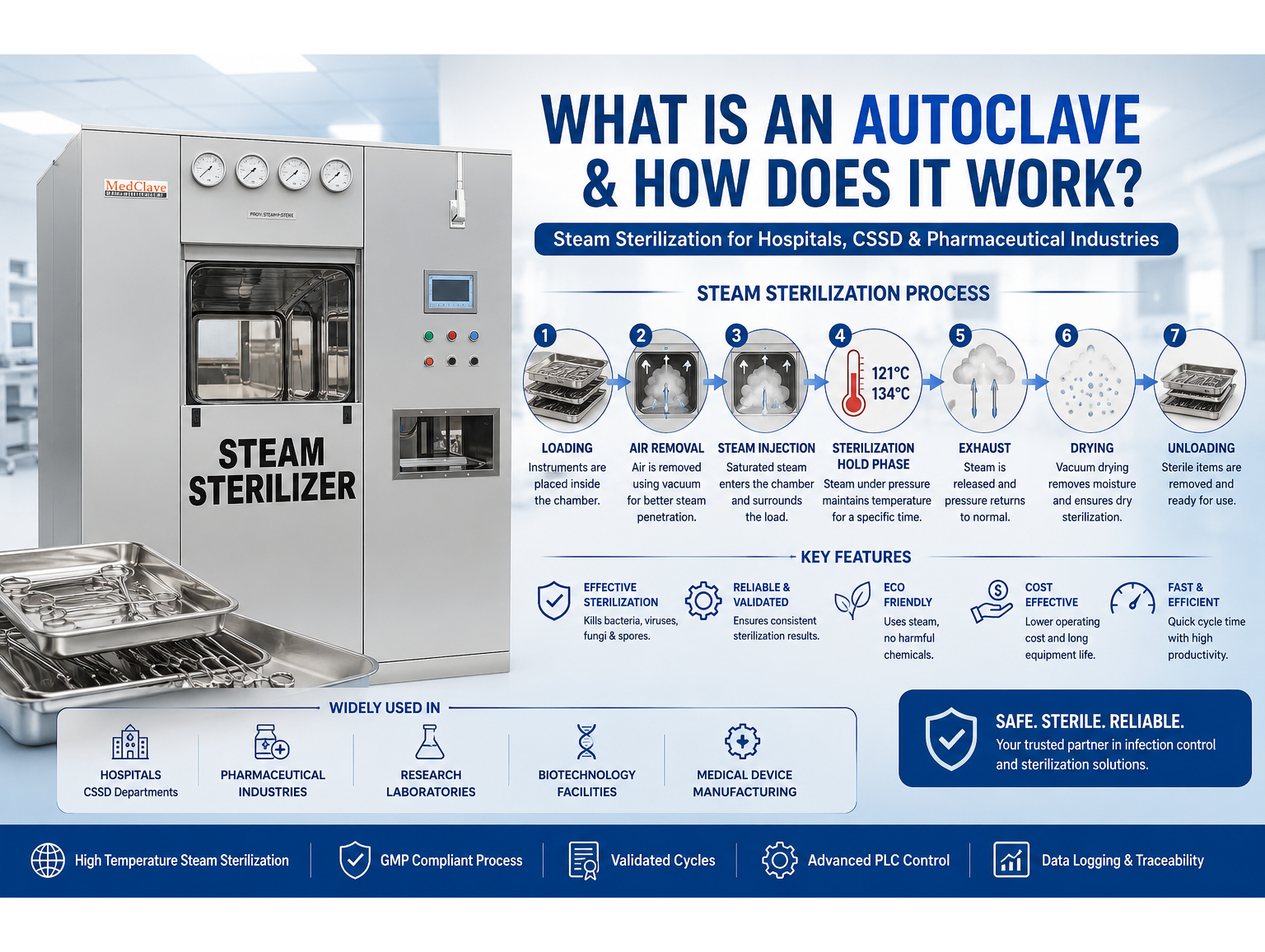
What is an Autoclave and How Does it Work?
Complete Sterilization Guide | Ahmedabad
Sterilization is one of the most critical
processes in healthcare, pharmaceutical manufacturing, biotechnology, research
laboratories, and medical device production. Every day, thousands of
instruments and materials must be sterilized to eliminate harmful
microorganisms and ensure safety.
One of the most trusted and widely used
sterilization methods is the autoclave, also known as a steam sterilizer.
Autoclaves have been used for decades because
they provide reliable, efficient, and validated sterilization using saturated
steam under pressure.
In this complete guide, you'll learn what an
autoclave is, how it works, its components, sterilization cycles, applications,
advantages, limitations, and best practices.
What is
an Autoclave?
An autoclave is a sterilization device that
uses high-pressure saturated steam to destroy microorganisms, including:
- Bacteria
- Viruses
- Fungi
- Spores
- Pathogens
The process ensures that medical instruments,
pharmaceutical products, laboratory equipment, and other materials become
sterile and safe for use.
Autoclaves are commonly used in:
- Hospitals
- Pharmaceutical industries
- Biotechnology facilities
- Research laboratories
- Medical device manufacturing
- Healthcare institutions
Why is
Sterilization Important?
Contaminated instruments can transmit
infections and compromise product quality.
Without proper sterilization, organizations
may face:
- Healthcare-associated infections (HAIs)
- Product contamination
- Regulatory non-compliance
- Patient safety risks
- Product recalls
Autoclaves play a vital role in preventing
these issues.
How Does
an Autoclave Work?
The working principle of an autoclave is based
on a simple scientific concept:
Steam under
pressure reaches higher temperatures than boiling water.
Normally, water boils at 100°C.
Inside an autoclave, pressure increases,
allowing steam temperatures to reach:
- 121°C
- 134°C
- Higher temperatures for specialized applications
This high-temperature steam penetrates
materials and destroys microorganisms effectively.
Step-by-Step
Autoclave Working Process
Step 1:
Loading
Items are placed inside the sterilization
chamber.
Examples include:
- Surgical instruments
- Stainless steel trays
- Glassware
- Medical devices
- Laboratory equipment
Proper loading is essential for steam
circulation.
Step 2: Air
Removal
Air inside the chamber must be removed.
Common methods include:
Gravity
Displacement
Steam pushes air out naturally.
Vacuum
System
Vacuum pumps remove air completely.
Vacuum systems provide better steam
penetration.
Step 3:
Steam Injection
Saturated steam enters the chamber.
The steam surrounds and penetrates the load.
This ensures uniform heating.
Step 4:
Sterilization Hold Phase
The chamber maintains a specific temperature
and pressure for a predetermined time.
Typical sterilization conditions:
- 121°C for 15–30 minutes
- 134°C for 3–10 minutes
The exact cycle depends on the load type.
Step 5:
Exhaust Phase
Steam is removed from the chamber.
Pressure gradually returns to normal.
Step 6:
Drying
Vacuum drying removes residual moisture.
Dry instruments help maintain sterility during
storage.
Step 7:
Unloading
Sterile items are removed and transferred to
storage or production areas.
Main
Components of an Autoclave
Sterilization
Chamber
The chamber holds materials being sterilized.
Usually manufactured from high-grade stainless
steel.
Steam
Generator
Produces saturated steam required for
sterilization.
Vacuum Pump
Removes air and assists drying.
Control
System
Modern autoclaves use PLC and HMI systems for:
- Cycle control
- Monitoring
- Data recording
Safety
Valves
Protect the system from excessive pressure.
Temperature
and Pressure Sensors
Ensure accurate sterilization parameters.
Types of
Autoclaves
Vertical
Autoclave
Commonly used in:
- Laboratories
- Research facilities
- Small healthcare centers
Advantages:
- Compact design
- Cost-effective
Horizontal Autoclave
Widely used in:
- Hospitals
- Pharmaceutical industries
- Medical device manufacturing
Advantages:
- Large capacity
- Better productivity
Double Door
Autoclave
Used in cleanroom and pharmaceutical
applications.
Benefits:
- Prevents cross-contamination
- Supports GMP requirements
Pass-Through
Autoclave
Installed between clean and non-clean areas.
Frequently used in sterile manufacturing
facilities.
Types of
Sterilization Cycles
Gravity
Cycle
Suitable for:
- Glassware
- Metal instruments
Pre-Vacuum
Cycle
Ideal for:
- Wrapped instruments
- Porous materials
Provides superior steam penetration.
Liquid
Cycle
Used for:
- Culture media
- Pharmaceutical liquids
Flash
Sterilization Cycle
Used for emergency sterilization requirements.
Typically not recommended for routine
processing.
Applications
of Autoclaves
Hospitals
Used for sterilizing:
- Surgical instruments
- Dressing materials
- Medical equipment
Pharmaceutical
Industry
Used for:
- Manufacturing equipment
- Components
- Sterile products
Research
Laboratories
Used for:
- Glassware
- Media preparation
- Waste decontamination
Biotechnology
Facilities
Used for sterile processing and contamination
control.
Medical
Device Manufacturing
Used for sterilizing medical products before
distribution.
Advantages
of Autoclaves
Highly
Effective Sterilization
Kills microorganisms and bacterial spores.
Reliable
and Validated
Recognized worldwide as a proven sterilization
method
Environment
Friendly
Uses water and steam rather than harmful
chemicals.
Cost
Effective
Lower operating costs compared to many
alternative methods.
Fast
Processing
Modern autoclaves provide quick cycle times.
Limitations
of Autoclaves
While autoclaves are highly effective, they
are not suitable for all materials.
Not ideal for:
- Heat-sensitive plastics
- Certain electronic devices
- Moisture-sensitive products
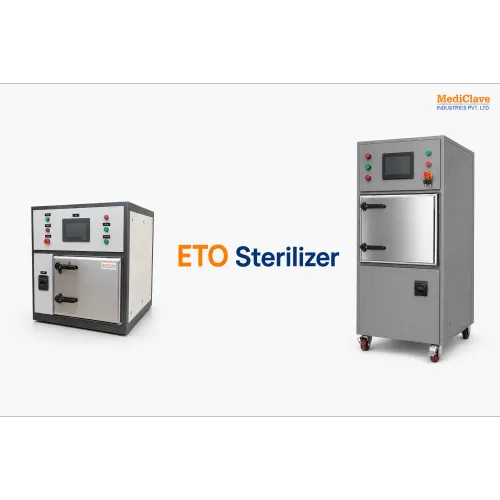
For such products, ETO sterilization may be
preferred.
Common
Autoclave Applications in CSSD
Hospital CSSD departments rely heavily on
autoclaves.
Sterilized items include:
- Surgical sets
- Orthopedic instruments
- Dental instruments
- Stainless steel containers
- Medical trays
Autoclaves are considered the backbone of CSSD
operations.
Autoclave
Validation
Validation ensures sterilization
effectiveness.
Common validation stages include:
IQ
(Installation Qualification)
Confirms proper installation.
OQ
(Operational Qualification)
Verifies operating performance.
PQ
(Performance Qualification)
Confirms consistent sterilization results.
Biological
Indicators vs Chemical Indicators
Biological
Indicators
Contain resistant bacterial spores.
Provide the highest level of sterilization
verification.
Chemical
Indicators
Change color when sterilization conditions are
achieved.
Used for routine monitoring.
Common
Autoclave Problems
Wet Loads
Usually caused by insufficient drying.
Incomplete
Sterilization
May result from improper loading.
Vacuum
Leaks
Can reduce sterilization efficiency.
Steam
Quality Issues
Poor steam quality affects performance.
Regular maintenance helps prevent these
issues.
Best
Practices for Autoclave Operation
Load
Properly
Avoid overloading the chamber.
Follow
Validated Cycles
Use the correct cycle for each load.
Monitor
Every Cycle
Record temperature, pressure, and exposure
time.
Perform
Preventive Maintenance
Maintain equipment regularly.
Conduct
Routine Validation
Verify performance consistently.
Future
of Autoclave Technology
Modern sterilization systems are becoming
increasingly intelligent.
Emerging features include:
- PLC Automation
- Touchscreen HMI
- Remote Monitoring
- Data Logging
- IoT Connectivity
- Predictive Maintenance
- Electronic Batch Records
These innovations improve efficiency,
compliance, and traceability.
How
Mediclave Industries Supports Sterilization Operations
Mediclave Industries manufactures advanced
sterilization solutions designed for hospitals, pharmaceutical industries,
laboratories, and healthcare facilities.
Solutions include:
- Steam Sterilizers
- Horizontal Autoclaves
- Double Door Autoclaves
- Pass-Through Sterilizers
- Hospital CSSD Equipment
- Pharmaceutical Sterilization Systems
These systems help organizations achieve
reliable sterilization, compliance, and operational excellence.
Conclusion
An autoclave is one of the most important
sterilization devices used in healthcare and pharmaceutical industries. By
utilizing high-pressure saturated steam, autoclaves effectively destroy
microorganisms and ensure safe, sterile products and instruments.
Whether used in hospitals, laboratories,
pharmaceutical plants, or medical device facilities, autoclaves remain the gold
standard for steam sterilization.
Organizations investing in modern, validated
autoclave systems can significantly improve safety, efficiency, and regulatory
compliance.
Frequently
Asked Questions (FAQs)
What is an
autoclave used for?
An autoclave is used to sterilize instruments,
equipment, and materials using high-pressure steam.
How does an
autoclave kill microorganisms?
High-temperature saturated steam destroys
bacteria, viruses, fungi, and spores.
What
temperature is used in an autoclave?
Most cycles operate at 121°C or 134°C.
What is the
difference between an autoclave and an ETO sterilizer?
Autoclaves use steam, while ETO sterilizers
use ethylene oxide gas for heat-sensitive products.
Why is
autoclave validation important?
Validation confirms that sterilization cycles consistently achieve the required sterility level.
https://www.mediclaveindustries.in/latest-update/eto-sterilizer/56
https://www.mediclaveindustries.in/latest-update/vertical-autoclave-reliable-sterilization-solution-for-hospitals-laboratories/54