
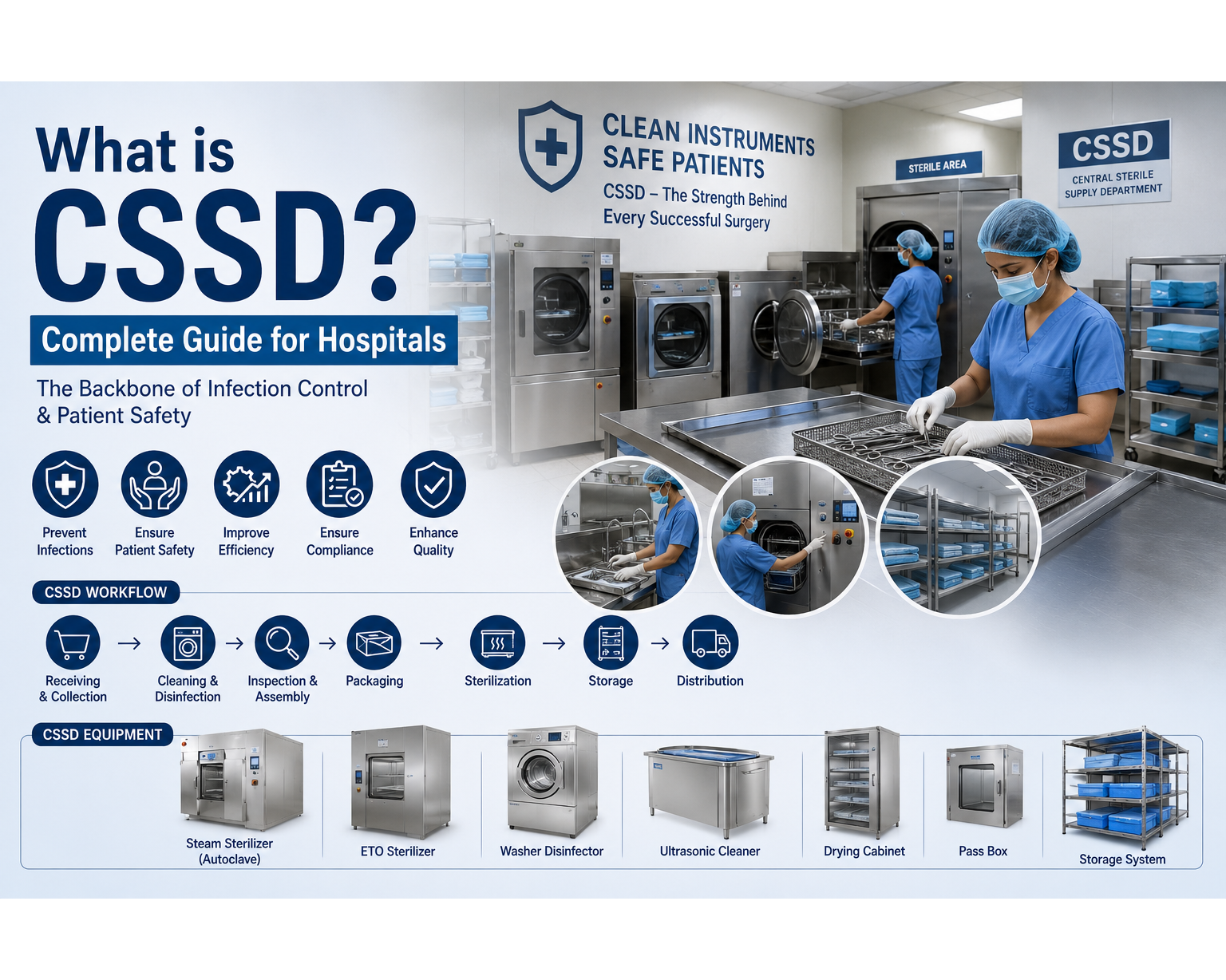
What is CSSD? Complete Guide for Hospitals | CSSD Equipment & Sterilization Process | Ahmedabad
What is
CSSD? Complete Guide for Hospitals
Modern healthcare facilities rely heavily on
effective sterilization and infection control systems to ensure patient safety.
Every surgical instrument, reusable medical device, and healthcare tool must be
properly cleaned, disinfected, sterilized, and stored before use.
This critical responsibility is handled by a
specialized hospital department known as the CSSD (Central Sterile Supply
Department).
A well-designed CSSD is often considered the
backbone of hospital infection control because it helps prevent
healthcare-associated infections (HAIs), improves operational efficiency, and
ensures compliance with healthcare quality standards.
In this complete guide, we will explore what CSSD
is, how it works, the equipment used, workflow processes, benefits, challenges,
and future trends in hospital sterilization.
What is
CSSD?
CSSD stands for Central Sterile Supply
Department.
It is a dedicated department within a hospital
responsible for:
- Cleaning medical instruments
- Disinfecting reusable devices
- Sterilizing surgical tools
- Packaging sterile items
- Storing sterile supplies
- Distributing sterile products to various hospital departments
The primary objective of CSSD is to ensure
that every reusable instrument used in patient care is completely safe and free
from harmful microorganisms.
Without a properly functioning CSSD, hospitals
face serious risks such as:
- Surgical site infections
- Cross-contamination
- Delayed procedures
- Increased healthcare costs
- Regulatory non-compliance
Why is
CSSD Important in Hospitals?
Every hospital uses thousands of instruments
daily.
These instruments come into contact with:
- Blood
- Body fluids
- Tissues
- Infectious microorganisms
If not properly sterilized, they can transmit
infections from one patient to another.
A modern CSSD helps hospitals:
Prevent
Hospital-Acquired Infections (HAIs)
Proper sterilization significantly reduces
infection risks.
Improve
Patient Safety
Sterile instruments are essential for
successful surgical outcomes.
Enhance
Operational Efficiency
Departments receive sterile instruments when
needed.
Ensure
Regulatory Compliance
Hospitals must follow infection control
guidelines and quality standards.
Reduce
Equipment Damage
Proper cleaning and sterilization increase
instrument lifespan.
Main
Functions of CSSD
The CSSD department performs several critical
tasks.
Collection
of Used Instruments
Contaminated instruments are collected from:
- Operation Theatres
- ICU
- Emergency Departments
- Dental Clinics
- Endoscopy Units
- Wards
Cleaning
The first step is removing visible
contamination.
Cleaning methods include:
Manual
Cleaning
Used for delicate instruments.
Ultrasonic
Cleaning
Removes microscopic contaminants using sound
waves.
Washer
Disinfectors
Automated cleaning systems that ensure
consistent results.
Inspection
After cleaning, instruments are inspected for:
- Cleanliness
- Damage
- Functionality
- Corrosion
Defective instruments are repaired or
replaced.
Packaging
Instruments are packed using approved
sterilization materials.
Proper packaging ensures sterility is
maintained until use.
Sterilization
The packaged instruments are sterilized using
validated sterilization methods.
Common methods include:
Steam
Sterilization
Most widely used method in hospitals.
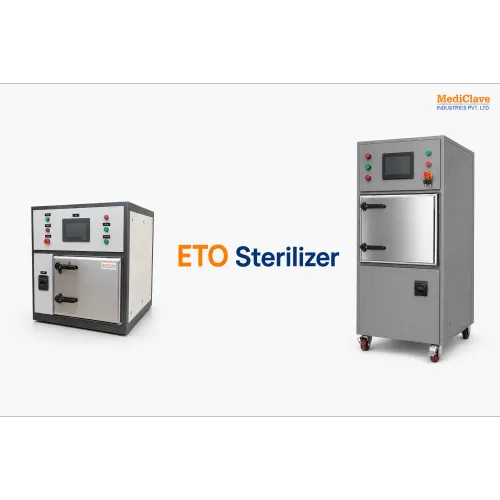
ETO
Sterilization
Used for heat-sensitive medical devices.
Low-Temperature
Sterilization
Used for specialized instruments.
Storage
Sterile products are stored in controlled
environments until required.
Distribution
Sterile supplies are distributed throughout
the hospital.
CSSD
Workflow Explained
A modern CSSD follows a one-way workflow.
Step 1:
Receiving
Contaminated instruments enter the dirty area.
Step 2:
Cleaning & Decontamination
Removal of biological contamination.
Step 3:
Inspection & Assembly
Instruments are checked and arranged.
Step 4:
Packaging
Preparation for sterilization.
Step 5:
Sterilization
Execution of validated sterilization cycle.
Step 6:
Sterile Storage
Storage under controlled conditions.
Step 7:
Distribution
Supply to hospital departments.
This unidirectional flow minimizes
contamination risks.
Major
Equipment Used in CSSD
A modern CSSD contains various specialized
equipment.
Steam
Sterilizers (Autoclaves)
Used for:
- Surgical instruments
- Stainless steel items
- Medical trays
Benefits:
- Fast sterilization
- Cost-effective
- Reliable
ETO
Sterilizers
Used for:
- Plastic devices
- Catheters
- Heat-sensitive products
Benefits:
- Low-temperature operation
- High penetration capability
Washer
Disinfectors
Provide automated cleaning and disinfection.
Advantages:
- Consistency
- Reduced labor
- Better hygiene
Ultrasonic
Cleaners
Remove contaminants from difficult-to-reach
areas.
Drying
Cabinets
Ensure moisture-free instruments before
packaging.
Pass Boxes
Allow contamination-controlled material
transfer.
Stainless
Steel Storage Systems
Used for sterile storage and transportation.
CSSD
Zones
Modern CSSD departments are divided into three
zones.
Dirty Zone
Receives contaminated instruments.
Activities:
- Receiving
- Sorting
- Cleaning
Clean Zone
Activities include:
- Inspection
- Assembly
- Packaging
Sterile
Zone
Activities include:
- Sterile storage
- Distribution
Physical separation prevents contamination.
Common
Challenges in CSSD
Hospitals often face several CSSD challenges.
High
Instrument Volume
Large hospitals process thousands of
instruments daily.
Human
Errors
Improper packaging or sterilization may affect
outcomes.
Equipment
Downtime
Breakdowns can delay surgeries.
Compliance
Requirements
Hospitals must maintain extensive
documentation.
Staff
Training
Continuous training is essential.
Best
Practices for an Efficient CSSD
Hospitals can improve performance by adopting
these practices:
Use
Automated Equipment
Automation improves consistency.
Follow
Standard Operating Procedures (SOPs)
Ensures process reliability.
Perform
Routine Validation
Maintains sterilization effectiveness.
Maintain
Equipment Regularly
Reduces downtime.
Train Staff
Continuously
Improves quality and safety.
CSSD and
Infection Control
According to healthcare studies, effective
sterilization programs significantly reduce healthcare-associated infections.
CSSD plays a central role in:
- Infection prevention
- Patient safety
- Quality healthcare delivery
A strong infection control program is
impossible without a well-managed CSSD.
https://www.mediclaveindustries.in/products/category/hospital-cssd-equipments/2
Future
of CSSD
Technology is transforming sterile processing
departments.
Emerging trends include:
Smart
Sterilizers
Real-time monitoring and reporting.
Automated
Tracking Systems
Instrument traceability.
Digital
Documentation
Paperless compliance management.
IoT
Integration
Predictive maintenance and performance
monitoring.
AI-Based
Workflow Optimization
Improved efficiency and resource management.
https://www.mediclaveindustries.in/products/category/hospital-cssd-equipments/1
How
Mediclave Industries Supports Modern CSSD Departments
Hospitals increasingly require reliable
equipment partners who understand sterilization, infection control, and
workflow optimization.
Mediclave Industries manufactures advanced:
- Hospital CSSD Equipment
- Steam Sterilizers
- ETO Sterilizers
- Washer Disinfectors
- Ultrasonic Cleaning Systems
- Pass Boxes
- Stainless Steel CSSD Accessories
These solutions help healthcare facilities
improve efficiency, compliance, and patient safety.
Conclusion
CSSD is one of the most important departments
in any hospital. It ensures that instruments used in patient care are properly
cleaned, disinfected, sterilized, stored, and supplied safely.
A well-designed CSSD not only protects
patients and healthcare workers but also improves operational efficiency and
supports compliance with healthcare standards.
As healthcare facilities continue to
modernize, investment in advanced CSSD equipment and best practices will remain
essential for delivering safe and high-quality patient care.
FAQs
What does
CSSD stand for?
CSSD stands for Central Sterile Supply
Department.
What is the
main purpose of CSSD?
To clean, disinfect, sterilize, store, and
distribute reusable medical instruments.
Which
equipment is used in CSSD?
Autoclaves, ETO sterilizers, washer
disinfectors, ultrasonic cleaners, drying cabinets, and storage systems.
Why is CSSD
important?
It prevents infections and ensures patient
safety.
What are
the three CSSD zones?
Dirty Zone, Clean Zone, and Sterile Zone.