In pharmaceutical manufacturing, producing a safe and consistent injectable medicine requires much more than simply mixing ingredients with water. Injectable products are introduced directly into the human body, which means every stage of their manufacturing process must be carefully controlled. Cleanliness, accurate formulation, uniform mixing, temperature control, material quality, and contamination prevention all play an important role in achieving the required product quality.
One of the most important pieces of equipment used in this process is the Injectable Liquid Manufacturing Vessel. It is specially designed for the preparation, mixing, heating, cooling, and controlled processing of liquid pharmaceutical formulations. Unlike a conventional mixing tank, an injectable manufacturing vessel is designed around the demanding hygiene and process requirements of sterile pharmaceutical production.
Modern pharmaceutical plants may use these vessels for products such as injectable solutions, IV fluids, sterile formulations, vaccines, injectable antibiotics, vitamins, nutritional solutions, and other liquid pharmaceutical preparations. Depending on the formulation and production requirement, the vessel can be equipped with specialized mixing technology, heating and cooling arrangements, temperature monitoring, load cells, sterile filtration connections, and CIP/SIP compatibility.
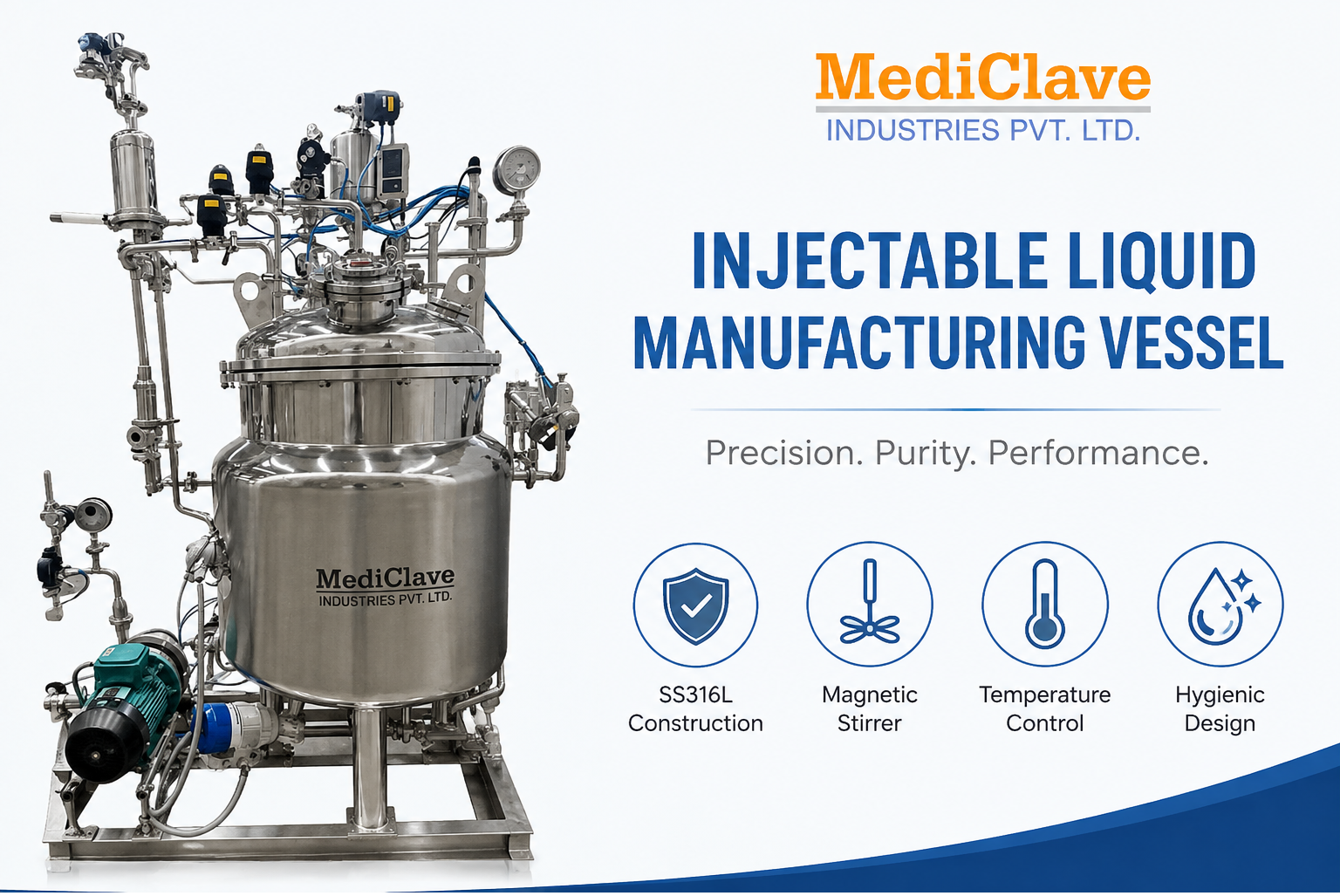
Mediclave Industries Pvt. Ltd. manufactures pharmaceutical process equipment designed for applications where hygiene, reliability, and process consistency are important. Its Injectable Liquid Manufacturing Vessel With Magnetic Stirrer is developed for controlled and uniform preparation of sterile liquid formulations, with magnetic stirring technology that helps reduce contamination risks associated with conventional mechanical shaft seals.
What Is an Injectable Liquid Manufacturing Vessel?
An Injectable Liquid Manufacturing Vessel is a specialized pharmaceutical process vessel used to prepare and process liquid formulations intended for injectable applications.
The vessel provides a controlled environment where pharmaceutical ingredients can be charged, dissolved, mixed, heated or cooled, and prepared for the next stage of production. Its design is focused on maintaining hygienic conditions and minimizing the possibility of contamination.
Typical applications can include:
-
Injectable medicines
-
IV fluids
-
Small Volume Parenterals (SVP)
-
Large Volume Parenterals (LVP)
-
Injectable antibiotics
-
Injectable vitamins
-
Vaccines
-
Nutritional solutions
-
Biopharmaceutical formulations
-
Sterile pharmaceutical liquids
The exact design depends on the formulation, batch size, process temperature, mixing requirements, viscosity, pressure conditions, and level of automation required.
A modern vessel may include pharmaceutical-grade stainless-steel product-contact surfaces, a hygienic internal finish, controlled agitation, heating and cooling jackets, temperature sensors, pressure monitoring, load cells, sterile vent filters, and provisions for cleaning and sterilization.
Why Are Injectable Manufacturing Vessels So Important?
The most important reason is contamination control.
When manufacturing an oral syrup or other non-sterile product, the process requirements may be different. Injectable products demand significantly greater control because the finished medicine can be introduced directly into the body.
A manufacturing vessel therefore needs to support a process where contamination risks are carefully managed from the beginning.
A properly designed injectable manufacturing vessel can help manufacturers achieve:
Consistent mixing: Ingredients need to be distributed uniformly throughout the batch.
Controlled temperature: Some formulations require heating or cooling at specific stages.
Hygienic processing: Product-contact surfaces should be suitable for pharmaceutical manufacturing.
Reduced contamination risk: The vessel should be designed to minimize unnecessary exposure to the surrounding environment.
Repeatable production: Similar process conditions can be maintained from batch to batch.
Efficient cleaning: Internal surfaces and process connections should support effective cleaning procedures.
Sterilization compatibility: Where required, the vessel can be integrated with appropriate SIP arrangements.
The goal is not simply to manufacture a vessel that can hold liquid. The goal is to create a controlled processing environment that supports the complete pharmaceutical manufacturing operation.
How Does an Injectable Liquid Manufacturing Vessel Work?
Although the exact process varies according to the formulation, a typical manufacturing sequence can be understood through several stages.
1. Charging of Water or Base Solution
The process generally begins with the controlled charging of the required pharmaceutical-grade water or base liquid into the vessel.
For injectable manufacturing, water quality is especially important. Pharmaceutical facilities may use Water for Injection (WFI) as required by their formulation and process design.
This is why injectable manufacturing equipment often works as part of a larger pharmaceutical water system. Mediclave's Multi Column Distillation Plant is designed for the production of high-purity distilled water and WFI applications through multiple-effect distillation.
2. Addition of Ingredients
Once the required liquid or WFI has been charged, active pharmaceutical ingredients and other formulation components can be added according to the manufacturing process.
Controlled ingredient addition is important because inaccurate quantities or poor dispersion can affect the final formulation.
The vessel should therefore provide suitable access and process arrangements for safe and controlled ingredient charging.
3. Mixing and Dissolution
Mixing is one of the most important operations in liquid manufacturing.
Ingredients need to dissolve properly and remain uniformly distributed throughout the batch. Poor mixing can lead to concentration differences, which may affect product quality and consistency.
This is where an appropriate agitation system becomes important.
The Injectable Liquid Manufacturing Vessel With Magnetic Stirrer offered by Mediclave uses magnetic stirring technology to support uniform mixing while avoiding a conventional mechanical shaft passing through the vessel wall. This type of arrangement can be particularly useful where minimizing potential contamination points is important.
4. Heating or Cooling
Some injectable formulations require controlled heating during dissolution, while others require cooling before filtration or filling.
A jacketed vessel can provide controlled heat transfer around the product chamber. Depending on the process, heating or cooling media can be circulated through the jacket.
Temperature sensors can monitor the product temperature and allow operators or automated control systems to maintain the desired process conditions.
This controlled approach is much more reliable than depending on uncontrolled external heating or cooling methods.
5. Homogenization and Final Mixing
After ingredients have been added, additional mixing may be required to achieve a uniform final solution.
The mixing speed and duration depend on the product characteristics.
Factors such as viscosity, formulation concentration, batch size, ingredient solubility, and temperature can influence the required mixing conditions.
A properly selected agitation system helps manufacturers establish repeatable processing conditions.
6. Filtration and Transfer
After the formulation has been prepared, it may undergo sterile filtration depending on the manufacturing process and product requirements.
The prepared liquid can then be transferred through hygienic piping to the next processing stage, such as a sterile holding vessel or filling line.
Good vessel design is important here because product transfer lines, valves, connections, and outlets can also influence the overall hygiene of the process.
What Are the Main Components of an Injectable Liquid Manufacturing Vessel?
A modern vessel is made up of several components that work together to provide controlled processing.
Pharmaceutical-Grade Vessel
The main chamber holds the formulation during manufacturing.
For pharmaceutical applications, product-contact surfaces are commonly designed using suitable stainless-steel grades such as SS316L, depending on the application and customer specifications.
Magnetic Stirrer or Agitator
The mixing system ensures that ingredients are properly dispersed and dissolved.
Magnetic stirring can be especially useful for sterile applications because it can eliminate certain mechanical shaft-sealing arrangements.
Heating and Cooling Jacket
The jacket allows controlled heat transfer to or from the product.
This provides better temperature management during formulation preparation.
Temperature Monitoring
Temperature sensors allow operators and control systems to monitor process conditions.
Accurate monitoring helps maintain repeatability between batches.
Load Cells
Load cells can be integrated where accurate measurement of vessel contents is required.
This can simplify ingredient addition and improve batch control.
Sterile Vent Filter
A suitable sterile venting arrangement can help protect the vessel from unwanted contamination while allowing pressure equalization where required.
CIP/SIP Connections
Modern pharmaceutical vessels can be designed to work with Clean-In-Place and Sterilize-In-Place processes.
This reduces the need to dismantle equipment for routine cleaning and sterilization.
PLC and HMI Control
Automation can be used to monitor and control important process parameters such as temperature, mixing speed, timing, and other defined conditions.
The level of automation can be selected according to the manufacturing facility's requirements.
Why Is SS316L Important in Injectable Manufacturing Equipment?
Material selection is one of the first things pharmaceutical manufacturers should consider when selecting process equipment.
SS316L is widely used in pharmaceutical equipment because of its corrosion resistance, durability, and suitability for hygienic process applications when appropriately specified and finished.
The internal surface of a pharmaceutical vessel should also be designed to support cleaning and reduce the possibility of product residues accumulating in difficult-to-clean areas.
A smooth, hygienic internal surface can make cleaning easier and help reduce contamination risks.
However, material grade alone does not guarantee a suitable pharmaceutical vessel. Manufacturers should also consider surface finish, weld quality, drainability, dead-leg control, connections, seals, valves, instrumentation, and the overall hygienic design.
What Is the Advantage of Magnetic Stirring?
Traditional mechanical agitators can require shaft penetration through the vessel, which means mechanical seals and associated components may become important considerations.
Magnetic stirring uses magnetic coupling to transfer the required mixing action without relying on a conventional rotating shaft passing directly through the vessel wall.
For sterile liquid manufacturing, this can offer an important advantage by reducing potential contamination points associated with mechanical shaft seals.
A magnetic stirring system can also provide smooth and controlled mixing for suitable formulations.
The right mixing technology should always be selected according to the product's viscosity, batch size, mixing requirements, and process characteristics rather than choosing equipment based only on its name or appearance.
How Does CIP and SIP Support Injectable Manufacturing?
Cleaning and sterilization are critical parts of sterile pharmaceutical manufacturing.
After a batch has been completed, product residues must be removed before the equipment is used again. If residues remain inside the vessel or connected pipelines, they may affect the next batch or create contamination concerns.
CIP, or Clean-In-Place, allows suitable equipment to be cleaned without complete dismantling. Cleaning solutions, water, and other process media can be circulated through the vessel and connected equipment according to the validated cleaning procedure.
SIP, or Sterilize-In-Place, uses steam to sterilize suitable equipment and process-contact surfaces.
Mediclave's SIP & CIP Systems are designed for automated cleaning and sterilization of process equipment, tanks, pipelines, vessels, and related systems without dismantling.
For an injectable manufacturing facility, integrating the manufacturing vessel with an appropriate CIP/SIP strategy can help reduce manual intervention, improve cleaning consistency, and support efficient production.
Why Is Pure Steam Important for Sterile Processing?
When SIP is part of the manufacturing process, the quality of the steam supply becomes important.
Industrial plant steam may not be suitable for applications requiring pharmaceutical-grade steam because it can contain impurities associated with conventional steam generation.
A Pure Steam Generator is designed to generate high-purity steam for pharmaceutical sterilization and clean-process applications.
Mediclave's Pure Steam Generator is designed for applications such as equipment sterilization and SIP in pharmaceutical and biotechnology environments.
A properly planned sterile manufacturing facility may therefore integrate the injectable manufacturing vessel with pharmaceutical water systems, CIP/SIP systems, and pure steam generation equipment.
This approach creates a connected process environment rather than treating the manufacturing vessel as an isolated piece of machinery.
What Are the Benefits of Using a Modern Injectable Liquid Manufacturing Vessel?
A well-designed vessel can provide several important benefits to pharmaceutical manufacturers.
Better Batch Consistency
Controlled mixing and process parameters can help manufacturers achieve more consistent batches.
Improved Hygiene
Pharmaceutical-grade construction and hygienic design can help reduce contamination risks.
Controlled Processing
Heating, cooling, mixing, and monitoring can be integrated into one controlled process.
Reduced Manual Intervention
Automation can reduce unnecessary operator handling and improve process repeatability.
Easier Cleaning
CIP-compatible designs can simplify routine cleaning procedures.
Sterilization Support
SIP-compatible configurations can support sterilization of suitable process equipment.
Improved Production Efficiency
Well-integrated process equipment can reduce unnecessary downtime between batches.
Flexible Applications
Depending on the configuration, the same basic vessel technology can support different types of sterile liquid formulations.
What Should You Consider Before Buying an Injectable Liquid Manufacturing Vessel?
Choosing the correct vessel is an important investment decision. A pharmaceutical manufacturer should not select equipment only on the basis of capacity or price.
1. Required Batch Capacity
Determine the actual production requirement.
The vessel should be large enough for the required batch while still providing suitable operating volume and mixing performance.
2. Product Characteristics
Consider viscosity, density, solubility, sensitivity to temperature, foaming behavior, and other formulation characteristics.
These factors influence the mixing and heating/cooling system.
3. Mixing Technology
Different products require different types of agitation.
For sterile applications, magnetic stirring may be an attractive option where appropriate.
4. Material of Construction
The product-contact material should be selected according to pharmaceutical and formulation requirements.
SS316L is commonly considered for product-contact applications, subject to the specific project specification.
5. Surface Finish
The internal surface finish should support hygienic processing and effective cleaning.
6. CIP/SIP Requirements
If the facility requires automated cleaning and sterilization, the vessel should be designed accordingly from the beginning.
7. Automation
Consider whether the process requires manual, semi-automatic, or fully automated operation.
PLC and HMI systems can help control and monitor defined process parameters.
8. Future Expansion
If production is expected to increase, consider whether the equipment and plant utilities can accommodate future requirements.
9. Documentation and Validation
Pharmaceutical equipment projects may require engineering and validation documentation according to the facility's quality system and applicable requirements.
Discussing documentation requirements with the equipment manufacturer before ordering can prevent delays later.
Injectable Vessel vs. Ordinary Mixing Tank
It may be tempting to use a standard industrial mixing tank for pharmaceutical liquid production. However, the two are not necessarily designed for the same purpose.
An ordinary mixing tank may focus primarily on holding and mixing materials.
An injectable manufacturing vessel must consider additional requirements such as hygienic construction, contamination control, pharmaceutical-grade materials, controlled processing, cleaning, sterilization, drainability, and integration with sterile process utilities.
This is why selecting equipment specifically designed for pharmaceutical applications is important.
How an Injectable Vessel Fits Into a Complete Pharmaceutical Manufacturing System
An injectable manufacturing vessel is only one part of a larger production system.
A typical sterile liquid manufacturing setup may involve:
Pharmaceutical water system → Manufacturing vessel → Mixing and processing → Filtration → Sterile holding → Filling
Supporting systems may include:
WFI generation → WFI storage and distribution → CIP → SIP → Pure steam generation → Process equipment
This integrated approach helps manufacturers maintain control over the complete manufacturing environment.
For example, a Multi Column Distillation Plant can support WFI generation, while a CIP & SIP System can support cleaning and sterilization of suitable process equipment. A Pure Steam Generator can provide high-purity steam for appropriate SIP applications.
This is one reason why it is useful to work with an equipment manufacturer that understands not only individual machines but also the relationship between process equipment and pharmaceutical utilities.
Why Choose Mediclave Industries for Injectable Manufacturing Equipment?
Mediclave Industries Pvt. Ltd. focuses on pharmaceutical, hospital, and sterile-process equipment.
For manufacturers planning a new injectable production line or upgrading existing process equipment, the company offers solutions across pharmaceutical process and utility applications.
Its product range includes injectable liquid manufacturing equipment, pure steam generation systems, CIP/SIP systems, pharmaceutical water systems, sterilization equipment, and other specialized machinery.
The Injectable Liquid Manufacturing Vessel With Magnetic Stirrer is particularly relevant where controlled, uniform, and hygienic mixing is required for sterile liquid manufacturing.
The advantage of considering these systems together is that the manufacturer can better understand how the vessel needs to interact with water, steam, cleaning, sterilization, and downstream processing requirements.
Frequently Asked Questions
What is an Injectable Liquid Manufacturing Vessel?
It is a pharmaceutical process vessel designed for preparing and processing liquid formulations intended for injectable manufacturing. It can provide controlled mixing, heating, cooling, and other process functions.
What products can be manufactured using this vessel?
Depending on its design and process suitability, it can be used for injectable solutions, IV fluids, vaccines, injectable antibiotics, vitamins, nutritional formulations, and other sterile pharmaceutical liquids.
Why is SS316L commonly used?
SS316L offers corrosion resistance, durability, and suitable hygienic characteristics for many pharmaceutical product-contact applications when correctly specified and finished.
What is the purpose of a magnetic stirrer?
A magnetic stirrer provides controlled mixing while avoiding a conventional rotating shaft passing directly through the vessel wall. This can help reduce certain contamination risks in sterile applications.
Can the vessel be heated and cooled?
Yes. Depending on the process requirement, the vessel can be equipped with a jacket or suitable heat-transfer arrangement for controlled heating and cooling.
Can an injectable manufacturing vessel be connected to CIP and SIP?
Yes, where the vessel is specifically designed for it. CIP and SIP integration can allow suitable cleaning and sterilization procedures without complete equipment dismantling.
Why is WFI important for injectable manufacturing?
Water quality is critical in sterile pharmaceutical manufacturing. Water for Injection is used for applications where the process requires pharmaceutical-grade water meeting the applicable specifications.
Can the vessel be automated?
Yes. Depending on the project, automation can include PLC-based control, HMI operation, temperature monitoring, mixing control, alarms, and other process functions.
How do I select the correct vessel capacity?
Capacity should be selected according to batch size, operating volume, formulation characteristics, production targets, mixing requirements, and future expansion plans.
Is every injectable vessel the same?
No. Vessel design should be customized according to the product, batch size, mixing technology, temperature requirements, cleaning and sterilization requirements, level of automation, and other project specifications.
Conclusion
An Injectable Liquid Manufacturing Vessel is much more than a stainless-steel tank. It is a central part of the controlled environment required to manufacture sterile liquid pharmaceutical products safely and consistently.
From ingredient charging and mixing to temperature control, filtration, transfer, cleaning, and sterilization, the vessel plays an important role in maintaining process reliability. When equipped with appropriate technologies such as magnetic stirring, hygienic SS316L construction, controlled heating and cooling, instrumentation, automation, and CIP/SIP compatibility, it can become a highly efficient part of a modern pharmaceutical production line.
Just as importantly, the vessel should be considered as part of a complete manufacturing system. High-quality pharmaceutical water, reliable pure steam, effective CIP/SIP, hygienic piping, sterile filtration, and suitable downstream equipment all contribute to the final manufacturing environment.
For pharmaceutical manufacturers looking for reliable process equipment for sterile liquid production, Mediclave Industries provides solutions designed around pharmaceutical manufacturing requirements. Explore the Injectable Liquid Manufacturing Vessel With Magnetic Stirrer and related pharmaceutical process and utility systems to develop an efficient, hygienic, and dependable manufacturing setup.
For more information about pharmaceutical process equipment and customized solutions, visit Mediclave Industries.

 Chat with us
 Chat with us



