

Injectable Liquid Manufacturing Vessel: Features, Working, Applications & Benefits Guide 2026 | Ahmedabad
Introduction
The pharmaceutical industry demands the highest level of precision, sterility, and quality, especially when manufacturing injectable products. Injectable medicines are administered directly into the human body, making contamination control and process reliability critical.
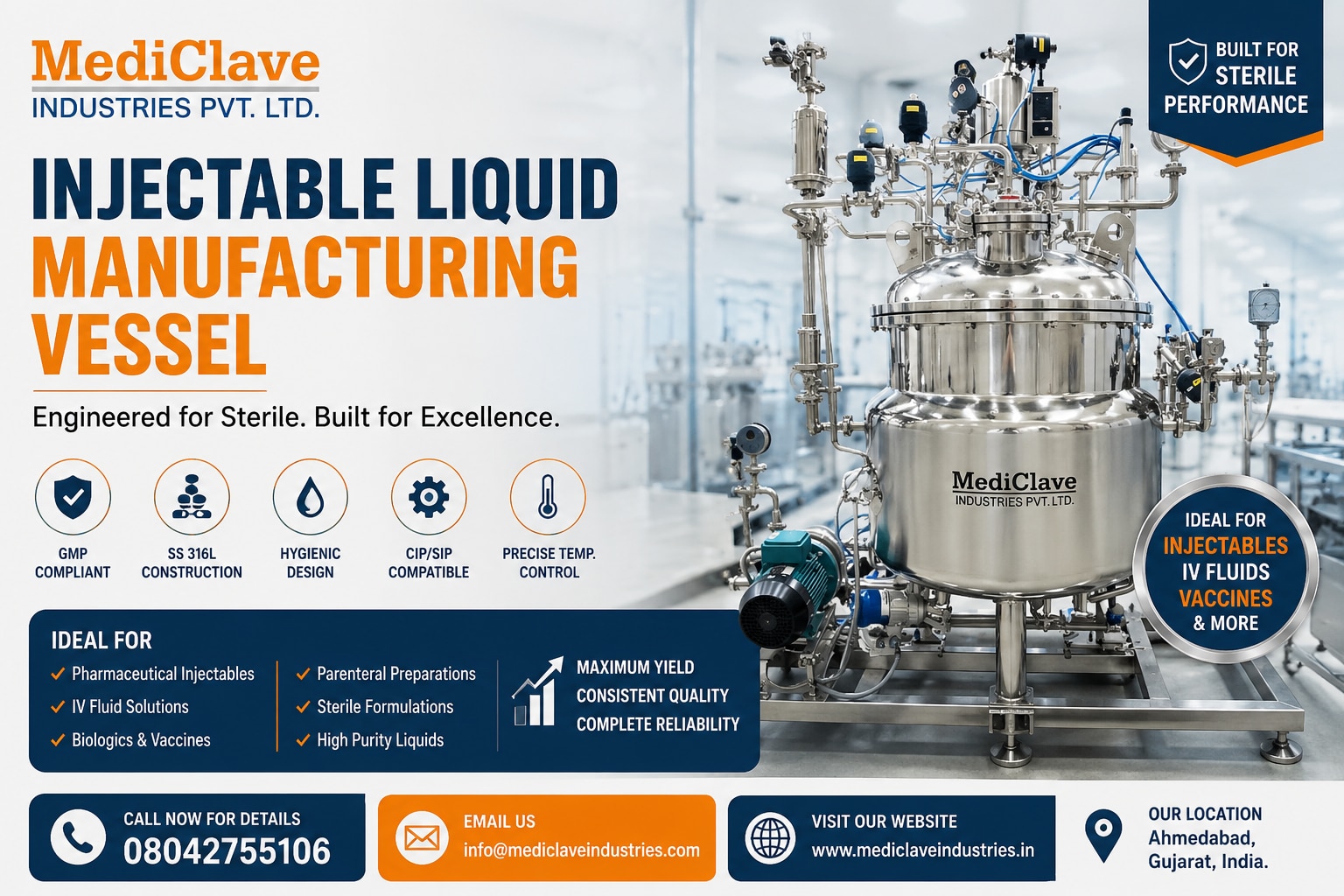
An Injectable Liquid Manufacturing Vessel is one of the most important pieces of equipment used in sterile pharmaceutical production. It is specifically designed for the preparation, mixing, heating, cooling, storage, and transfer of injectable formulations under highly controlled conditions.
Modern pharmaceutical facilities rely on GMP-compliant manufacturing vessels to ensure product safety, regulatory compliance, and consistent product quality.
This comprehensive guide explains everything about Injectable Liquid Manufacturing Vessels, including their working principle, features, applications, advantages, design considerations, and GMP requirements.
What is an Injectable Liquid Manufacturing Vessel?
An Injectable Liquid Manufacturing Vessel is a specially engineered pharmaceutical vessel used for manufacturing sterile injectable formulations.
These vessels are designed to process:
- Small Volume Parenterals (SVP)
- Large Volume Parenterals (LVP)
- Intravenous Fluids
- Injectable Antibiotics
- Injectable Vaccines
- Sterile Solutions
- Injectable Nutraceuticals
- Injectable Veterinary Products
The vessel provides a controlled environment for preparing sterile pharmaceutical liquids while maintaining product integrity.
Importance of Injectable Liquid Manufacturing Vessels
Injectable products require strict quality control because they bypass the body's natural defense systems.
A high-quality manufacturing vessel helps achieve:
- Sterile production conditions
- Accurate ingredient mixing
- Product consistency
- Reduced contamination risk
- Regulatory compliance
- Efficient batch processing
- Reliable product quality
Without proper manufacturing vessels, maintaining pharmaceutical standards becomes extremely difficult.
Working Principle of Injectable Liquid Manufacturing Vessel
The manufacturing process typically involves several stages.
1. Water Charging
Pharmaceutical-grade water such as:
- Water for Injection (WFI)
- Purified Water
is transferred into the vessel.
https://www.mediclaveindustries.in/products/multi-column-distillation-plant/15
2. Ingredient Addition
Active pharmaceutical ingredients and excipients are added according to the batch formulation.
https://www.mediclaveindustries.in/products/liquid-syrup-manufacturing-process-plant/17
3. Mixing Process
A specially designed agitator ensures:
- Uniform mixing
- Proper dissolution
- Consistent formulation
4. Heating and Cooling
The jacketed vessel provides controlled temperature management.
Benefits include:
- Faster dissolution
- Process stability
- Improved product quality
5. Filtration and Transfer
The finished formulation is transferred through sterile filtration systems before filling operations.
Major Components of an Injectable Liquid Manufacturing Vessel
Manufacturing Vessel
The main processing chamber where product preparation takes place.
Agitator System
Ensures homogeneous mixing throughout the batch.
Jacketed Construction
Provides heating and cooling functionality.
Sterile Filters
Help maintain sterility during production.
Load Cells
Enable accurate batch measurement.
CIP/SIP System
Supports cleaning and sterilization processes.
Key Features of Injectable Liquid Manufacturing Vessel
GMP Compliant Design
Designed according to pharmaceutical industry regulations.
SS316L Product Contact Parts
Provides excellent corrosion resistance and hygienic processing.
Mirror Finish Surface
Minimizes contamination and supports easy cleaning.
Closed Processing System
Reduces exposure to external contaminants.
CIP/SIP Compatibility
Allows efficient cleaning and sterilization.
Automated Control System
Provides process monitoring and operational accuracy.
Applications of Injectable Liquid Manufacturing Vessel
Pharmaceutical Industry
Manufacturing of:
- Injectable medicines
- Sterile solutions
- Intravenous fluids
Biotechnology Industry
Production of:
- Biological products
- Vaccine formulations
Healthcare Industry
Preparation of specialty sterile formulations.
Veterinary Pharmaceutical Industry
Manufacturing of veterinary injectable products.
Advantages of Injectable Liquid Manufacturing Vessel
Improved Sterility Assurance
Maintains sterile manufacturing conditions.
Consistent Product Quality
Ensures uniform formulation throughout production.
Reduced Contamination Risk
Closed-loop processing minimizes contamination.
GMP Compliance
Supports regulatory approvals.
Higher Production Efficiency
Automation improves productivity.
Easy Cleaning and Maintenance
CIP/SIP systems reduce downtime.
Long Equipment Life
SS316L construction offers durability and corrosion resistance.
GMP Requirements for Injectable Manufacturing
Injectable production must comply with strict GMP standards.
Cleanroom Environment
Production should be carried out in classified cleanroom areas.
Validated Equipment
Equipment must undergo:
- IQ
- OQ
- PQ
Validation processes.
Documentation
Maintain:
- Batch records
- SOPs
- Validation reports
- Cleaning records
Sterility Assurance
Comprehensive contamination control measures must be implemented.
How to Choose the Right Injectable Liquid Manufacturing Vessel
Production Capacity
Select equipment according to batch requirements.
Material Construction
Prefer SS316L pharmaceutical-grade stainless steel.
Automation Level
Advanced automation improves process control.
Validation Support
Ensure the supplier provides validation documentation.
Regulatory Compliance
Equipment should comply with GMP standards.
After-Sales Service
Choose a manufacturer offering installation, commissioning, and maintenance support.
Future Trends in Injectable Manufacturing Equipment
The pharmaceutical industry is rapidly adopting:
- Smart manufacturing systems
- Industry 4.0 integration
- Automated batch monitoring
- Digital process control
- Advanced CIP/SIP systems
- Data-driven manufacturing
These innovations improve productivity and compliance while reducing operational costs.
Why Pharmaceutical Manufacturers Invest in High-Quality Injectable Manufacturing Vessels
Modern Injectable Liquid Manufacturing Vessels provide:
- Enhanced product safety
- Improved process efficiency
- Regulatory compliance
- Better batch consistency
- Reduced contamination risks
- Long-term operational reliability
These advantages make them essential equipment for sterile pharmaceutical production facilities.
Conclusion
An Injectable Liquid Manufacturing Vessel is a critical component in pharmaceutical sterile manufacturing operations. It ensures safe, efficient, and GMP-compliant production of injectable formulations while maintaining the highest standards of product quality and sterility.
As pharmaceutical companies continue to expand injectable production, investing in advanced manufacturing vessels equipped with automation, CIP/SIP systems, and SS316L construction becomes essential for long-term success.
FAQs
What is an Injectable Liquid Manufacturing Vessel?
An Injectable Liquid Manufacturing Vessel is pharmaceutical equipment used to manufacture sterile injectable formulations under controlled conditions.
Why is SS316L used in injectable manufacturing vessels?
SS316L offers superior corrosion resistance, hygienic processing, and pharmaceutical-grade performance.
What products are manufactured using injectable vessels?
Injectable medicines, vaccines, IV fluids, sterile solutions, and biotechnology products.
Why are CIP/SIP systems important?
They ensure proper cleaning and sterilization, reducing contamination risks and supporting GMP compliance.
What industries use injectable manufacturing vessels?
Pharmaceutical, biotechnology, healthcare, and veterinary industries.
