

Complete Guide to CIP & SIP Systems: Working Principle, Benefits, Applications & Validation (2026)
Introduction
In the pharmaceutical, biotechnology, food, beverage, dairy, cosmetics, and chemical industries, maintaining a contamination-free production environment is essential. As manufacturing standards become more stringent and regulatory expectations continue to evolve, companies are adopting automated cleaning and sterilization technologies to ensure product quality, operational efficiency, and compliance with international standards.
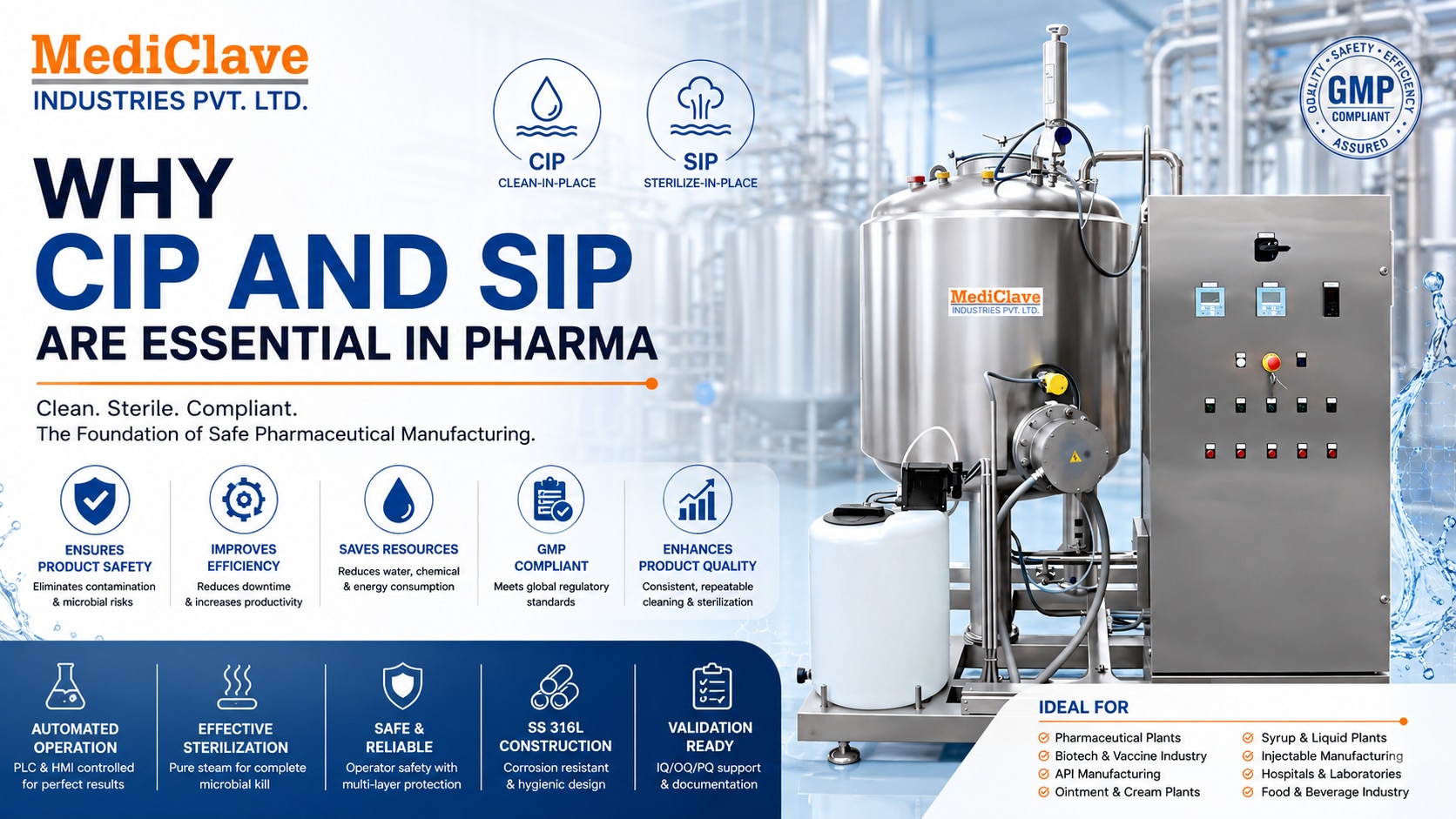
Among the most important technologies used in hygienic manufacturing are CIP (Clean-In-Place) and SIP (Sterilize-In-Place) systems. These systems allow manufacturers to clean and sterilize process equipment, pipelines, tanks, reactors, heat exchangers, and filling machines without dismantling them. By eliminating manual cleaning, CIP and SIP systems reduce downtime, improve consistency, minimize contamination risks, and support Good Manufacturing Practices (GMP).
This guide explains everything you need to know about CIP & SIP Systems, including their working principles, components, applications, advantages, validation requirements, and how to choose the right solution for your facility.
What is a CIP System?
Clean-In-Place (CIP) is an automated cleaning process that removes product residues, microorganisms, and contaminants from the internal surfaces of processing equipment without disassembling it.
The system circulates cleaning solutions such as water, alkaline detergents, acid solutions, and purified water through pipelines and equipment under controlled temperature, flow, and pressure conditions.
CIP ensures consistent cleaning while reducing labor costs and production downtime.
What is a SIP System?
Sterilize-In-Place (SIP) is the process of sterilizing cleaned equipment using saturated steam or other sterilizing media without dismantling the equipment.
After the cleaning cycle is completed through CIP, SIP eliminates any remaining microorganisms by exposing the equipment to high-temperature steam for a validated holding time.
Together, CIP and SIP provide complete cleaning and sterilization of pharmaceutical process equipment.
Why are CIP & SIP Systems Important?
Modern manufacturing facilities require high levels of hygiene and contamination control. Manual cleaning methods are time-consuming, inconsistent, and increase the risk of human error.
CIP & SIP Systems help manufacturers:
- Improve product quality
- Reduce contamination risks
- Minimize production downtime
- Ensure repeatable cleaning results
- Save water and cleaning chemicals
- Reduce labor requirements
- Increase production efficiency
- Support GMP compliance
- Simplify validation processes
- Extend equipment life
Working Principle of a CIP System
A typical CIP cycle consists of several automated steps:
1. Pre-Rinse
The equipment is flushed with water to remove loose product residues.
2. Alkaline Wash
Hot alkaline cleaning solution circulates through the system to remove organic deposits, oils, proteins, and fats.
3. Intermediate Rinse
Purified water removes the alkaline cleaning solution.
4. Acid Wash
Acid solution removes mineral deposits, scaling, and inorganic contaminants.
5. Final Rinse
Purified Water (PW) or Water for Injection (WFI) removes all remaining cleaning agents.
6. Drain & Dry
The system is drained and prepared for sterilization or production.
Working Principle of a SIP System
Once cleaning is completed, the SIP cycle begins.
Steam Introduction
Clean saturated steam enters the equipment through sterilization piping.
Temperature Increase
Steam heats all internal surfaces to the required sterilization temperature.
Holding Time
The system maintains the validated sterilization temperature for a specified period to destroy microorganisms and bacterial spores.
Cooling
After sterilization, the equipment cools under controlled conditions and is ready for production.
Major Components of CIP & SIP Systems
A modern CIP & SIP system typically includes:
- CIP Solution Tanks
- Purified Water Tank
- WFI Tank (if required)
- Chemical Dosing System
- Transfer Pumps
- Sanitary Valves
- Heat Exchanger
- Steam Generator
- Steam Distribution Lines
- PLC Control Panel
- Touchscreen HMI
- Flow Meters
- Temperature Sensors
- Pressure Sensors
- Conductivity Sensors
- Return Pumps
- Spray Balls
- Hygienic Stainless Steel Piping
- SS316L Process Tanks
Applications of CIP & SIP Systems
CIP & SIP systems are used in various industries, including:
Pharmaceutical Industry
- Injectable manufacturing
- Syrup manufacturing
- Ointment manufacturing
- Vaccine production
- API manufacturing
- Biotech processing
Biotechnology Industry
- Fermenters
- Bioreactors
- Media preparation systems
- Cell culture equipment
Food & Beverage Industry
- Dairy processing
- Beverage plants
- Juice production
- Brewery systems
- Food processing lines
Cosmetic Industry
- Cream manufacturing
- Shampoo production
- Lotion processing
- Personal care products
Chemical Industry
- Chemical reactors
- Mixing vessels
- Storage tanks
- Process pipelines
Equipment Cleaned Using CIP & SIP
- Mixing Tanks
- Storage Tanks
- Reactors
- Fermenters
- Homogenizers
- Heat Exchangers
- Filling Machines
- Transfer Pipelines
- Process Vessels
- Buffer Tanks
- Filters
- Membrane Systems
Benefits of CIP & SIP Systems
Improved Product Quality
Automated cleaning ensures every production batch begins with hygienically clean equipment.
Reduced Contamination
Eliminates cross-contamination between production batches.
Higher Productivity
Cleaning takes less time compared to manual methods.
Lower Operating Costs
Optimized use of water, chemicals, and steam reduces utility consumption.
Consistent Cleaning Results
Automated programs provide repeatable cleaning cycles every time.
Better Worker Safety
Employees avoid direct exposure to chemicals and high-temperature cleaning processes.
GMP Compliance
Supports pharmaceutical regulations and international quality standards.
Easy Validation
Automated systems simplify IQ, OQ, PQ, and cleaning validation.
Validation of CIP & SIP Systems
Validation ensures that cleaning and sterilization processes consistently achieve the required standards.
Typical validation includes:
- Design Qualification (DQ)
- Installation Qualification (IQ)
- Operational Qualification (OQ)
- Performance Qualification (PQ)
- Cleaning Validation
- Steam Quality Testing
- Temperature Mapping
- Riboflavin Test
- Conductivity Testing
- TOC Testing
- Microbial Testing
- Calibration of Sensors
GMP & Regulatory Compliance
CIP & SIP Systems should comply with:
- WHO GMP
- US FDA cGMP
- EU GMP
- ISPE Guidelines
- ASME BPE Standards
- ISO Standards
- PIC/S Guidelines
Compliance ensures reliable cleaning, sterilization, and documentation.
Choosing the Right CIP & SIP System
Before selecting a system, consider:
- Production capacity
- Number of process lines
- Automation level
- Tank capacity
- Chemical consumption
- Steam availability
- Validation requirements
- Utility requirements
- Future expansion
- Service support
A customized system designed for your process improves operational efficiency and long-term reliability.
Why Choose Mediclave Industries?
Mediclave Industries Pvt. Ltd. manufactures advanced CIP & SIP Systems designed for pharmaceutical, biotechnology, healthcare, food, and cosmetic industries.
Our systems are engineered to provide:
- GMP-compliant hygienic design
- SS316L product contact parts
- Fully automatic PLC control
- Touchscreen HMI
- Automated recipe management
- Low utility consumption
- Validation-ready design
- Easy maintenance
- Customized solutions
- Reliable after-sales support
Whether you need a standalone CIP unit or an integrated CIP & SIP solution, Mediclave Industries delivers systems that improve productivity, ensure consistent cleaning, and support regulatory compliance.
Frequently Asked Questions (FAQs)
What is the difference between CIP and SIP?
CIP cleans equipment by circulating cleaning solutions, while SIP sterilizes the cleaned equipment using saturated steam.
Is manual cleaning better than CIP?
No. Automated CIP systems provide more consistent, repeatable, and validated cleaning than manual methods.
Which industries use CIP & SIP Systems?
Pharmaceutical, biotechnology, food, beverage, dairy, cosmetics, and chemical industries.
Why is SIP performed after CIP?
Cleaning removes residues, while sterilization destroys microorganisms. Both processes are essential for hygienic manufacturing.
Can CIP & SIP Systems be fully automated?
Yes. Modern systems use PLC and HMI controls for fully automatic operation with recipe management and data logging.
Conclusion
CIP & SIP Systems have become indispensable in modern hygienic manufacturing. By automating cleaning and sterilization processes, they help industries maintain the highest standards of product quality, safety, and operational efficiency. These systems reduce contamination risks, optimize resource utilization, minimize downtime, and ensure compliance with global regulatory standards.
For pharmaceutical, biotechnology, food, and cosmetic manufacturers seeking reliable and validated cleaning solutions, investing in a high-quality CIP & SIP System is a strategic decision that enhances both productivity and product integrity.
Mediclave Industries Pvt. Ltd. offers advanced, customized, and GMP-compliant CIP & SIP Systems tailored to meet the unique requirements of your manufacturing facility. Contact our team today to learn how we can help you achieve efficient, reliable, and compliant cleaning and sterilization processes.
