
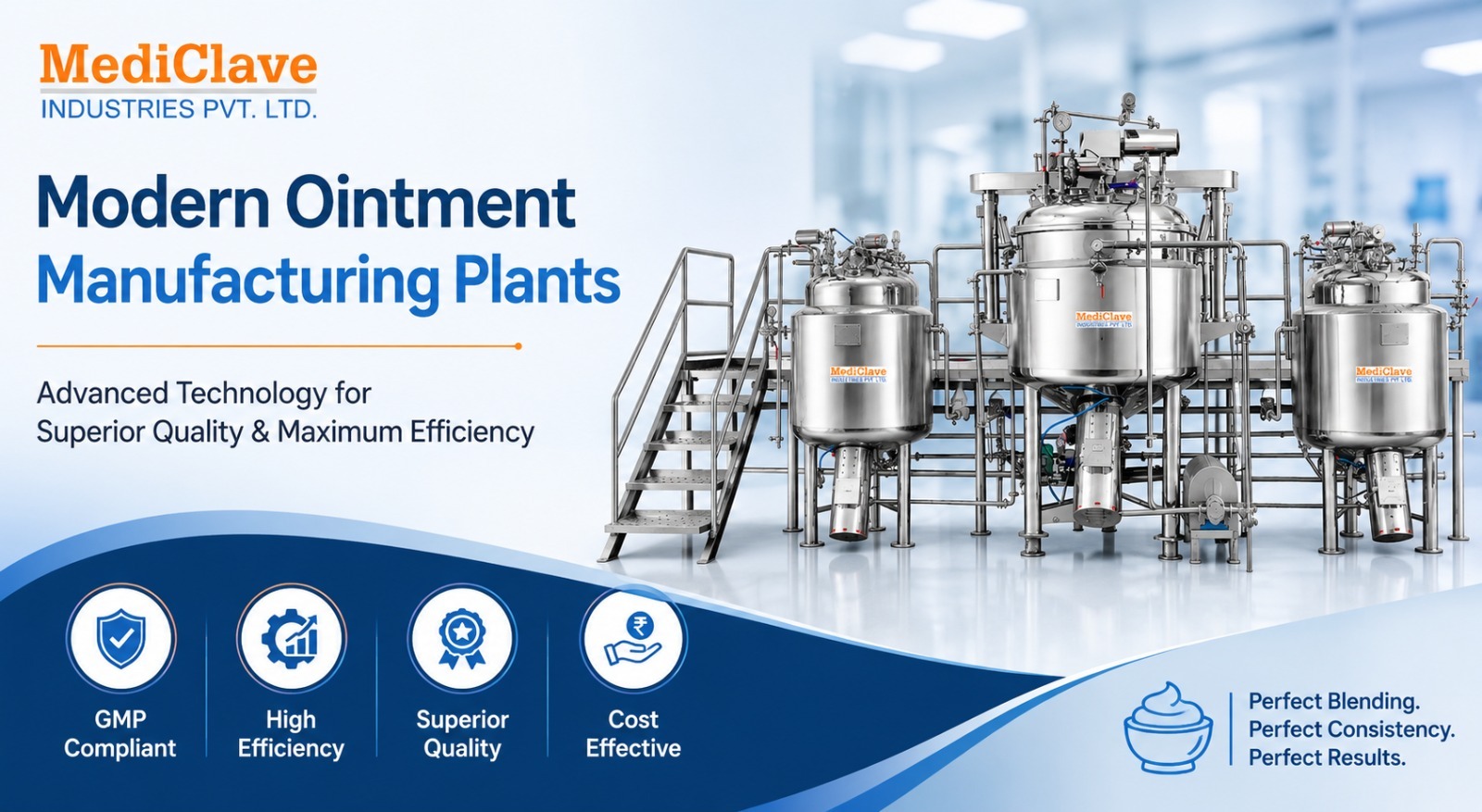
Introduction
The pharmaceutical and cosmetic industries are evolving rapidly, with increasing demand for high-quality creams, ointments, gels, lotions, and medicated formulations. To meet stringent quality standards and growing production requirements, manufacturers are shifting from conventional manufacturing methods to modern, automated ointment manufacturing plants.
A modern ointment manufacturing plant is designed to ensure precise mixing, homogenization, heating, cooling, vacuum processing, and hygienic transfer of semi-solid products. These advanced systems help manufacturers produce consistent, contamination-free, and high-quality products while improving production efficiency and reducing operational costs.
Whether you manufacture pharmaceutical ointments, cosmetic creams, herbal formulations, antiseptic gels, veterinary products, or skincare products, investing in a modern ointment manufacturing plant significantly enhances productivity, product quality, and regulatory compliance.
In this comprehensive guide, we will explore the benefits, features, working principles, applications, and selection criteria of modern ointment manufacturing plants.
What is an Ointment Manufacturing Plant?
An ointment manufacturing plant is an integrated pharmaceutical processing system specifically designed for manufacturing semi-solid products such as:
- Pharmaceutical ointments
- Creams
- Cosmetic creams
- Moisturizers
- Herbal ointments
- Antifungal creams
- Antibiotic ointments
- Pain relief gels
- Petroleum jelly
- Cosmetic lotions
- Medical gels
- Veterinary ointments
Modern plants combine multiple production stages into one integrated system, ensuring efficient and hygienic manufacturing.
Why Modern Ointment Manufacturing Plants are Important
Traditional production methods involve manual operations, inconsistent mixing, contamination risks, and longer production times.
Modern pharmaceutical manufacturers require:
- Higher production capacity
- Better product consistency
- Regulatory compliance
- Faster batch production
- Automated cleaning systems
- Reduced human intervention
- Improved traceability
- Lower operational costs
Modern ointment manufacturing plants address all these challenges through automation and intelligent process control.
Main Components of a Modern Ointment Manufacturing Plant
A complete ointment manufacturing plant generally includes:
Vacuum Emulsifying Vessel
Used for mixing ingredients under vacuum conditions, eliminating air bubbles and ensuring smooth texture.
Oil Phase Vessel
Used for heating oil-soluble ingredients.
Water Phase Vessel
Used for preparing water-soluble ingredients.
Vacuum System
Removes entrapped air and improves product stability.
Homogenizer
Produces ultra-fine emulsions with excellent consistency.
Transfer Pump
Transfers finished products hygienically to storage or filling machines.
Heating System
Maintains accurate processing temperatures.
Cooling System
Ensures controlled cooling for product stability.
PLC Control Panel
Automates the complete manufacturing process.
Stainless Steel Piping
Maintains hygienic product transfer throughout production.
How a Modern Ointment Manufacturing Plant Works
The manufacturing process typically involves:
Step 1: Raw Material Preparation
Oil-based and water-based ingredients are weighed according to the formulation.
Step 2: Heating
Both phases are heated separately to the required temperature.
Step 3: Mixing
Ingredients are transferred into the main vacuum vessel.
Step 4: Vacuum Processing
Air is removed to prevent oxidation and bubble formation.
Step 5: Homogenization
High-speed homogenization creates a smooth and uniform product.
Step 6: Cooling
Controlled cooling stabilizes the formulation.
Step 7: Quality Inspection
Samples are tested for viscosity, pH, appearance, and stability.
Step 8: Transfer
Finished products are transferred to filling machines using sanitary pumps.
Top Benefits of Modern Ointment Manufacturing Plants
1. Superior Product Quality
Modern plants ensure uniform mixing and consistent particle distribution, resulting in premium-quality ointments with excellent texture and stability.
2. Excellent Product Consistency
Every production batch maintains identical quality, ensuring customer satisfaction and regulatory compliance.
3. High Production Efficiency
Automation significantly reduces production time, allowing manufacturers to produce more batches within the same working hours.
4. Vacuum Processing Eliminates Air Bubbles
Vacuum technology removes trapped air, improving:
- Product appearance
- Shelf life
- Stability
- Filling accuracy
5. Improved Homogenization
High-speed homogenizers produce:
- Smooth creams
- Fine emulsions
- Better absorption
- Enhanced therapeutic performance
6. Reduced Human Error
PLC-controlled automation minimizes manual intervention, ensuring precise process parameters.
7. GMP Compliance
Modern systems are designed according to pharmaceutical GMP requirements with hygienic construction, documentation support, and validated processes.
8. Stainless Steel Hygienic Construction
Most pharmaceutical plants use SS316L product-contact parts, offering:
- Corrosion resistance
- Easy cleaning
- Long service life
- Product safety
9. Better Temperature Control
Accurate heating and cooling improve formulation stability and prevent degradation of active ingredients.
10. Increased Shelf Life
Proper homogenization and vacuum processing help produce stable formulations with longer shelf life.
11. Lower Production Costs
Automation reduces:
- Labor costs
- Material wastage
- Production downtime
- Energy consumption
12. Faster Batch Changeover
Modern equipment allows quick cleaning and rapid switching between different formulations.
13. Enhanced Safety
Automated systems reduce operator exposure to chemicals and high-temperature processes.
14. Scalability
Manufacturers can choose plant capacities ranging from laboratory-scale production to large industrial batches, making expansion easier as business grows.
15. Easy Integration with Filling Lines
Modern ointment manufacturing plants integrate seamlessly with:
- Tube filling machines
- Jar filling machines
- Bottle filling systems
- Automatic packaging lines
This improves overall production flow and minimizes product handling.
16. Easy Cleaning and Maintenance
Modern plants are designed with smooth internal surfaces, sanitary fittings, and provisions for automated cleaning, reducing downtime and helping maintain hygienic production conditions.
17. Support for Multiple Formulations
A single plant can often manufacture different products with appropriate process settings, including:
- Medicated creams
- Cosmetic creams
- Herbal gels
- Moisturizers
- Petroleum jelly
- Antiseptic gels
- Veterinary ointments
This flexibility increases equipment utilization and business profitability.
18. Improved Batch Traceability
Integrated PLC and HMI systems help record critical production parameters such as temperature, mixing speed, vacuum level, and processing time. These records simplify documentation and support quality audits.
Industries Using Ointment Manufacturing Plants
Modern ointment manufacturing plants are widely used in:
- Pharmaceutical manufacturing
- Cosmetic manufacturing
- Personal care industry
- Herbal product manufacturing
- Ayurvedic medicine production
- Veterinary pharmaceutical companies
- Biotechnology companies
- Research and development laboratories
- Contract manufacturing organizations (CMOs)
GMP and Regulatory Compliance
Pharmaceutical manufacturers must comply with stringent quality requirements. A modern ointment manufacturing plant supports compliance through:
- Hygienic stainless-steel construction
- Controlled manufacturing environment
- Repeatable production processes
- Validation-friendly design
- Documentation support
- Reduced contamination risk
- Compatibility with Clean-in-Place (CIP) and Sterilize-in-Place (SIP) systems where required
Manufacturers should also align their operations with guidelines issued by regulatory authorities such as the World Health Organization (WHO), Good Manufacturing Practices (GMP), and relevant national regulatory agencies.
How to Choose the Right Ointment Manufacturing Plant
Before investing, evaluate the following factors:
- Required production capacity
- Product viscosity range
- Type of formulations
- Heating and cooling efficiency
- Homogenizer performance
- Vacuum capability
- Automation level (PLC/HMI)
- Material of construction (SS316L contact parts)
- Ease of cleaning
- Availability of spare parts and service
- Validation and documentation support
- Future expansion possibilities
Selecting the right equipment ensures long-term operational efficiency and lower lifecycle costs.
Why Choose Mediclave Industries Pvt. Ltd.
Mediclave Industries Pvt. Ltd. is committed to delivering advanced pharmaceutical process equipment engineered for performance, reliability, and regulatory compliance.
Our ointment manufacturing plants are designed to offer:
- Advanced vacuum emulsification technology
- Efficient homogenization systems
- Robust stainless-steel construction
- User-friendly PLC automation
- Energy-efficient operation
- Hygienic design
- Customizable capacities
- Reliable after-sales support
- Compliance-focused engineering
- Long service life with low maintenance requirements
Whether you are establishing a new pharmaceutical facility or upgrading an existing production line, our solutions are tailored to meet modern manufacturing requirements.
Frequently Asked Questions (FAQs)
1. What is an ointment manufacturing plant?
It is an integrated processing system used for manufacturing pharmaceutical ointments, creams, gels, lotions, and other semi-solid formulations under controlled and hygienic conditions.
2. Why is vacuum technology used?
Vacuum processing removes entrapped air, improves product stability, enhances texture, and minimizes oxidation.
3. What materials are used for construction?
Most pharmaceutical-grade plants use SS316L for product-contact parts and SS304 for external structures.
4. Can one plant produce different products?
Yes. Modern plants can manufacture multiple semi-solid formulations with proper cleaning and validated process parameters.
5. Is automation important?
Yes. PLC-based automation improves process accuracy, repeatability, productivity, and documentation.
6. Which industries use these plants?
Pharmaceutical, cosmetic, herbal, veterinary, biotechnology, and personal care industries.
7. What production capacities are available?
Plants are available in various capacities, from pilot-scale units to large industrial systems, depending on production requirements.
8. How does homogenization improve quality?
Homogenization reduces particle size and creates a uniform emulsion, resulting in smoother texture, better stability, and improved product performance.
9. Are these plants suitable for GMP manufacturing?
Yes. Modern ointment manufacturing plants are designed to support GMP-compliant production when installed and operated according to applicable regulations.
10. Why should manufacturers invest in modern systems?
Modern systems improve efficiency, reduce waste, enhance product quality, support regulatory compliance, and provide better long-term returns on investment.
Conclusion
Modern ointment manufacturing plants have transformed the production of pharmaceutical and cosmetic semi-solid formulations by combining automation, precision, and hygienic engineering. Compared with conventional manufacturing methods, these advanced systems deliver consistent product quality, improved process efficiency, reduced operational costs, and better compliance with global manufacturing standards.
As market demand for high-quality creams, gels, and ointments continues to grow, investing in a modern manufacturing plant is not just a technological upgrade—it is a strategic decision that strengthens productivity, product reliability, and customer confidence. Manufacturers who adopt advanced processing solutions are better positioned to meet regulatory expectations, scale production, and remain competitive in the evolving pharmaceutical industry.