
Introduction
In the pharmaceutical and cosmetic industries, the quality of ointments, creams, gels, lotions, and topical formulations depends not only on the ingredients used but also on the manufacturing process. A well-designed Ointment Manufacturing Plant plays a vital role in producing homogeneous, contamination-free, and stable products that meet stringent quality standards. From dermatological creams and medicated ointments to cosmetic creams and herbal formulations, modern manufacturing plants ensure consistent product quality, improved productivity, and compliance with global pharmaceutical regulations.
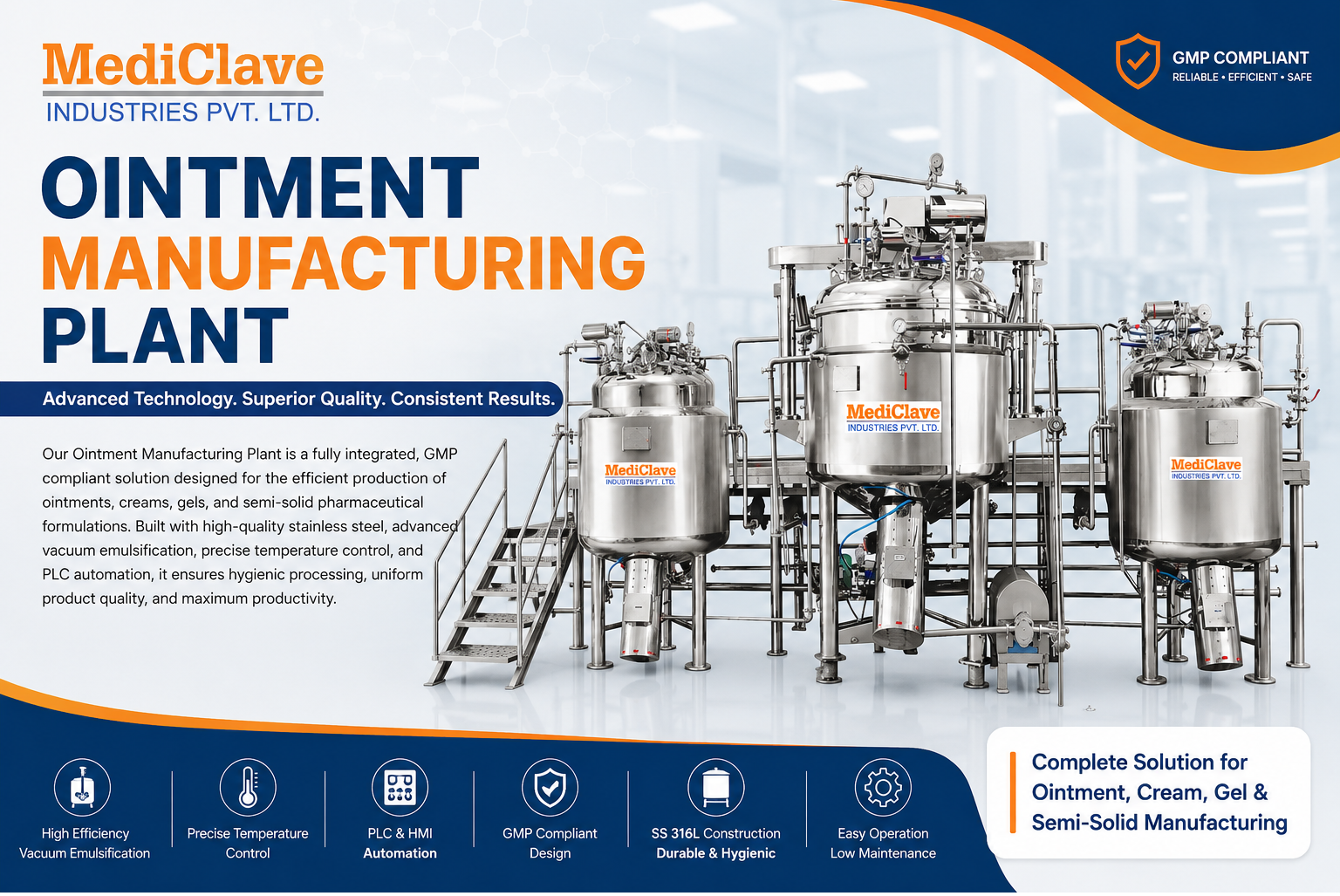
An Ointment Manufacturing Plant is a complete processing system designed for the mixing, heating, homogenizing, emulsifying, vacuum processing, cooling, storage, and transfer of semi-solid pharmaceutical products. These systems are widely used by pharmaceutical companies, cosmetic manufacturers, ayurvedic medicine producers, biotechnology companies, and personal care product manufacturers. Equipped with advanced PLC automation, vacuum technology, precision temperature control, and hygienic stainless steel construction, modern plants help manufacturers achieve efficient production while maintaining the highest standards of safety and hygiene.
Whether you are manufacturing small laboratory batches or large-scale commercial production volumes, investing in a high-quality Ointment Manufacturing Plant improves product consistency, reduces production time, minimizes contamination risks, and supports GMP-compliant manufacturing practices.
What is an Ointment Manufacturing Plant?
An Ointment Manufacturing Plant is an integrated pharmaceutical processing system designed to manufacture semi-solid formulations such as ointments, creams, gels, lotions, petroleum jelly products, medicated creams, cosmetic creams, antiseptic creams, herbal ointments, and topical pharmaceutical products.
The plant consists of several interconnected units including preparation vessels, oil phase vessels, water phase vessels, vacuum emulsifying mixers, homogenizers, transfer pumps, storage vessels, pipelines, and control panels. Together, these components ensure uniform mixing, proper emulsification, and consistent product quality throughout the manufacturing process.
Modern systems are manufactured using pharmaceutical-grade stainless steel (SS316L and SS304), ensuring corrosion resistance, easy cleaning, long service life, and compliance with GMP requirements.
How an Ointment Manufacturing Plant Works
The manufacturing process follows a carefully controlled sequence to ensure high-quality production.
1. Raw Material Preparation
The required pharmaceutical ingredients, oils, waxes, emulsifiers, preservatives, active pharmaceutical ingredients (APIs), fragrances, and purified water are accurately weighed according to the formulation.
2. Oil Phase Preparation
Oil-soluble ingredients are heated in a dedicated oil phase vessel until completely melted and uniformly mixed.
3. Water Phase Preparation
Water-soluble ingredients are processed in a separate vessel where temperature and mixing speed are precisely controlled.
4. Vacuum Emulsification
Both phases are transferred into the main manufacturing vessel under vacuum conditions. Vacuum processing minimizes air entrapment, producing a smooth, bubble-free product with improved stability.
5. Homogenization
High-speed homogenizers reduce particle size and create a fine, uniform emulsion, ensuring excellent texture and product consistency.
6. Cooling
The product is gradually cooled while mixing continues, maintaining stability and preventing separation.
7. Storage and Transfer
The finished product is transferred hygienically to storage vessels or directly to the filling line for packaging.
Major Components of an Ointment Manufacturing Plant
A complete manufacturing plant generally includes:
- Main Manufacturing Vessel
- Oil Phase Vessel
- Water Phase Vessel
- Vacuum Emulsifier
- High-Speed Homogenizer
- Slow-Speed Anchor Stirrer
- Vacuum Pump
- Transfer Pump
- Product Storage Vessel
- PLC Control Panel
- HMI Touchscreen
- Stainless Steel Pipelines
- CIP (Clean-in-Place) System
- Temperature Control System
- Load Cell System (Optional)
Each component is designed to maximize productivity while ensuring hygienic operation and ease of maintenance.
Key Features
Modern Ointment Manufacturing Plants are equipped with advanced features that improve production efficiency and product quality.
- Stainless Steel SS316L contact parts
- SS304 external structure
- PLC-based automation
- HMI touchscreen operation
- Vacuum processing system
- High-speed homogenizer
- Variable speed agitator
- Anchor stirrer with scraper
- Precision temperature control
- Steam or electrical heating
- Chilled water cooling arrangement
- CIP-compatible design
- Hygienic piping system
- Sanitary valves
- Automatic ingredient transfer
- Digital monitoring
- Batch recording
- Energy-efficient operation
- Low maintenance requirements
- GMP-compliant construction
Advantages of an Ointment Manufacturing Plant
Uniform Product Quality
Advanced homogenization ensures smooth texture, consistent viscosity, and uniform distribution of active ingredients.
Improved Productivity
Automation significantly reduces manual intervention and increases batch production efficiency.
Vacuum Processing
Vacuum technology removes entrapped air, improving product appearance, shelf life, and stability.
Hygienic Manufacturing
Pharmaceutical-grade stainless steel construction prevents contamination and supports easy cleaning.
Energy Efficiency
Optimized heating and cooling systems reduce operational costs.
Regulatory Compliance
The plant is designed to meet GMP, WHO, and FDA guidelines for pharmaceutical manufacturing.
Flexible Production
Suitable for producing a wide variety of pharmaceutical, cosmetic, and personal care formulations.
Applications
Ointment Manufacturing Plants are used for manufacturing:
- Pharmaceutical ointments
- Dermatological creams
- Antibiotic creams
- Antifungal creams
- Pain relief gels
- Cosmetic creams
- Moisturizing creams
- Beauty creams
- Herbal creams
- Ayurvedic ointments
- Petroleum jelly
- Antiseptic creams
- Sunscreen lotions
- Face creams
- Hair gels
- Skin care gels
- Medical gels
- Veterinary ointments
- Personal care products
- Topical formulations
Industries Served
These plants are widely installed in:
- Pharmaceutical Companies
- Cosmetic Manufacturers
- Ayurvedic Medicine Manufacturers
- Herbal Product Companies
- Biotechnology Industries
- Personal Care Product Manufacturers
- Healthcare Product Manufacturers
- Veterinary Pharmaceutical Companies
- Contract Manufacturing Organizations (CMOs)
- Research and Development Laboratories
Why Automation Matters
Automation has transformed pharmaceutical manufacturing by improving precision, repeatability, and process control. PLC and HMI-based Ointment Manufacturing Plants allow operators to monitor temperatures, mixing speeds, vacuum levels, and production cycles in real time. Automated recipes reduce batch-to-batch variations and help maintain consistent product quality while improving documentation for regulatory audits.
Quality and Compliance
Pharmaceutical manufacturers operate under strict quality standards. A modern Ointment Manufacturing Plant is designed to support:
- Good Manufacturing Practices (GMP)
- WHO Guidelines
- FDA Compliance
- Hygienic Design Standards
- Validation Requirements
- Process Traceability
- Batch Documentation
- Easy Cleaning and Maintenance
These features help manufacturers maintain consistent product quality and meet domestic as well as international regulatory expectations.
Why Choose Mediclave Industries Pvt. Ltd.?
Mediclave Industries Pvt. Ltd. designs and manufactures advanced pharmaceutical process equipment with a focus on quality, innovation, and reliability. Our Ointment Manufacturing Plants are engineered for efficient mixing, precise temperature control, excellent homogenization, and hygienic processing. Manufactured using premium stainless steel and modern automation technologies, our systems are suitable for pharmaceutical, cosmetic, biotechnology, and personal care industries. We also provide customization options to match specific production capacities and process requirements, along with dependable technical support and documentation.
Conclusion
An Ointment Manufacturing Plant is an essential investment for manufacturers seeking to produce high-quality creams, ointments, gels, and other semi-solid formulations with consistency and efficiency. By combining advanced homogenization, vacuum emulsification, precise temperature control, and automated process management, these plants ensure superior product quality, enhanced productivity, and compliance with international pharmaceutical standards. Whether you are expanding an existing production line or establishing a new manufacturing facility, a modern Ointment Manufacturing Plant provides the reliability, flexibility, and performance required to meet the evolving demands of the pharmaceutical and cosmetic industries.