

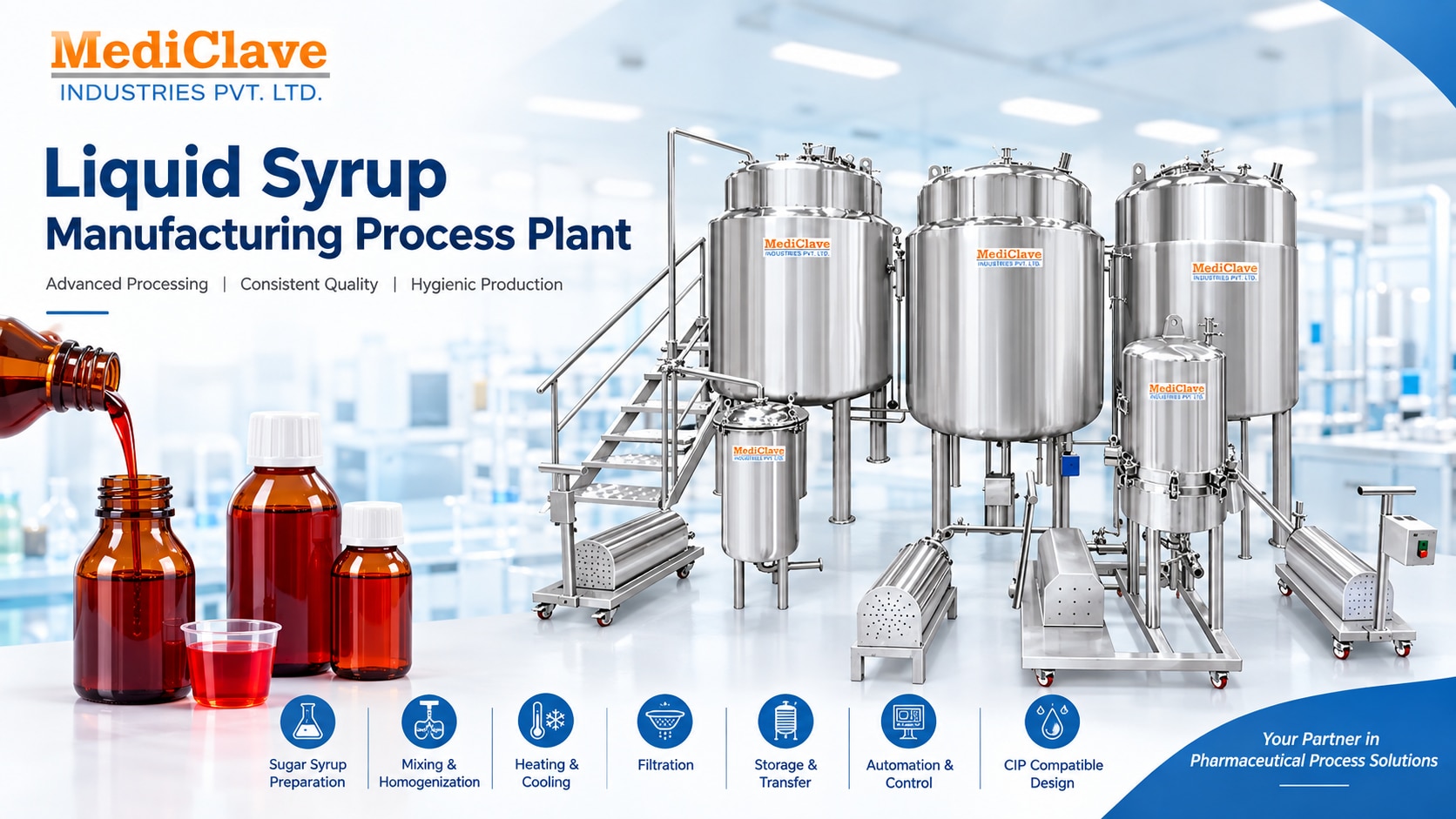
Liquid medicines are an important part of the pharmaceutical industry. From cough syrups and pediatric medicines to vitamin formulations, antacids, iron tonics, herbal preparations, and nutraceutical liquids, many products are manufactured in liquid form because they are convenient to consume and can be formulated for different patient requirements.
However, producing a high-quality pharmaceutical syrup is much more than simply mixing ingredients in a tank. The manufacturing process requires controlled temperature, accurate ingredient addition, efficient mixing, hygienic processing, filtration, storage, and reliable product transfer.
This is where a Liquid Syrup Manufacturing Process Plant becomes an important part of a modern pharmaceutical manufacturing facility.
A properly designed plant integrates different processing stages into one organized system. It can help pharmaceutical manufacturers achieve consistent batches, reduce manual handling, improve production efficiency, and maintain hygienic manufacturing conditions.
Mediclave Industries Pvt. Ltd. designs and manufactures pharmaceutical process equipment and customized liquid processing solutions for pharmaceutical, nutraceutical, herbal, and healthcare manufacturing applications. The configuration of a plant can be selected according to formulation characteristics, batch size, production capacity, automation requirements, and facility layout.
What Is a Liquid Syrup Manufacturing Process Plant?
A Liquid Syrup Manufacturing Process Plant is an integrated pharmaceutical processing system used for the preparation, mixing, heating, cooling, homogenization, filtration, storage, and transfer of liquid formulations.
Unlike a basic mixing vessel, a complete syrup manufacturing plant consists of several interconnected equipment and systems. Depending on the formulation and production requirements, these may include:
- Sugar syrup preparation vessel
- Manufacturing vessel
- Storage vessel
- Agitator and mixing system
- Heating and cooling arrangement
- Transfer pumps
- Filtration system
- Sanitary piping
- Instrumentation
- Control panel
- CIP connections or cleaning system
- Platform and access arrangement
The exact configuration depends on the formulation, viscosity, batch size, ingredients, required processing temperature, filtration requirements, and desired level of automation.
The objective is to provide a controlled manufacturing environment from raw-material preparation through final bulk syrup transfer to the filling section.
Why Is a Liquid Syrup Manufacturing Plant Important?
Pharmaceutical syrup manufacturing requires consistency. A small variation in ingredient concentration, temperature, mixing, or processing time can affect the characteristics of the finished product.
A properly designed manufacturing plant helps control these variables throughout the batch.
1. Consistent Product Quality
Controlled mixing and processing help maintain uniform distribution of ingredients throughout the batch.
This is important for maintaining characteristics such as:
- Appearance
- Viscosity
- Concentration
- pH
- Uniformity
- Taste characteristics
- Physical stability
2. Hygienic Manufacturing
Pharmaceutical products require carefully controlled manufacturing conditions. Hygienic equipment design and suitable product-contact materials can help reduce contamination risks.
Smooth internal surfaces, sanitary connections, suitable piping, and appropriate cleaning arrangements are important considerations.
3. Better Production Efficiency
An integrated plant reduces the need to manually move materials between separate processing stages.
Ingredients can move through the production process using controlled transfer systems, improving workflow and reducing unnecessary handling.
4. Improved Batch Reproducibility
Once suitable process parameters are established and validated, automated or controlled equipment can help manufacturers reproduce the same manufacturing procedure from batch to batch.
5. Easy Cleaning and Maintenance
Modern pharmaceutical process plants can be designed with cleaning requirements in mind. Depending on the application, CIP-compatible arrangements can simplify cleaning of vessels and process lines.
Main Components of a Liquid Syrup Manufacturing Process Plant
A complete plant is normally made up of multiple pieces of equipment that work together.
1. Sugar Syrup Preparation Vessel
The sugar syrup preparation vessel is used to dissolve sugar or other suitable soluble ingredients in purified water.
It may include:
- Heating arrangement
- Agitator
- Temperature monitoring
- Hygienic construction
- Suitable insulation
Controlled heating and agitation help achieve proper dissolution and consistent syrup preparation.
2. Manufacturing Vessel
The manufacturing vessel is the main processing unit where different ingredients are combined according to the approved formulation.
Depending on the product, the vessel may handle:
- Active pharmaceutical ingredients
- Sweeteners
- Preservatives
- Flavors
- Colors
- Stabilizers
- Other excipients
An appropriate agitator provides controlled mixing and helps maintain product uniformity.
3. Storage Vessel
After processing and quality approval, the finished bulk syrup can be transferred to a storage vessel before filling.
The storage vessel provides controlled holding capacity and can be designed according to the product characteristics and required batch size.
4. Transfer Pump
Sanitary transfer pumps move the syrup between processing vessels, filtration systems, storage tanks, and filling areas.
The pump selection should consider factors such as:
- Product viscosity
- Flow rate
- Temperature
- Pressure
- Hygienic requirements
5. Filtration System
Filtration can be an important part of liquid syrup processing when the formulation requires removal of particulate matter or improvement in clarity.
The filtration arrangement should be selected according to the formulation and validated manufacturing process.
6. Heating and Cooling System
Some formulations require controlled heating during dissolution or processing, while cooling may be required before adding heat-sensitive ingredients or transferring the finished product.
A suitable heating and cooling system helps maintain the required process temperature.
7. Control Panel
Modern syrup manufacturing plants can incorporate PLC-based control systems and HMI interfaces.
Depending on the plant configuration, operators may monitor and control:
- Temperature
- Mixing speed
- Processing time
- Pump operation
- Heating
- Cooling
- Process sequence
- Alarms
Automation can reduce operator dependency and improve process repeatability.
Liquid Syrup Manufacturing Process: Step-by-Step
The actual manufacturing procedure varies according to the formulation and approved batch manufacturing process. However, a typical liquid syrup production sequence can include the following stages.
Step 1: Raw Material Preparation
The first stage is the preparation and verification of the required raw materials.
These may include:
- Purified water
- Sugar or sweeteners
- Active pharmaceutical ingredients
- Preservatives
- Flavors
- Colors
- Stabilizers
- Other excipients
Materials should be weighed and handled according to the approved manufacturing procedure.
Step 2: Purified Water Charging
Purified water is charged into the appropriate preparation or manufacturing vessel.
The water quality is an important consideration because water can form a major part of the final formulation.
For pharmaceutical manufacturing facilities, the water-generation and distribution system should be planned according to the product and applicable quality requirements.
For facilities requiring high-purity pharmaceutical water, a Multi Column Distillation Plant can form part of the overall pharmaceutical water infrastructure.
Step 3: Sugar or Excipient Dissolution
Sugar, sweeteners, or other soluble excipients are added to the preparation vessel.
Controlled agitation helps distribute the material throughout the water. Heating may be used when required by the formulation.
The objective is to obtain proper dissolution without negatively affecting formulation ingredients.
Step 4: Preparation of Active Ingredients
Active pharmaceutical ingredients and other formulation components are prepared according to the approved batch procedure.
Depending on the formulation, some ingredients may require separate preparation or pre-dissolution before being added to the main manufacturing vessel.
Step 5: Ingredient Addition and Mixing
The prepared ingredients are transferred into the manufacturing vessel.
The agitator mixes the materials to achieve a homogeneous formulation.
Mixing conditions should be selected according to:
- Product viscosity
- Batch size
- Ingredient characteristics
- Required mixing time
- Formulation requirements
Step 6: Heating or Cooling
Some formulations require controlled heating to support dissolution or processing.
After heating, the batch may need controlled cooling.
Temperature-sensitive ingredients should be handled according to the validated manufacturing procedure to protect their required characteristics.
Step 7: Homogenization
Homogenization may be required for certain formulations, particularly when uniform distribution of components or specific physical characteristics are important.
The requirement for homogenization depends entirely on the product formulation.
Step 8: Filtration
The processed liquid may be passed through an appropriate filtration system.
Filtration can help remove unwanted particulate matter and improve product clarity where required.
The filtration method and filter selection should be based on the formulation and validated process.
Step 9: Quality Testing
Before the batch proceeds to filling, quality-control testing is performed according to the approved specifications.
Typical quality parameters may include:
- Appearance
- pH
- Viscosity
- Assay
- Specific formulation parameters
- Microbial quality
- Other applicable tests
The actual tests depend on the pharmaceutical product and applicable specifications.
Step 10: Storage and Transfer
After processing and required quality approval, the finished bulk syrup is transferred to a suitable storage vessel.
Sanitary transfer systems help move the product toward the filling area while minimizing unnecessary manual handling.
Step 11: Filling and Packaging
The approved syrup is transferred to the liquid filling section.
Depending on the product, the packaging process may include:
Filling → Capping → Labeling → Inspection → Packing
The finished products are then prepared for storage and distribution according to the manufacturer's procedures.
Types of Products Manufactured Using Syrup Plants
A suitably configured Liquid Syrup Manufacturing Process Plant can support a wide range of liquid formulations.
Pharmaceutical Products
Common examples include:
- Cough syrups
- Pediatric syrups
- Antacid liquids
- Vitamin syrups
- Iron tonics
- Oral solutions
- Oral suspensions
- Flavored pharmaceutical liquids
Nutraceutical Products
Nutraceutical manufacturers may use liquid processing systems for:
- Nutritional supplements
- Vitamin liquids
- Health formulations
- Mineral supplements
- Nutritional tonics
Herbal and Ayurvedic Products
Suitable processing systems can also be used for:
- Herbal syrups
- Ayurvedic liquids
- Herbal tonics
- Plant-based liquid formulations
The equipment configuration should always be selected according to the specific formulation and manufacturing process.
Key Features of a Modern Liquid Syrup Manufacturing Plant
A modern pharmaceutical syrup plant can be designed with a combination of mechanical, hygienic, and automation features.
Important features may include:
- Pharmaceutical-grade stainless-steel construction
- SS316L product-contact surfaces where required
- Efficient agitator design
- Controlled heating
- Controlled cooling
- Hygienic product transfer
- Sanitary piping
- Filtration arrangement
- Temperature monitoring
- PLC automation
- HMI interface
- Safety interlocks
- Batch process monitoring
- CIP-compatible design
- Customized vessel capacities
The final specification should be determined based on the actual product and facility requirements rather than selecting equipment only by vessel volume.
Importance of Material of Construction
Material selection is an important consideration in pharmaceutical process equipment.
Product-contact surfaces are commonly designed using suitable pharmaceutical-grade stainless steel. SS316L is frequently selected for critical product-contact applications because of its corrosion resistance and suitability for hygienic pharmaceutical equipment.
The surface finish, weld quality, internal geometry, sanitary connections, and drainability should also be considered during equipment design.
A hygienic vessel should minimize areas where product residues can accumulate and should support effective cleaning.
Automation in Syrup Manufacturing
Automation has become an important part of modern pharmaceutical production.
A PLC-based system can help control and monitor different process parameters according to the equipment configuration.
Automation can provide:
- Repeatable process sequences
- Controlled mixing
- Temperature monitoring
- Automated heating and cooling
- Pump control
- Alarm management
- Reduced manual intervention
- Improved batch consistency
- Process data management
The required level of automation can range from semi-automatic operation to highly automated production depending on the facility's requirements.
Role of CIP in Syrup Manufacturing
Cleaning is a critical part of pharmaceutical manufacturing.
Residual product left inside vessels, pipes, pumps, or transfer lines can create contamination and cross-contamination concerns.
A suitable CIP (Clean-In-Place) arrangement can help clean process equipment without requiring complete dismantling.
Depending on the plant design, CIP may involve controlled circulation of cleaning solutions through:
- Manufacturing vessels
- Storage tanks
- Transfer lines
- Pumps
- Filters
- Process piping
For pharmaceutical facilities requiring integrated cleaning and sterilization arrangements, manufacturers can also consider CIP & SIP Systems as part of the overall process equipment design.
The exact cleaning cycle should be established according to the equipment, formulation, cleaning agents, and validated cleaning procedure.
Pharmaceutical Water and Syrup Manufacturing
Water quality is one of the most important considerations in liquid pharmaceutical production.
The appropriate pharmaceutical water grade depends on the formulation and applicable requirements.
A complete facility may therefore include supporting water systems such as:
- Purified Water systems
- Water storage tanks
- Water distribution loops
- WFI systems where applicable
- Water monitoring systems
For facilities requiring pharmaceutical-grade water generation, a Multi Column Distillation Plant can support WFI production through multi-stage distillation.
Where sterile processing equipment requires high-purity steam, a Pure Steam Generator can support applications such as SIP and sterilization of pharmaceutical equipment.
This shows why syrup production should not be viewed as an isolated mixing process. A modern pharmaceutical facility often requires interconnected process, utility, cleaning, and quality systems.
Capacity Selection for a Liquid Syrup Manufacturing Plant
Plant capacity should be selected based on current production requirements as well as expected future demand.
Typical capacity considerations may include:
- 100 L
- 250 L
- 500 L
- 1,000 L
- 2,000 L
- 5,000 L
- 10,000 L
- Customized capacities
These are examples rather than universal standard sizes. The actual working volume, batch size, vessel geometry, headspace, mixing requirement, and transfer volume should be finalized according to the formulation and manufacturing process.
Before selecting a plant, manufacturers should evaluate:
- Current production volume
- Future expansion plans
- Number of batches per day
- Product viscosity
- Heating requirements
- Cooling requirements
- Mixing requirements
- Filtration requirements
- Cleaning requirements
- Available floor space
- Utility availability
- Automation requirements
How to Choose the Right Liquid Syrup Manufacturing Plant
Selecting the right plant requires more than comparing vessel capacities or equipment prices.
Consider the Formulation
Different products require different mixing, heating, cooling, and filtration conditions.
Consider Batch Size
The vessel should provide an appropriate working volume for the intended batch size while allowing suitable operating headspace.
Consider Material of Construction
Product-contact components should be selected according to pharmaceutical and formulation requirements.
Consider Automation
Determine whether the facility requires manual, semi-automatic, or PLC-based automated operation.
Consider Cleaning
The equipment should be designed around the facility's cleaning and sanitation strategy.
Consider Future Expansion
A plant designed only for today's production may become restrictive as demand increases. Future capacity requirements should therefore be considered during project planning.
Consider Documentation and Validation
Pharmaceutical equipment projects may require documentation and qualification support such as:
- Design Qualification (DQ)
- Installation Qualification (IQ)
- Operational Qualification (OQ)
- Performance Qualification (PQ)
The exact documentation package should be agreed upon according to the project and customer requirements.
Liquid Syrup Manufacturing Plant for Pharmaceutical Projects
A syrup manufacturing plant is often only one part of a complete pharmaceutical production project.
Depending on the facility, manufacturers may require additional process equipment such as:
- Liquid manufacturing vessels
- Storage vessels
- Ointment manufacturing systems
- Pure steam systems
- Pharmaceutical water systems
- Sterilization equipment
- CIP/SIP systems
- Transfer systems
For manufacturers producing sterile or injectable liquid products, a Liquid Manufacturing Vessel with Magnetic Stirrer may be relevant for suitable formulation and mixing applications.
For semi-solid products such as creams, ointments, and gels, an Ointment Manufacturing Plant can provide a different processing solution.
This type of integrated approach can help pharmaceutical manufacturers plan their process equipment according to the overall production workflow.
Applications Across Different Industries
Pharmaceutical Manufacturing
Liquid syrup plants are widely considered for pharmaceutical companies producing oral liquid medicines.
Nutraceutical Manufacturing
Nutraceutical companies can use suitable liquid processing systems for vitamins, nutritional supplements, and health formulations.
Herbal Manufacturing
Herbal and Ayurvedic manufacturers may use customized systems for syrup and tonic production.
Contract Manufacturing
Contract manufacturing organizations can benefit from flexible equipment configurations that support different products and batch sizes.
Healthcare Products
Suitable liquid processing systems can support the manufacturing of various healthcare liquid formulations.
Benefits of a Properly Designed Liquid Syrup Manufacturing Process Plant
A well-engineered plant can provide several operational benefits:
- Consistent batch processing
- Controlled ingredient mixing
- Improved hygiene
- Reduced manual handling
- Better production efficiency
- Controlled temperature management
- Easier product transfer
- Improved process monitoring
- Flexible production configurations
- Easier cleaning
- Better scalability
- Improved batch reproducibility
The actual performance and benefits depend on the formulation, equipment configuration, operating procedure, utilities, and validation of the complete process.
Why Choose Mediclave Industries?
Mediclave Industries Pvt. Ltd. provides pharmaceutical process equipment designed around the specific requirements of modern manufacturing facilities.
Our approach focuses on understanding the customer's formulation, production capacity, process requirements, available utilities, automation expectations, and plant layout before finalizing the equipment configuration.
Our liquid syrup manufacturing solutions can be customized for:
- Pharmaceutical manufacturers
- Nutraceutical companies
- Herbal manufacturers
- Ayurvedic product manufacturers
- Healthcare product manufacturers
- Contract manufacturing facilities
Depending on the project, solutions can incorporate hygienic stainless-steel construction, controlled mixing, heating and cooling, filtration, sanitary transfer, automation, and cleaning provisions.
Mediclave Industries also offers a broader range of pharmaceutical process and utility equipment, allowing customers to plan multiple requirements through a coordinated equipment approach. The company's current product categories include pharmaceutical sterilization, water systems, and process equipment.
Frequently Asked Questions
What is a Liquid Syrup Manufacturing Process Plant?
A Liquid Syrup Manufacturing Process Plant is an integrated pharmaceutical processing system used for preparing, mixing, heating, cooling, filtering, storing, and transferring liquid syrup formulations.
What products can be manufactured using a syrup manufacturing plant?
Depending on the equipment configuration and formulation, the plant can support cough syrups, pediatric syrups, vitamin formulations, antacids, iron tonics, herbal syrups, oral solutions, oral suspensions, and other suitable liquid products.
What are the main components of a syrup manufacturing plant?
The main components may include a sugar syrup preparation vessel, manufacturing vessel, storage vessel, agitator, transfer pumps, filtration system, piping, instrumentation, heating/cooling system, and control panel.
Why is filtration used in syrup manufacturing?
Filtration can help remove particulate matter and improve the clarity or cleanliness of the formulation where required by the product and manufacturing process.
Is SS316L suitable for syrup manufacturing equipment?
SS316L is commonly used for critical pharmaceutical product-contact applications. However, the final material specification should be selected according to the formulation, process conditions, and project requirements.
Can the syrup plant be automated?
Yes. Depending on the project, the plant can be designed with semi-automatic or PLC-based automatic controls for parameters such as mixing, temperature, heating, cooling, pumps, and process sequencing.
Can a syrup manufacturing plant include CIP?
Yes. CIP-compatible arrangements can be incorporated when required. The exact cleaning system depends on the vessel design, piping arrangement, formulation, and validated cleaning process.
How do I select the right plant capacity?
Capacity should be selected based on batch size, production targets, number of batches, working volume, formulation characteristics, future expansion, and available utilities.
Can Mediclave Industries customize the syrup manufacturing plant?
Yes. The plant configuration can be customized according to formulation, batch capacity, process requirements, automation level, utility availability, and plant layout.
Conclusion
A Liquid Syrup Manufacturing Process Plant is an important investment for pharmaceutical manufacturers looking to produce oral liquid formulations with consistent quality, controlled processing, and hygienic manufacturing conditions.
A modern plant can integrate sugar syrup preparation, ingredient mixing, heating, cooling, homogenization, filtration, storage, and transfer into a coordinated production system. When designed correctly, it can reduce manual handling, improve batch reproducibility, support efficient production, and provide a foundation for scalable pharmaceutical manufacturing.
The right equipment configuration should always be based on the actual formulation, batch size, production target, material characteristics, cleaning requirements, utilities, automation expectations, and applicable pharmaceutical manufacturing practices.
For pharmaceutical companies planning a new syrup production facility or upgrading an existing manufacturing line, Mediclave Industries Pvt. Ltd. can provide customized pharmaceutical process equipment and engineering solutions designed around specific production requirements.
Mediclave Industries Pvt. Ltd.
Ahmedabad, Gujarat, India
Website: www.mediclaveindustries.in
Email: info@mediclaveindustries.com
Phone: +91 8042755106
