

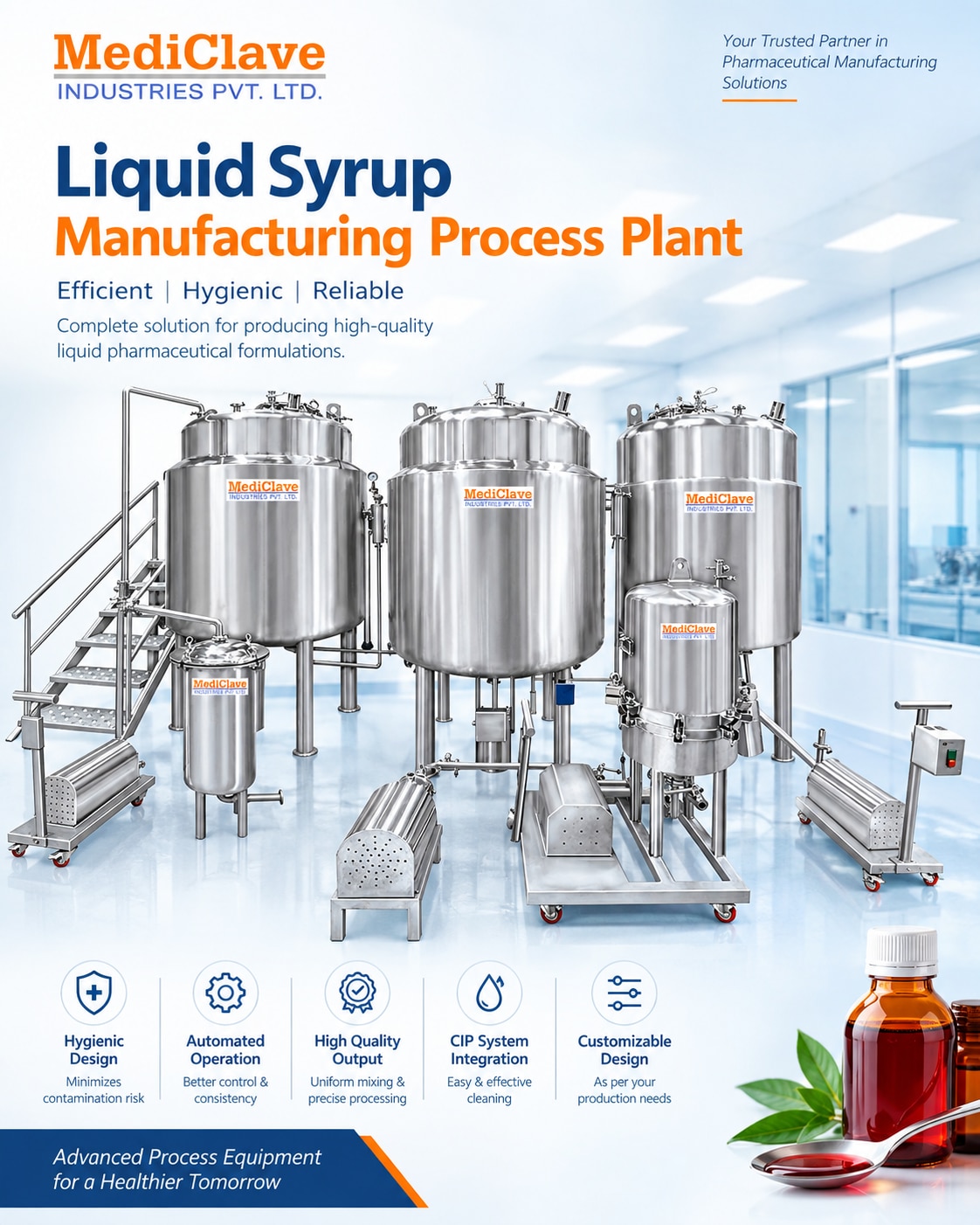
The pharmaceutical industry requires reliable, hygienic, and efficient manufacturing systems for producing high-quality liquid medicines. Among the different pharmaceutical dosage forms, liquid syrups are widely used because they are easy to administer and can be suitable for patients who have difficulty swallowing tablets or capsules. To manufacture consistent and high-quality liquid syrup products, pharmaceutical companies require a properly designed Liquid Syrup Manufacturing Process Plant.
A Liquid Syrup Manufacturing Process Plant is an integrated pharmaceutical processing system designed to support the preparation, mixing, homogenization, filtration, storage, and transfer of liquid syrup formulations. The plant can be configured according to the formulation, production capacity, process requirements, and facility layout of the pharmaceutical manufacturer.
For international pharmaceutical manufacturers, choosing the right manufacturing plant is important for achieving consistent production, hygienic processing, efficient operation, and reliable product quality.
What Is a Liquid Syrup Manufacturing Process Plant?
A Liquid Syrup Manufacturing Process Plant is a combination of pharmaceutical processing equipment used for manufacturing liquid oral formulations such as syrups, oral solutions, suspensions, and other liquid pharmaceutical products.
The plant typically includes equipment for:
- Raw material preparation
- Purified water handling
- Sugar or excipient solution preparation
- Heating and mixing
- Ingredient addition
- Homogenization
- Filtration
- Product transfer
- Intermediate storage
- Final product storage
- Cleaning and sanitization
The exact configuration depends on the formulation and production requirements.
A properly designed system helps manufacturers maintain controlled processing conditions while reducing manual handling and improving production efficiency.
Liquid Syrup Manufacturing Process
The manufacturing process generally begins with the preparation of the liquid base or vehicle. Purified water and other required ingredients are introduced into the appropriate manufacturing vessel according to the formulation.
The major steps may include:
1. Preparation of Purified Water
Purified water is an important raw material in many liquid pharmaceutical formulations. The water is transferred into the manufacturing system through a controlled process.
The quality of water used during production can have a significant impact on the final product. Therefore, pharmaceutical manufacturing facilities normally use an appropriate pharmaceutical-grade water system.
2. Preparation of Sugar Solution
Depending on the formulation, sugar or another sweetening agent may be dissolved in purified water.
The manufacturing vessel provides controlled mixing and, where required, heating to help achieve proper dissolution.
3. Addition of Ingredients
Active pharmaceutical ingredients and other formulation components are added according to the approved manufacturing procedure.
These may include:
- Active pharmaceutical ingredients
- Sweeteners
- Flavours
- Colours
- Preservatives
- Stabilizers
- Buffers
- Solubilizers
- Other pharmaceutical excipients
The order and method of addition depend on the specific formulation.
4. Mixing
Mixing is one of the most important stages of syrup manufacturing.
An appropriately designed agitator or stirrer helps distribute the ingredients throughout the batch. Proper mixing can help achieve uniformity and minimize the possibility of concentration differences within the batch.
5. Heating
Certain formulations require controlled heating during processing.
Heating can assist in dissolving ingredients and preparing the required formulation. The temperature should be controlled according to the product's validated manufacturing process.
6. Homogenization
Some formulations require additional homogenization to achieve the desired consistency and uniformity.
A homogenization system can help process the formulation according to its specific requirements.
7. Filtration
After processing, the liquid may pass through an appropriate filtration system.
Filtration can help remove unwanted particulate matter and provide the required clarity or cleanliness, depending on the product formulation and manufacturing process.
8. Storage
The processed syrup can be transferred to a suitable storage vessel before the filling operation.
Storage vessels used in pharmaceutical applications are generally designed with hygienic construction and suitable connections for product transfer.
9. Transfer to Filling Section
After the batch has completed the required processing and quality checks, the product can be transferred to the liquid filling line.
The filling system then fills the required quantity into bottles or other suitable containers.
Major Equipment Used in a Liquid Syrup Manufacturing Plant
The configuration of a Liquid Syrup Manufacturing Process Plant can vary depending on production requirements. Common equipment may include:
| Equipment | Main Function |
|---|---|
| Manufacturing Vessel | Mixing and processing of liquid formulation |
| Preparation Vessel | Preparation of sugar/excipient solutions |
| Storage Vessel | Holding processed liquid |
| Mixing System | Uniform distribution of ingredients |
| Homogenizer | Homogenization of suitable formulations |
| Filtration System | Filtration of processed liquid |
| Transfer Pump | Controlled product transfer |
| Pipeline System | Hygienic movement of product |
| Control System | Monitoring and controlling process parameters |
| CIP System | Cleaning of product-contact equipment |
The final equipment selection should be based on the formulation, batch size, process requirements, facility design, and applicable quality requirements.
Hygienic Design for Pharmaceutical Production
Hygienic construction is particularly important in pharmaceutical liquid manufacturing.
Product-contact surfaces are commonly designed to minimize areas where product residues can accumulate. Proper equipment geometry, suitable surface finishing, hygienic connections, and effective cleaning procedures can support pharmaceutical manufacturing requirements.
The plant can also be integrated with cleaning systems such as CIP (Clean-in-Place) systems where appropriate.
A suitable hygienic design can provide advantages such as:
- Reduced product contamination risks
- Easier cleaning
- Reduced product residue
- Better process consistency
- Improved operational efficiency
- Reduced manual intervention
Why Choose a Properly Designed Liquid Syrup Manufacturing Plant?
Pharmaceutical manufacturers need more than individual processing vessels. They require a complete and coordinated process system.
A properly designed plant can help with:
Consistent Batch Processing
Controlled mixing, temperature, and processing conditions can help manufacturers achieve repeatable production results.
Improved Production Efficiency
Integrated equipment and controlled product transfer can reduce unnecessary manual operations.
Better Process Control
Modern manufacturing systems can incorporate instruments and controls for monitoring important process parameters.
Flexible Production
Depending on the plant configuration, the system can be designed for manufacturing different liquid formulations.
Hygienic Manufacturing
Pharmaceutical-grade equipment construction can support hygienic processing and cleaning requirements.
Scalability
The plant can be designed according to required batch volumes and future production requirements.
Applications of Liquid Syrup Manufacturing Process Plants
Liquid manufacturing plants can be used for producing various pharmaceutical and healthcare liquid formulations, depending on the equipment configuration and validated process.
Applications may include:
- Pharmaceutical syrups
- Oral solutions
- Oral suspensions
- Pediatric liquid formulations
- Nutraceutical liquids
- Healthcare formulations
- Vitamin syrups
- Herbal liquid formulations
- Pharmaceutical liquid preparations
The suitability of the equipment depends on the individual formulation and manufacturing process.
Factors to Consider Before Purchasing a Liquid Syrup Manufacturing Plant
International pharmaceutical companies should evaluate several factors before selecting a manufacturing plant.
Production Capacity
The required batch size and annual production volume should be considered before finalizing the equipment.
Material of Construction
The material used for product-contact components should be suitable for the pharmaceutical formulation and manufacturing requirements.
Mixing Requirements
Different formulations require different mixing characteristics. The agitator design should therefore be selected according to product viscosity, batch size, and formulation requirements.
Temperature Requirements
If heating or cooling is required, the vessel and utility system should be designed accordingly.
Automation
The required level of automation should be determined based on production requirements, operator involvement, process control, and facility standards.
Cleaning Requirements
The plant should support an appropriate cleaning strategy, including manual cleaning or automated CIP where applicable.
Facility Layout
Equipment dimensions, access, piping routes, utility connections, maintenance space, and material movement should be considered during plant planning.
Customization of Liquid Syrup Manufacturing Plants
Every pharmaceutical manufacturing facility has different requirements. Therefore, a Liquid Syrup Manufacturing Process Plant can be designed according to individual project specifications.
Customization may involve:
- Batch capacity
- Vessel configuration
- Agitator design
- Heating and cooling arrangement
- Homogenization requirements
- Filtration system
- Transfer system
- Automation level
- Piping configuration
- Storage capacity
- CIP integration
- Utility requirements
A customized system allows pharmaceutical manufacturers to develop a plant around their actual production process instead of adapting their process to a standard equipment configuration.
Importance of Process Automation
Automation can play an important role in modern pharmaceutical liquid manufacturing.
Depending on the project requirements, a plant can incorporate instruments and control systems for monitoring parameters such as:
- Temperature
- Mixing speed
- Processing time
- Level
- Pressure
- Product transfer
Automation can help reduce manual intervention and improve process repeatability.
The appropriate level of automation depends on the manufacturer's production requirements and validated process.
Liquid Syrup Manufacturing Plant for International Pharmaceutical Markets
Pharmaceutical companies operating in international markets may have different facility standards, documentation requirements, and project specifications.
Therefore, the equipment manufacturer should understand the customer's intended application, production capacity, process requirements, utilities, facility layout, and applicable regulatory expectations before finalizing the system.
For international projects, important project documentation may include equipment specifications, drawings, material details, manuals, testing documentation, and other documents agreed upon during the project.
Selecting a Liquid Syrup Manufacturing Plant Manufacturer
Selecting the right manufacturer is an important step when establishing or upgrading a pharmaceutical liquid manufacturing facility.
Manufacturers should evaluate:
- Pharmaceutical equipment manufacturing experience
- Engineering capabilities
- Customization options
- Equipment construction quality
- Process understanding
- Documentation support
- Installation requirements
- After-sales support
- Spare parts availability
- Project execution capabilities
The manufacturer should be capable of understanding the complete process rather than supplying only individual equipment.
Why Mediclave Industries for Liquid Syrup Manufacturing Equipment?
Mediclave Industries Pvt. Ltd. provides pharmaceutical manufacturing equipment and process solutions for different pharmaceutical applications.
The company's approach focuses on developing equipment according to customer process requirements, production capacity, and project specifications.
For a Liquid Syrup Manufacturing Process Plant, the system can be planned around the required manufacturing stages, including preparation, mixing, homogenization, filtration, storage, and product transfer.
The equipment configuration can be discussed according to the customer's formulation, batch capacity, process parameters, and facility requirements.
Conclusion
A Liquid Syrup Manufacturing Process Plant is an important part of pharmaceutical liquid production. From raw material preparation and controlled mixing to filtration, storage, and transfer, each stage contributes to the overall manufacturing process.
For pharmaceutical companies entering new markets, expanding production, or upgrading existing facilities, selecting an appropriately designed liquid manufacturing system can support efficient and consistent production.
The right plant should be selected according to formulation requirements, batch capacity, material of construction, mixing requirements, automation, cleaning strategy, facility layout, and applicable project standards.
With suitable engineering, hygienic design, reliable equipment, and proper process control, a Liquid Syrup Manufacturing Process Plant can become an effective solution for modern pharmaceutical liquid manufacturing facilities across international markets.
Looking for a Liquid Syrup Manufacturing Process Plant for your pharmaceutical production facility? Contact Mediclave Industries Pvt. Ltd. to discuss your batch capacity, process requirements, and customized equipment configuration.
