
Introduction
In the pharmaceutical industry, ensuring sterility is critical for patient safety and regulatory compliance. Injectable products, IV fluids, ophthalmic preparations, biological products, and other sterile formulations require reliable terminal sterilization methods that eliminate microorganisms without damaging the product or packaging.
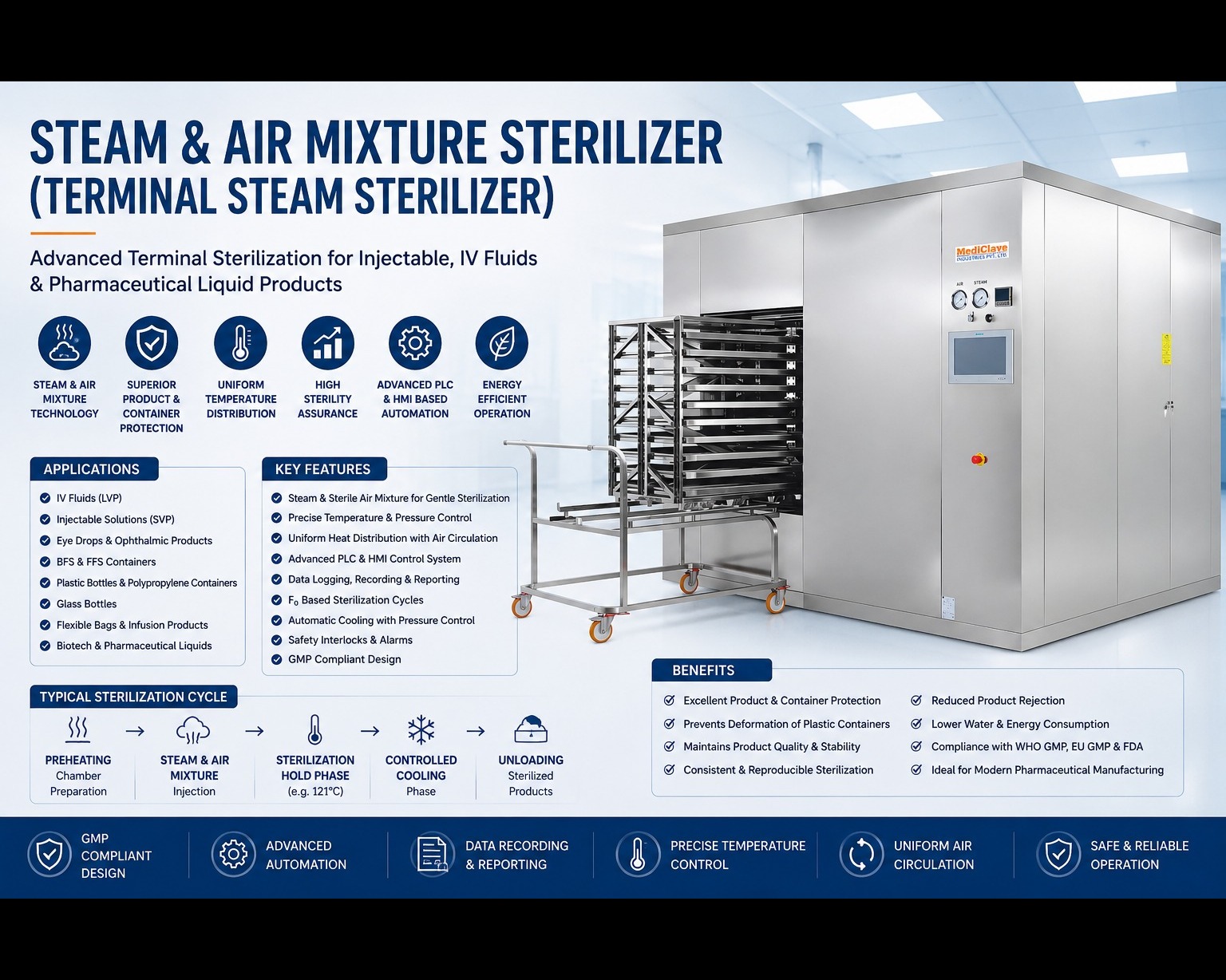
One of the most advanced technologies used today is the Steam & Air Mixture Sterilizer, also known as a Terminal Steam Sterilizer.
This sterilization technology combines saturated steam with filtered compressed air to achieve precise temperature distribution, controlled pressure, and excellent product protection during terminal sterilization.
Because of its ability to sterilize sensitive pharmaceutical products in sealed containers, Steam & Air Mixture Sterilizers have become increasingly important in modern pharmaceutical manufacturing facilities.
What is a Steam & Air Mixture Sterilizer?
A Steam & Air Mixture Sterilizer is a specialized terminal sterilization system that uses a controlled mixture of saturated steam and sterile compressed air inside a pressure chamber.
Unlike conventional steam sterilizers that rely solely on steam, this technology introduces sterile filtered air to maintain pressure and ensure uniform temperature distribution throughout the sterilization cycle.
This makes it ideal for products packaged in:
- Plastic bottles
- Polypropylene containers
- BFS containers
- FFS containers
- Flexible bags
- IV fluid containers
- Glass bottles
- Injectable product packaging
Why Terminal Sterilization is Important
Terminal sterilization is considered the highest level of sterility assurance because products are sterilized after filling and sealing.
Benefits include:
- Higher Sterility Assurance Level (SAL)
- Improved patient safety
- Reduced contamination risk
- Better product reliability
- Regulatory acceptance
- Longer shelf life
For pharmaceutical manufacturers, terminal sterilization is often the preferred sterilization method whenever product stability allows.
Working Principle of Steam & Air Mixture Sterilizer
Step 1: Product Loading
Sealed pharmaceutical products are loaded into the sterilization chamber.
Typical products include:
- IV fluids
- Injectable solutions
- Eye drops
- Dialysis solutions
- Biotechnology products
Step 2: Chamber Pressurization
Filtered sterile air is introduced into the chamber.
The air helps maintain pressure and protects sensitive containers during the sterilization cycle.
Step 3: Steam Injection
Saturated steam enters the chamber and mixes with sterile air.
Special circulation systems ensure:
- Uniform heat distribution
- Consistent temperature
- Effective sterilization
Step 4: Sterilization Hold Phase
The load is maintained at validated sterilization conditions.
Common cycles include:
- 121°C cycles
- F₀-based sterilization cycles
- Customized pharmaceutical cycles
Step 5: Controlled Cooling
After sterilization, the load is cooled while chamber pressure is maintained.
This prevents:
- Bottle deformation
- Container collapse
- Product damage
Step 6: Product Unloading
Sterilized products are unloaded and transferred for further processing or packaging.
Major Components of Steam & Air Mixture Sterilizer
Sterilization Chamber
Manufactured from pharmaceutical-grade stainless steel.
Steam Distribution System
Provides saturated steam throughout the chamber.
Sterile Air System
Supplies filtered compressed air.
Air Circulation Fans
Ensure uniform temperature distribution.
PLC & HMI Control System
Provides:
- Recipe management
- Batch recording
- Data logging
- Process monitoring
Pressure Control System
Protects product packaging during sterilization.
Cooling System
Allows controlled product cooling after sterilization.
Applications of Steam & Air Mixture Sterilizers
Pharmaceutical Industry
Used for:
- Injectable products
- IV fluids
- Ophthalmic solutions
- Dialysis solutions
- Sterile liquids
Biotechnology Industry
Used for:
- Biological products
- Biotechnology formulations
- Sterile media
Healthcare Industry
Used for:
- Specialized sterile products
- Medical formulations
Products Suitable for Steam & Air Mixture Sterilization
Plastic Bottles
- IV fluids
- Infusion solutions
Polypropylene Containers
- Injectable products
- Sterile liquids
BFS Containers
- Eye drops
- Pharmaceutical liquids
FFS Containers
- Sterile formulations
Flexible Bags
- Medical solutions
- Infusion products
Glass Containers
- Injectable products
- Sterile liquids
Key Benefits of Steam & Air Mixture Sterilizer
Excellent Temperature Uniformity
Provides highly uniform temperature distribution throughout the chamber.
Product Protection
Reduces risk of overheating and thermal damage.
Container Protection
Prevents collapse of plastic containers during sterilization.
High Sterility Assurance
Achieves reliable microbial destruction.
Faster Heat Transfer
Provides efficient sterilization performance.
Reduced Product Rejection
Protects packaging integrity and product quality.
GMP Compliance
Supports pharmaceutical regulatory requirements.
Energy Efficient Operation
Optimized sterilization cycles reduce utility consumption.
Steam & Air Mixture Sterilizer vs Water Shower Sterilizer
| Feature | Steam & Air Mixture | Water Shower |
|---|---|---|
| Heating Medium | Steam + Air | Water Spray |
| Temperature Uniformity | Excellent | Excellent |
| Container Protection | Excellent | Excellent |
| Water Consumption | Low | Higher |
| Maintenance | Lower | Moderate |
| Energy Efficiency | High | High |
Steam & Air Mixture Sterilizer vs Saturated Steam Sterilizer
| Feature | Steam & Air Mixture | Saturated Steam |
|---|---|---|
| Pressure Control | Advanced | Standard |
| Plastic Containers | Excellent | Limited |
| Flexible Packaging | Excellent | Moderate |
| Product Protection | Excellent | Good |
| Temperature Uniformity | Excellent | Very Good |
GMP and Regulatory Requirements
Steam & Air Mixture Sterilizers must comply with:
- WHO GMP
- EU GMP
- FDA Requirements
- PIC/S Guidelines
- Annex 1 Requirements
- Data Integrity Guidelines
Proper validation and documentation are mandatory.
Validation Requirements
Design Qualification (DQ)
Equipment design verification.
Installation Qualification (IQ)
Installation verification.
Operational Qualification (OQ)
Operational testing.
Performance Qualification (PQ)
Performance verification.
Heat Distribution Study
Temperature uniformity testing.
Heat Penetration Study
Product sterilization verification.
F₀ Validation
Sterility assurance verification.
Common Challenges and Solutions
Uneven Temperature Distribution
Solution:
Advanced circulation fan systems.
Container Deformation
Solution:
Precise pressure control.
Product Quality Changes
Solution:
Optimized sterilization recipes.
Validation Complexity
Solution:
Comprehensive thermal mapping studies.
Future of Steam & Air Mixture Sterilizers
The future of pharmaceutical sterilization is moving toward smarter and more automated systems.
Industry 4.0 Integration
Real-time monitoring and analytics.
Electronic Batch Records
Paperless GMP compliance.
AI-Based Process Optimization
Artificial Intelligence will help optimize sterilization cycles, reduce energy consumption, and improve process consistency.
Predictive Maintenance
AI-powered systems will predict maintenance requirements before failures occur.
Digital Validation Systems
Automated validation and reporting.
Remote Diagnostics
Manufacturers can monitor equipment performance remotely.
Energy-Efficient Technologies
Future systems will consume less steam, water, and electricity.
Sustainable Pharmaceutical Manufacturing
Lower carbon footprint and environmental impact.
Why Pharmaceutical Companies Prefer Steam & Air Mixture Sterilizers
Pharmaceutical manufacturers increasingly choose this technology because it offers:
✅ Superior product protection
✅ Excellent container integrity
✅ Reliable sterility assurance
✅ GMP compliance
✅ Reduced rejection rates
✅ Improved operational efficiency
✅ Lower lifecycle costs
✅ Compatibility with modern packaging formats
How to Choose the Right Steam & Air Mixture Sterilizer
Consider:
- Chamber size
- Production volume
- Product type
- Container type
- Automation level
- Validation support
- Utility requirements
- Regulatory compliance
- Service support
Selecting the right equipment ensures long-term reliability and regulatory success.
Conclusion
Steam & Air Mixture Sterilizers Ahmedabad represent one of the most advanced terminal sterilization technologies available for pharmaceutical manufacturing today.
Their ability to combine saturated steam with sterile compressed air provides excellent temperature uniformity, superior container protection, high sterility assurance, and regulatory compliance.
As pharmaceutical manufacturing continues to evolve toward Industry 4.0, AI-driven automation, and sustainable production, Steam & Air Mixture Sterilizers will play an increasingly important role in ensuring safe, effective, and compliant sterile products.
FAQs
What is a Steam & Air Mixture Sterilizer?
A terminal sterilization system that uses a controlled mixture of saturated steam and sterile compressed air to sterilize pharmaceutical products in sealed containers.
What products can be sterilized?
IV fluids, injectable products, eye drops, BFS containers, FFS containers, plastic bottles, flexible bags, and glass containers.
Why is sterile air used?
Sterile air helps maintain pressure and protects containers during sterilization.
Is it suitable for plastic containers?
Yes. It is one of the best sterilization technologies for plastic pharmaceutical packaging.
Is it GMP compliant?
Yes. When properly validated, it fully supports WHO GMP, EU GMP, FDA, and Annex 1 requirements.
What is the future of Steam & Air Mixture Sterilizers?
Future systems will include AI-based optimization, Industry 4.0 connectivity, predictive maintenance, remote diagnostics, and energy-efficient operation.