

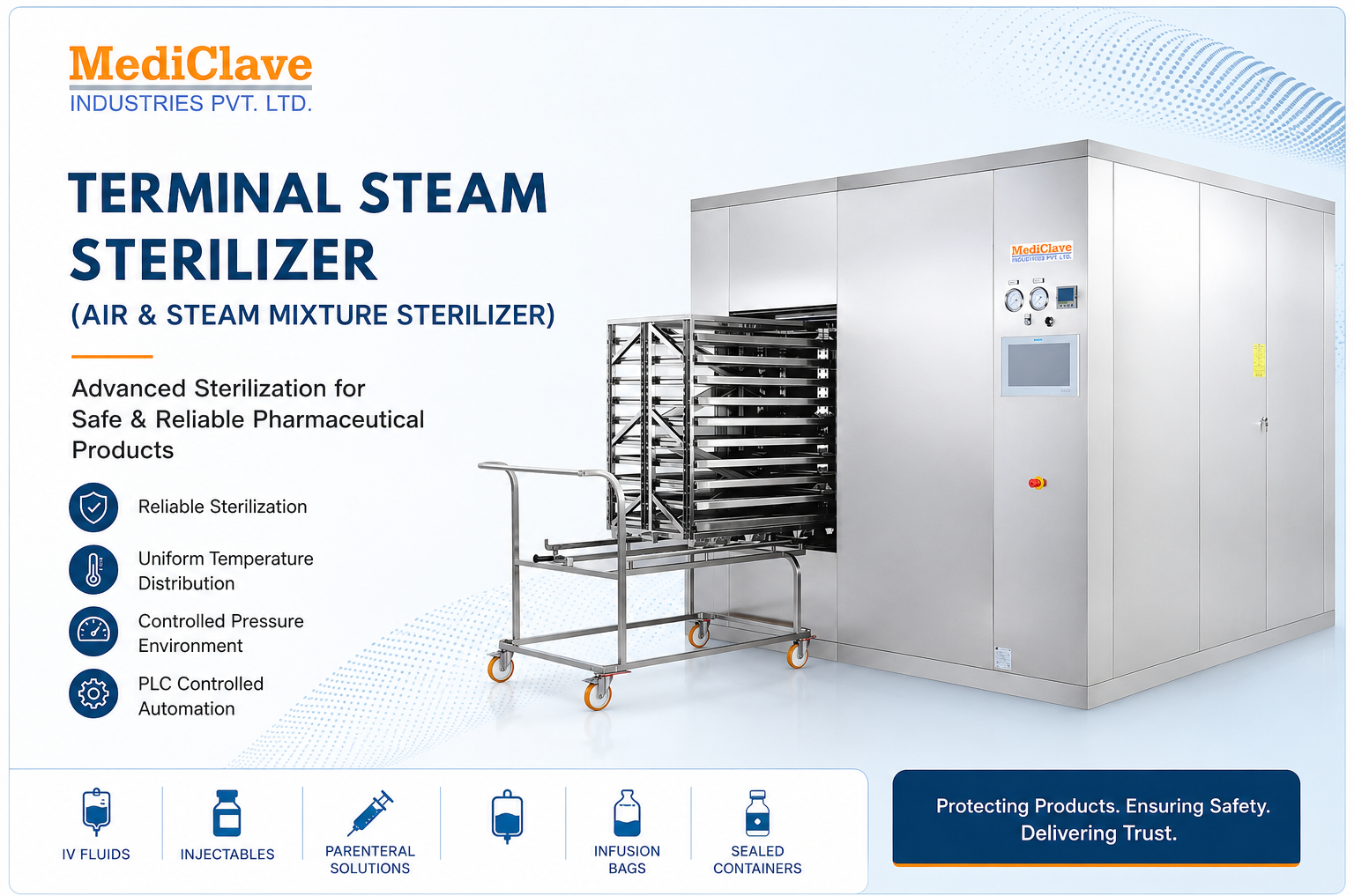
What Makes a Terminal Steam Sterilizer (Air & Steam Mixture Sterilizer) Essential for Modern Pharmaceutical Manufacturing?
Sterilization is one of the most important steps in pharmaceutical manufacturing. A medicine may be perfectly formulated, correctly filled, and carefully packaged, but if the final product is not properly sterilized, its safety and quality can be compromised. This is especially important for injectable products, IV fluids, parenteral solutions, ophthalmic products, and other pharmaceutical preparations that are supplied in sealed containers.
For these applications, Terminal Steam Sterilizer (Air & Steam Mixture Sterilizer) technology provides an advanced approach to achieving reliable terminal sterilization while protecting the product and its packaging. Instead of relying only on steam, an air and steam mixture can be carefully controlled to provide effective heat transfer while helping manage pressure around sealed containers.
Mediclave Industries Pvt. Ltd. offers advanced pharmaceutical sterilization equipment designed around the practical needs of modern manufacturing facilities. Its Steam + Air Mixture Sterilizer & Terminal Steam Sterilizer is intended for applications where temperature uniformity, pressure control, product protection, and repeatable sterilization are important.
Understanding Terminal Steam Sterilization
Terminal sterilization means sterilizing a pharmaceutical product after it has been filled into its final container and completely sealed. This is different from sterilizing an empty container or production component before filling.
The major advantage is simple: once the product has been sterilized inside its final sealed package, there is less opportunity for contamination to occur during later handling. This makes terminal sterilization an important part of the contamination-control strategy for suitable pharmaceutical products.
Typical applications can include IV fluids, parenteral solutions, injectable products, infusion fluids, suitable ophthalmic preparations, sealed pharmaceutical liquids, and other products whose formulation and packaging can tolerate the validated sterilization cycle. The actual cycle must always be developed and validated for the specific product and container combination.
This is where the Terminal Steam Sterilizer becomes particularly valuable. It is designed not simply to heat a product, but to provide controlled and repeatable processing conditions throughout the entire load.
What Is a Terminal Steam Sterilizer with Air & Steam Mixture Technology?
A Terminal Steam Sterilizer with air and steam mixture technology is a pharmaceutical sterilization system that uses controlled saturated steam together with filtered air. Steam provides efficient heat transfer, while controlled air pressure helps manage the pressure conditions inside the chamber.
This is especially useful when products are packed in sealed or flexible containers. During heating, the pressure inside a sealed liquid container can increase. If the pressure outside the container is not appropriately controlled, the container may swell, deform, leak, or experience stress around its seal.
A controlled steam-air mixture helps create a more balanced environment around the product. Modern systems can combine steam circulation, air circulation, temperature monitoring, pressure control, and controlled cooling to support uniform sterilization while helping protect packaging integrity.
The technology can be suitable for applications involving IV bags, flexible pharmaceutical bags, plastic containers, PP containers, sealed liquid containers, pre-filled syringes, infusion products, and suitable parenteral solutions.
Why Is Pressure Control So Important?
Temperature is only one part of a successful sterilization cycle. Pressure also plays an important role, particularly when the load consists of sealed containers containing liquids.
Imagine a sealed IV bag placed inside a conventional steam sterilizer. As the temperature rises, the liquid and air inside the bag respond to the changing thermal conditions. At the same time, the chamber pressure changes. If the pressure difference between the inside and outside of the container becomes too large, the packaging can become stressed.
For flexible containers, this may result in swelling or deformation. For other packaging formats, excessive pressure differences can contribute to seal stress or other packaging problems.
A steam and air mixture system addresses this challenge by using controlled air pressure along with steam. The objective is to create suitable external pressure conditions while maintaining the temperature needed for the validated sterilization process.
This makes pressure management one of the key reasons manufacturers consider a Terminal Steam Sterilizer (Air & Steam Mixture Sterilizer) for sensitive pharmaceutical products.
How Does a Terminal Steam Sterilizer Work?
Although the exact sequence depends on the machine configuration and validated process, the basic operating principle can be understood through several stages.
First, the products are loaded into the sterilization chamber. Depending on the facility design, loading may be manual, trolley-based, or integrated with an automated handling arrangement.
The chamber is then prepared for the sterilization cycle. Air removal or conditioning takes place according to the selected process. Proper air management is important because uncontrolled air pockets can affect heat distribution.
Next, saturated steam and filtered air are introduced and circulated under controlled conditions. A recirculation system helps distribute the steam-air mixture throughout the chamber. Heat exchangers and circulation arrangements can be configured to support rapid and uniform heat transfer.
During the sterilization phase, the system maintains the required temperature and pressure conditions for the validated holding period. Sensors continuously monitor important process parameters.
Once the sterilization stage is complete, controlled cooling begins. This stage is especially important for sealed liquid products because sudden pressure changes can place stress on containers. Controlled air and cooling conditions help the products return gradually toward their required unloading condition.
Finally, once the cycle has completed successfully, the products can be unloaded for inspection, secondary packaging, storage, or the next approved manufacturing step.
The purpose of the entire process is not simply to reach a particular temperature. The objective is to achieve a validated and repeatable sterilization cycle while maintaining product and container integrity.
What Products Can Be Processed?
One of the major strengths of steam-air mixture technology is its suitability for different types of sealed pharmaceutical products.
Depending on the validated process, applications may include:
IV fluids
Large-volume parenteral solutions
Injectable pharmaceutical products
Infusion solutions
Sealed plastic bottles
PP containers
Flexible bags
Pre-filled syringes
Blood bags for suitable controlled-temperature applications
Ampoules
Sealed pharmaceutical liquids
Certain ophthalmic products
Selected biotechnology products
The exact suitability of any product should always be determined through formulation studies, packaging compatibility assessments, process development, and sterilization validation.
For manufacturers working with different sterilization requirements, it can also be useful to consider other technologies within the pharmaceutical sterilization portfolio. For example, a Saturated Steam Sterilizer (Autoclave) is well suited to many conventional steam-sterilization applications involving suitable pharmaceutical components, equipment, and heat-resistant loads.
What Are the Main Advantages of Air & Steam Mixture Sterilization?
A well-designed Terminal Steam Sterilizer can offer several important advantages to pharmaceutical manufacturers.
Uniform heat distribution is one of the first benefits. A properly designed circulation system helps distribute the steam-air mixture throughout the chamber, reducing temperature variation and supporting consistent exposure across the load.
Controlled pressure is another major advantage. By introducing filtered air in a controlled manner, the system can help manage chamber pressure independently from the temperature conditions required by the process. This is particularly valuable for sealed flexible containers.
Better container protection can also help reduce the risk of deformation, swelling, leakage, or packaging damage. Protecting the container is important because sterilization should not solve one problem while creating another.
Repeatable processing is equally important. Pharmaceutical manufacturers need cycles that can be reproduced from batch to batch. Automated control of temperature, pressure, timing, and other process parameters can support consistent operation.
Improved product integrity is another consideration. A properly developed terminal sterilization process should provide microbial control without unnecessarily exposing the product to damaging thermal conditions.
Finally, a modern pharmaceutical sterilizer can support documentation and validation activities through automated monitoring and data recording.
What Features Should You Look for in a Terminal Steam Sterilizer?
Choosing a terminal sterilizer is a major investment, so manufacturers should look beyond the basic chamber size.
A modern system may include a hygienically designed stainless-steel chamber, steam distribution arrangement, filtered air supply, air circulation system, heat exchangers, temperature sensors, pressure sensors, PLC controls, HMI interface, safety interlocks, automatic door locking, data recording, and validation-related features.
Mediclave's Steam + Air Mixture Sterilizer & Terminal Steam Sterilizer is described with SS316L product-contact construction, PLC/HMI-based process control, controlled steam and air circulation, and a design intended for pharmaceutical applications.
The exact specification should be selected according to the product, container, batch size, facility utilities, production capacity, automation requirements, and validation strategy.
How Does It Compare with Conventional Saturated Steam Sterilization?
Saturated steam sterilization remains one of the most established and widely used sterilization methods. It provides excellent heat transfer because steam releases significant latent heat when it condenses on cooler surfaces. It is highly suitable for many heat-resistant pharmaceutical components, production accessories, equipment parts, glassware, and other appropriate loads.
However, sealed liquid products and flexible containers can present a different challenge.
A conventional saturated steam process may not provide the same level of pressure control required by certain flexible or deformable containers. Steam-air mixture technology is therefore particularly useful where the relationship between temperature, pressure, packaging, and product integrity must be carefully controlled.
The choice should never be based simply on which machine appears more advanced. The correct sterilization technology depends on the product, container, formulation, heat sensitivity, packaging material, batch configuration, and validated process.
How Is It Different from a Super Heated Water Shower Sterilizer?
Another technology commonly considered for terminal sterilization is the Super Heated Water Shower Sterilizer.
Instead of using a steam-air mixture as the primary heat-transfer medium, this technology circulates heated water and distributes it over the product load through spray nozzles. It can provide uniform heat transfer and is particularly useful for sealed containers and products where thermal stress and packaging protection are important.
Mediclave's Super Heated Water Shower Sterilizer is designed for applications such as injectable products, IV fluids, ampoules, vials, infusion bags, and other suitable pharmaceutical products.
The choice between steam-air mixture and water-shower technology should be based on the specific product and validated process rather than a general assumption that one method is always better.
Where Does a Dry Heat Sterilizer Fit?
Not every pharmaceutical material is suitable for steam or water-based sterilization.
Glassware, certain metal components, powders, oils, empty containers, and other moisture-sensitive materials may require dry heat treatment. A Dry Heat Sterilizer uses controlled hot air rather than steam and is widely used for suitable pharmaceutical and laboratory materials.
Mediclave's Dry Heat Sterilizer is designed for controlled high-temperature processing and can be used for applications including glass vials, ampoules, metal components, glassware, and suitable heat-resistant materials.
This illustrates an important point: a pharmaceutical facility may need several sterilization technologies because different products and materials have different processing requirements.
Why Is Validation Important?
In pharmaceutical manufacturing, installing a sterilizer is only the beginning. The sterilization process must be demonstrated to perform consistently and reliably.
Validation helps establish that the equipment and process can achieve the required results under defined operating conditions. Depending on the project and applicable standards, this may involve activities such as Design Qualification (DQ), Installation Qualification (IQ), Operational Qualification (OQ), and Performance Qualification (PQ).
Process development should consider the actual product and load configuration. Temperature distribution, heat penetration, pressure behavior, holding time, cooling performance, load pattern, container integrity, and other critical parameters may need to be evaluated.
A cycle should not simply be copied from another product because two products may behave differently during heating and cooling. The sterilization cycle should be scientifically developed and validated for the intended application.
This is one reason it is important to work with an experienced sterilization equipment manufacturer that understands not only machine construction but also the practical requirements of pharmaceutical processing.
How Can a Sterilizer Support a Larger Pharmaceutical Production System?
A terminal sterilizer rarely works completely alone. It forms part of a larger pharmaceutical manufacturing and contamination-control system.
For example, a facility may use a Pure Steam Generator to produce high-purity steam for suitable sterilization and SIP applications. Pure steam systems are important where steam quality is a critical part of the pharmaceutical process.
Similarly, CIP & SIP Systems can support cleaning and sterilization of process equipment, tanks, pipelines, and other systems.
For facilities processing rubber closures and pharmaceutical stoppers, a Rubber Bung Processor Cum Steam Sterilizer can combine washing, rinsing, processing, and steam sterilization functions in an integrated system.
This integrated approach can help manufacturers build a more complete and controlled sterile manufacturing environment.
What Should You Consider Before Buying a Terminal Steam Sterilizer?
Before purchasing equipment, manufacturers should clearly define their process requirements.
Start with the product. Understand its formulation, thermal stability, container type, fill volume, packaging material, and expected sterilization conditions.
Next, consider the production load. How many units need to be processed per batch? What is the required batch frequency? What chamber configuration will provide practical loading and unloading?
The container is equally important. Glass bottles, plastic bottles, IV bags, flexible bags, syringes, and other containers can behave differently during heating and cooling.
Utilities should also be evaluated. Steam quality, compressed air quality, electrical supply, cooling arrangements, water requirements, drainage, and installation space can all influence the final system design.
Automation is another important consideration. A modern PLC and HMI system can make recipe management, monitoring, alarms, interlocks, and cycle documentation easier. Depending on the facility's requirements, data logging and integration with plant systems may also be considered.
Finally, discuss validation and documentation before finalizing the purchase. Equipment documentation, material certificates, drawings, manuals, calibration information, and qualification support can be important parts of a pharmaceutical equipment project.
Why Choose Mediclave Industries for Pharmaceutical Sterilization Equipment?
Mediclave Industries Pvt. Ltd. focuses on sterilization and pharmaceutical process equipment for demanding healthcare and manufacturing environments. Its product range includes pharmaceutical sterilization systems such as Steam + Air Mixture Sterilizers, Terminal Steam Sterilizers, Saturated Steam Sterilizers, Dry Heat Sterilizers, Super Heated Water Shower Sterilizers, and other specialized equipment.
The company's Steam + Air Mixture Sterilizer & Terminal Steam Sterilizer is positioned for applications where uniform temperature distribution, controlled pressure, product protection, hygienic construction, and reliable process control are important.
Mediclave also emphasizes pharmaceutical-grade construction, automation, customization, and validation-oriented solutions. This allows equipment selection to be based on the actual production requirement rather than forcing every application into one standard machine configuration.
Final Thoughts
A Terminal Steam Sterilizer (Air & Steam Mixture Sterilizer) is much more than a conventional steam chamber. It is an advanced pharmaceutical process system designed to balance effective sterilization with product and packaging protection.
For sealed pharmaceutical products, particularly liquid-filled and flexible containers, controlling both temperature and pressure can be critical. The combination of steam and filtered air can help create a controlled sterilization environment, improve heat distribution, reduce the risk of container deformation, and support consistent processing.
However, the best sterilization solution is always application-specific. Some products may be better suited to saturated steam, others to dry heat, and others to superheated water shower technology. The right decision should be based on product characteristics, packaging, batch size, process requirements, utilities, validation needs, and regulatory expectations.
For pharmaceutical manufacturers looking for a reliable terminal sterilization solution, Mediclave Industries can help evaluate the application and develop an appropriate equipment configuration. With the right sterilization technology, careful process development, and proper validation, manufacturers can strengthen product quality, improve process consistency, and support safer pharmaceutical production.
Frequently Asked Questions
What is a Terminal Steam Sterilizer?
A Terminal Steam Sterilizer is used to sterilize suitable pharmaceutical products after they have been filled and sealed in their final containers. It is particularly useful when terminal sterilization is appropriate for the product and packaging.
What is an Air & Steam Mixture Sterilizer?
It is a sterilization system that combines controlled steam with filtered air. The steam provides heat transfer while controlled air pressure helps manage pressure conditions around sealed products.
Why is air mixed with steam during sterilization?
Controlled air can help balance chamber pressure, particularly when processing sealed or flexible containers. This can reduce the risk of deformation or packaging damage during heating and cooling.
Which products can be processed in a Steam & Air Mixture Sterilizer?
Suitable applications can include IV bags, parenteral solutions, infusion fluids, sealed plastic containers, flexible pharmaceutical bags, pre-filled syringes, and other products whose formulation and packaging are compatible with the validated process.
Is terminal sterilization better than aseptic processing?
Neither approach is universally better. Terminal sterilization can provide strong sterility assurance when the product and packaging can tolerate the validated process. If a product cannot withstand terminal sterilization, aseptic processing may be required.
Can the sterilization cycle be customized?
Yes. Sterilization cycles are developed according to product characteristics, container type, load configuration, thermal behavior, and validated process requirements.
What is the role of PLC and HMI in a terminal sterilizer?
PLC and HMI systems can automate and monitor important parameters such as temperature, pressure, time, cycle stages, alarms, and process recipes.
Does the equipment require validation?
Pharmaceutical sterilization equipment and processes generally require appropriate qualification and validation according to the applicable regulatory and quality requirements. The exact documentation and qualification strategy depends on the project.
Can Mediclave customize the sterilizer?
Equipment configuration can be developed according to application requirements such as chamber capacity, loading arrangement, automation level, process parameters, and facility utilities.
How can I select the right sterilization technology for my product?
Consider the product formulation, heat sensitivity, container material, fill volume, packaging, batch size, required sterility assurance, cooling requirements, and validated process conditions. A technical discussion with the sterilization equipment manufacturer can help identify the most suitable technology.
If your facility is planning a new sterile manufacturing line, upgrading existing sterilization capacity, or looking for a suitable solution for IV fluids, parenteral products, injectable liquids, or other sealed pharmaceutical products, Mediclave Industries Pvt. Ltd. can help you evaluate the application and identify the appropriate sterilization system.
Mediclave Industries Pvt. Ltd.
Ahmedabad, Gujarat, India
Email: info@mediclaveindustries.com
Phone: +91 8042755106
Website: https://www.mediclaveindustries.in/



