
Sterilization is one of the most critical processes in pharmaceutical manufacturing, biotechnology facilities, laboratories, and healthcare industries. While steam sterilization is widely used, certain products and materials cannot withstand moisture exposure. In such cases, Dry Heat Sterilizers provide an effective and reliable sterilization solution.
A Dry Heat Sterilizer uses high temperatures and controlled airflow to eliminate microorganisms, bacterial spores, and pyrogens from pharmaceutical components. These systems are especially important for sterilizing glassware, metal instruments, ampoules, vials, powders, and moisture-sensitive materials.
In this comprehensive guide, we will explore the working principle, sterilization process, depyrogenation applications, validation requirements, and advantages of Dry Heat Sterilizers.
What is a Dry Heat Sterilizer?
A Dry Heat Sterilizer is a specialized sterilization system that uses hot air at elevated temperatures to destroy microorganisms and bacterial contaminants without the use of steam or moisture.
Unlike autoclaves, which rely on saturated steam, dry heat sterilizers utilize controlled heating and forced air circulation to achieve sterilization and depyrogenation.
These systems are extensively used in:
- Pharmaceutical manufacturing
- Biotechnology facilities
- Research laboratories
- Healthcare institutions
- Medical device manufacturing
What is Dry Heat Sterilization?
Dry heat sterilization is a process that destroys microorganisms using high temperatures in the absence of moisture.
The process works through:
- Oxidation of cellular components
- Protein denaturation
- Destruction of microbial cells
- Elimination of bacterial spores
- Removal of pyrogens
This method is particularly suitable for materials that may be damaged by steam sterilization.
Why is Dry Heat Sterilization Important?
Many pharmaceutical products and materials cannot be sterilized using steam.
Examples include:
- Glass vials
- Ampoules
- Stainless steel parts
- Metal instruments
- Powders
- Oils
- Petroleum-based products
Dry heat sterilization ensures these materials remain sterile without introducing moisture.
Principle of Dry Heat Sterilization
The principle of dry heat sterilization is based on the transfer of thermal energy through hot air circulation.
High temperatures destroy microorganisms through:
Oxidation
Cellular components are oxidized, resulting in microbial death.
Protein Denaturation
Microbial proteins become inactive at elevated temperatures.
Membrane Damage
Cell membranes lose integrity and functionality.
Endotoxin Destruction
High temperatures destroy bacterial endotoxins that cannot be removed by conventional sterilization methods.
This makes dry heat sterilizers particularly valuable for depyrogenation applications.
What is Depyrogenation?
Depyrogenation is the process of removing or destroying pyrogens from pharmaceutical components.
Pyrogens are substances that can cause fever and adverse reactions when introduced into the human body.
The most common pyrogens are bacterial endotoxins.
Depyrogenation is critical for:
- Injectable drug manufacturing
- Vaccine production
- Sterile pharmaceutical products
- Intravenous solutions
Dry Heat Sterilizers are widely used as Depyrogenation Ovens because they can destroy endotoxins at high temperatures.
Difference Between Sterilization and Depyrogenation
| Parameter | Sterilization | Depyrogenation |
|---|---|---|
| Purpose | Kill Microorganisms | Destroy Pyrogens |
| Target | Bacteria, Fungi, Spores | Endotoxins |
| Temperature | Lower | Higher |
| Pharmaceutical Requirement | Essential | Critical for Injectables |
| Application | General Sterility | Injectable Manufacturing |
Many pharmaceutical facilities require both sterilization and depyrogenation processes.
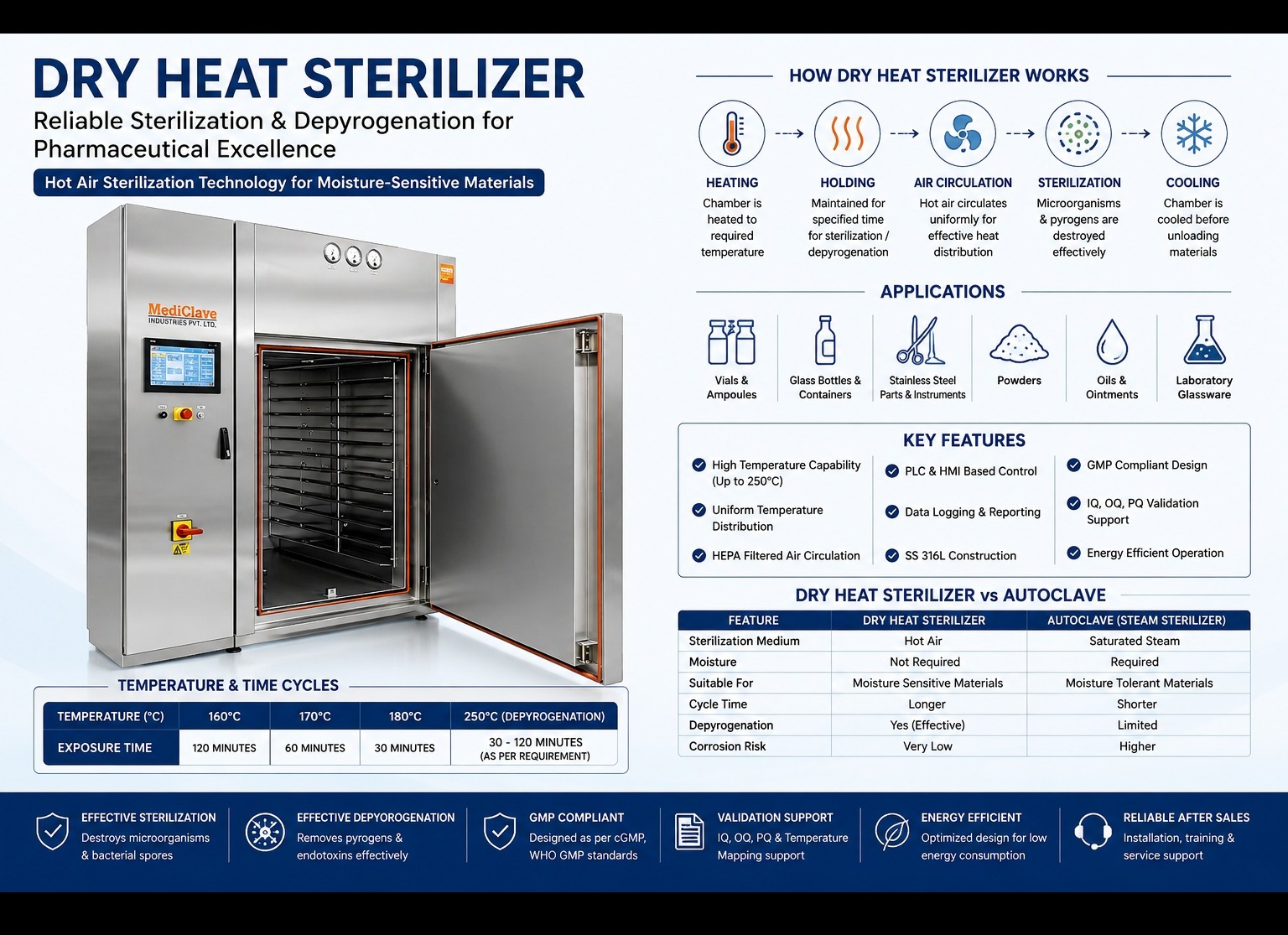
How Does a Dry Heat Sterilizer Work?
A Dry Heat Sterilizer operates through controlled heating and air circulation.
The process consists of several stages.
Step 1: Loading
Materials are loaded into the sterilization chamber.
Examples include:
- Glass bottles
- Ampoules
- Vials
- Stainless steel accessories
Step 2: Heating Phase
Heating elements gradually raise the chamber temperature.
Hot air is circulated evenly throughout the chamber.
Step 3: Holding Phase
The required sterilization temperature is maintained for a specified duration.
This phase ensures complete microbial destruction.
Step 4: Cooling Phase
After sterilization, the chamber is cooled under controlled conditions.
Step 5: Unloading
Sterile components are removed for further processing or packaging.
Standard Temperature and Time Cycles
The effectiveness of dry heat sterilization depends on temperature and exposure time.
| Temperature | Exposure Time |
|---|---|
| 160°C | 120 Minutes |
| 170°C | 60 Minutes |
| 180°C | 30 Minutes |
| 250°C | Depyrogenation Applications |
The exact cycle depends on product characteristics and validation requirements.
Major Components of a Dry Heat Sterilizer
1. Sterilization Chamber
The chamber is designed to provide uniform heat distribution and maintain sterile conditions.
Features
- Stainless steel construction
- GMP-compliant design
- High-temperature resistance
2. Heating System
Generates the required thermal energy for sterilization.
3. Air Circulation System
Ensures uniform temperature distribution throughout the chamber.
4. HEPA Filtration System
Provides filtered air during operation and cooling.
Benefits
- Reduced contamination risk
- Controlled airflow
- Clean operation
5. PLC & HMI Control System
Modern dry heat sterilizers include automated controls.
Functions
- Temperature control
- Cycle management
- Alarm monitoring
- Data logging
- Batch recording
6. Sensors and Monitoring Devices
Monitor:
- Temperature
- Pressure
- Airflow
- Process performance
Applications of Dry Heat Sterilizers
Pharmaceutical Industry
Used for sterilizing pharmaceutical components.
Applications include:
- Glass vials
- Ampoules
- Stainless steel accessories
- Manufacturing parts
Biotechnology Industry
Used in sterile manufacturing environments.
Medical Device Industry
Sterilizes moisture-sensitive medical devices.
Laboratories
Used for sterilizing glassware and instruments.
Research Facilities
Supports contamination-free research processes.
Dry Heat Sterilizer for Vials and Ampoules
One of the most important applications is the sterilization and depyrogenation of:
- Glass vials
- Glass ampoules
- Containers
- Closures
These components are widely used in injectable drug manufacturing.
Proper depyrogenation ensures patient safety and regulatory compliance.
Dry Heat Sterilizer vs Autoclave
| Feature | Dry Heat Sterilizer | Autoclave |
|---|---|---|
| Sterilization Medium | Hot Air | Saturated Steam |
| Moisture Required | No | Yes |
| Suitable for Powders | Yes | No |
| Suitable for Oils | Yes | No |
| Suitable for Glassware | Excellent | Good |
| Depyrogenation | Yes | Limited |
| Sterilization Speed | Slower | Faster |
Both systems have important roles in pharmaceutical manufacturing.
Advantages of Dry Heat Sterilizers
Moisture-Free Sterilization
Ideal for moisture-sensitive products.
Effective Depyrogenation
Destroys bacterial endotoxins.
Suitable for Glassware
Widely used for ampoules and vials.
Corrosion-Free Process
No moisture means reduced corrosion risks.
High Reliability
Provides consistent sterilization performance.
Regulatory Compliance
Supports GMP manufacturing requirements.
Limitations of Dry Heat Sterilization
While highly effective, dry heat sterilization has certain limitations.
Longer Cycle Times
Requires extended exposure periods.
Higher Energy Consumption
Operates at elevated temperatures.
Not Suitable for Heat-Sensitive Materials
Certain products may degrade under high temperatures.
GMP Requirements for Dry Heat Sterilizers
Pharmaceutical dry heat sterilizers must comply with:
WHO GMP
Supports pharmaceutical quality standards.
US FDA Guidelines
Required for regulated markets.
EU GMP Requirements
Ensures international compliance.
cGMP Standards
Promotes consistent manufacturing practices.
Validation of Dry Heat Sterilizers
Validation is essential before commercial operation.
Installation Qualification (IQ)
Confirms proper installation.
Operational Qualification (OQ)
Verifies operating performance.
Performance Qualification (PQ)
Confirms consistent sterilization effectiveness.
Temperature Mapping
Ensures uniform temperature distribution throughout the chamber.
Temperature mapping is one of the most important validation activities for Dry Heat Sterilizers.
How to Choose the Right Dry Heat Sterilizer?
Consider the following factors before selecting equipment.
Chamber Capacity
Choose a size based on production requirements.
Temperature Range
Ensure compatibility with sterilization and depyrogenation needs.
Automation Features
Look for PLC and HMI controls.
GMP Compliance
Verify pharmaceutical-grade design.
Validation Support
Ensure IQ, OQ, and PQ documentation availability.
After-Sales Service
Select a manufacturer with strong technical support.
Why Choose Mediclave Industries for Dry Heat Sterilizers?
Mediclave Industries manufactures advanced Dry Heat Sterilizers and Depyrogenation Ovens designed for pharmaceutical and biotechnology industries.
Our systems provide:
- GMP-Compliant Design
- SS316L Construction
- HEPA Filtration
- Uniform Temperature Distribution
- PLC-Based Automation
- Data Logging Capability
- Validation Documentation Support
- Customized Chamber Sizes
- Reliable After-Sales Service
Our solutions help pharmaceutical manufacturers achieve superior sterilization performance while meeting stringent regulatory requirements.
Frequently Asked Questions (FAQs)
What is a Dry Heat Sterilizer?
A Dry Heat Sterilizer is equipment that uses hot air and high temperatures to sterilize materials without moisture.
What is dry heat sterilization used for?
It is used for sterilizing glassware, metal instruments, powders, oils, vials, and ampoules.
What is depyrogenation?
Depyrogenation is the removal or destruction of pyrogens and bacterial endotoxins.
What temperature is used in dry heat sterilization?
Typical temperatures range from 160°C to 180°C, while depyrogenation may require temperatures up to 250°C.
Can a Dry Heat Sterilizer sterilize glass vials?
Yes, it is one of the most common applications.
Is dry heat sterilization better than steam sterilization?
Each method serves different applications. Dry heat is ideal for moisture-sensitive materials.
What is temperature mapping?
Temperature mapping verifies uniform heat distribution inside the chamber.
Is validation required?
Yes. IQ, OQ, PQ, and temperature mapping are generally required.
What industries use Dry Heat Sterilizers?
Pharmaceutical, biotechnology, healthcare, medical device, and laboratory industries.
What is the difference between a Depyrogenation Oven and a Dry Heat Sterilizer?
Many pharmaceutical facilities use the terms interchangeably because both perform high-temperature sterilization and endotoxin destruction.
Conclusion
A Dry Heat Sterilizer is a critical pharmaceutical sterilization system designed for sterilizing moisture-sensitive materials and performing depyrogenation of glassware, vials, ampoules, and pharmaceutical components. With advanced temperature control, HEPA filtration, validation support, and GMP-compliant construction, Dry Heat Sterilizers play a vital role in maintaining product quality, sterility assurance, and regulatory compliance.
For pharmaceutical manufacturers seeking reliable sterilization solutions, investing in a high-performance Dry Heat Sterilizer from Mediclave Industries Pvt. Ltd. ensures safe, efficient, and compliant operations.
Hospital-cssd-equipment
Pharma-sterilization
Pharma-process-equipment
Pharma-water-systems