Thank you for writing to us. One of our executive will reach back to you through your submitted medium. In case there’s an urgency, feel free to connect over WhatsApp for faster response.
Prefer calling? Dial +918042755945 (International callers) or 08042755945 (Indian callers).
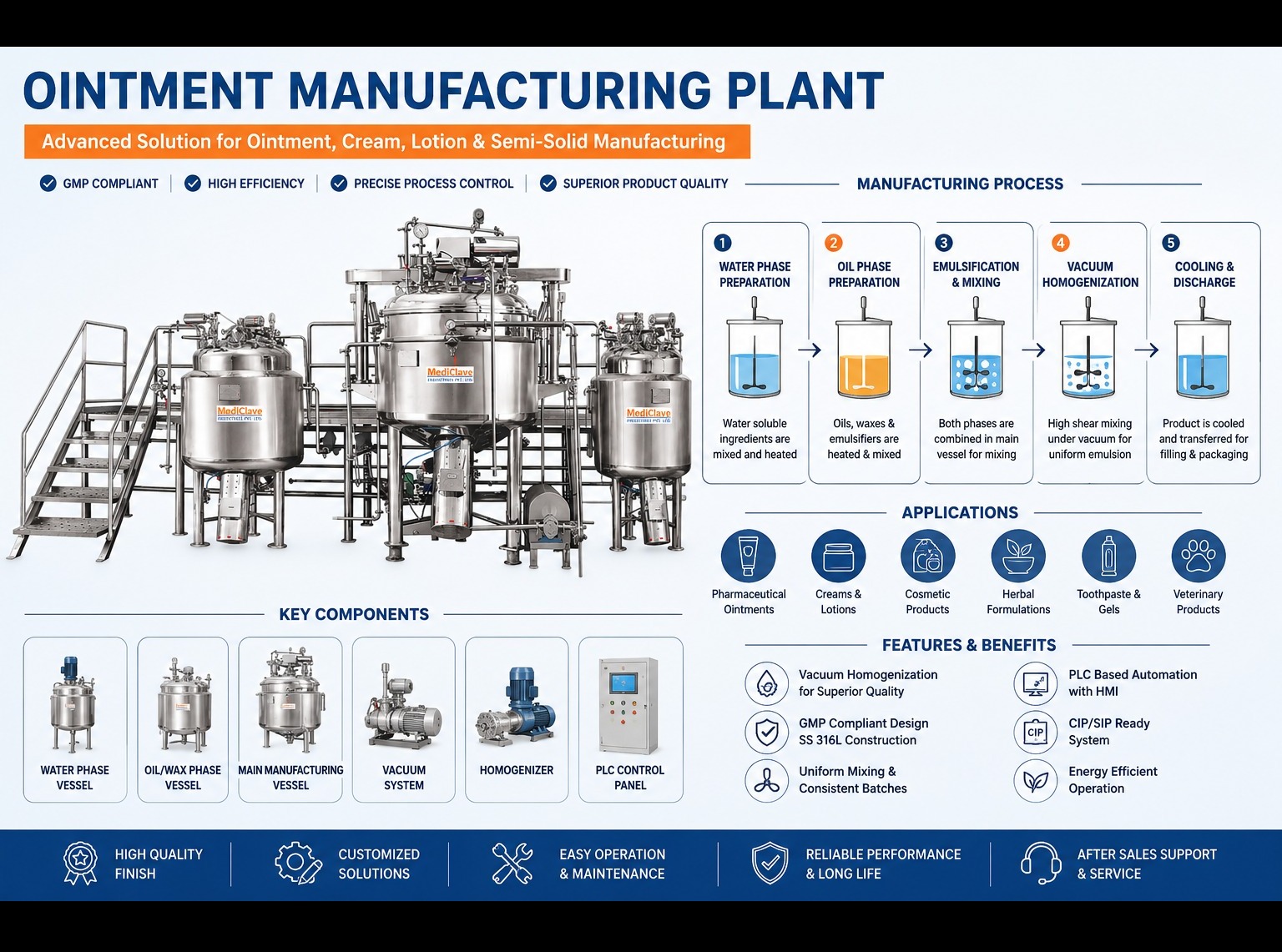
The pharmaceutical and cosmetic industries require highly efficient manufacturing systems to produce creams, ointments, lotions, gels, and other semi-solid products with consistent quality and stability. An Ointment Manufacturing Plant is specifically designed to handle the mixing, homogenization, emulsification, heating, cooling, and transfer of semi-solid products under controlled and hygienic conditions.
Modern ointment manufacturing plants are equipped with advanced vacuum homogenization technology, automated controls, and GMP-compliant designs to ensure superior product quality, reduced contamination risks, and efficient production.
In this comprehensive guide, we will explore the working principle, manufacturing process, components, applications, benefits, and selection criteria of an Ointment Manufacturing Plant.
What is an Ointment Manufacturing Plant?
An Ointment Manufacturing Plant is a complete processing system used for manufacturing:
Pharmaceutical ointments
Creams
Lotions
Gels
Moisturizers
Cosmetic creams
Herbal formulations
Toothpaste
Semi-solid products
The plant consists of multiple vessels and processing units designed to perform heating, mixing, homogenization, vacuum processing, cooling, and product transfer operations.
The primary objective of an ointment plant is to produce a smooth, stable, and uniform product while maintaining strict quality and hygiene standards.
What is Ointment Manufacturing?
Ointment manufacturing is the process of combining oil-based and water-based ingredients to create a homogeneous semi-solid formulation.
The manufacturing process typically involves:
Ingredient preparation
Heating
Emulsification
Mixing
Homogenization
Vacuum processing
Cooling
Product transfer
The final product must have:
Uniform consistency
Smooth texture
Stable formulation
Long shelf life
Desired viscosity
This is achieved through specialized equipment such as vacuum homogenizers and manufacturing vessels.
Types of Products Manufactured in an Ointment Manufacturing Plant
A modern Ointment Manufacturing Plant can be used to manufacture various products.
Pharmaceutical Products
Antibiotic Ointments
Medicated Creams
Dermatological Creams
Anti-Fungal Creams
Pain Relief Ointments
Burn Creams
Cosmetic Products
Face Creams
Moisturizers
Beauty Creams
Sunscreen Creams
Night Creams
Anti-Aging Creams
Personal Care Products
Lotions
Body Creams
Hand Creams
Hair Creams
Shaving Creams
Other Products
Toothpaste
Herbal Creams
Veterinary Ointments
Industrial Cream Products
Working Principle of an Ointment Manufacturing Plant
The working principle is based on controlled heating, mixing, emulsification, vacuum processing, and homogenization.
Two separate phases are generally prepared:
Water Phase
Water-soluble ingredients are mixed and heated in the water phase vessel.
Oil Phase
Waxes, oils, and oil-soluble ingredients are heated in the oil phase vessel.
Both phases are transferred into the main manufacturing vessel where high-shear mixing and homogenization create a uniform emulsion.
The vacuum system removes air bubbles and improves product quality.
The product is then cooled and transferred for filling and packaging.
Step-by-Step Ointment Manufacturing Process
Step 1: Preparation of Water Phase
Water-soluble ingredients are loaded into the water phase vessel.
The ingredients are heated and mixed until completely dissolved.
Step 2: Preparation of Oil Phase
Oils, waxes, and emulsifiers are loaded into the oil phase vessel.
The mixture is heated until all materials melt uniformly.
Step 3: Transfer to Main Manufacturing Vessel
Both phases are transferred into the main manufacturing vessel under controlled conditions.
Step 4: Emulsification Process
The water phase and oil phase are combined.
The emulsification process creates a stable formulation.
Step 5: Vacuum Homogenization
High-speed homogenization breaks particles into fine sizes.
Benefits include:
Better product texture
Improved stability
Uniform particle distribution
Enhanced appearance
Step 6: Vacuum Processing
The vacuum system removes entrapped air.
This prevents:
Foaming
Oxidation
Product instability
Step 7: Cooling Process
The product is gradually cooled while continuous mixing is maintained.
This helps achieve the required viscosity and consistency.
Step 8: Product Transfer
The finished product is transferred to storage tanks or filling machines.
Step 9: Filling and Packaging
The ointment is filled into:
Tubes
Jars
Containers
Bottles
and prepared for distribution.
Major Components of an Ointment Manufacturing Plant
1. Water Phase Vessel
Used for preparation of water-soluble ingredients.
Features
Jacketed construction
Agitator system
Heating arrangement
Temperature control
2. Oil/Wax Phase Vessel
Used for melting oils and waxes.
Features
Steam heating
Mixing system
Temperature monitoring
3. Main Manufacturing Vessel
The heart of the entire plant.
Functions
Mixing
Emulsification
Homogenization
Vacuum processing
4. Vacuum System
Removes air from the product during manufacturing.
Advantages
Better stability
Improved appearance
Longer shelf life
5. Homogenizer
Ensures uniform particle size distribution.
Benefits
Smooth texture
Better absorption
Enhanced product quality
6. Transfer Pump
Used for transferring finished product to storage or filling systems.
7. Storage Vessel
Stores finished products before packaging.
8. PLC Control Panel
Provides automation and process control.
Controls
Temperature
Mixing speed
Vacuum level
Batch timing
Product transfer
Why Vacuum Homogenization is Important?
Vacuum homogenization is one of the most critical processes in ointment manufacturing.
It helps:
Reduce particle size
Improve product stability
Enhance cream texture
Eliminate air bubbles
Improve product appearance
Increase shelf life
Without proper homogenization, creams and ointments may separate during storage.
Advantages of Ointment Manufacturing Plant
Superior Product Quality
Ensures smooth and homogeneous formulations.
GMP Compliance
Designed according to pharmaceutical manufacturing standards.
Reduced Contamination
Closed processing systems minimize contamination risks.
Improved Productivity
Automated systems reduce manual intervention.
Energy Efficient Operation
Modern plants are designed for optimal energy utilization.
Batch Consistency
Produces uniform products batch after batch.
Flexible Production
Suitable for multiple product types.
Applications of Ointment Manufacturing Plant
Pharmaceutical Industry
Used for manufacturing medicated creams and ointments.
Cosmetic Industry
Widely used for beauty and skincare products.
Personal Care Industry
Supports production of lotions and creams.
Herbal Products Industry
Used for herbal and Ayurvedic formulations.
Veterinary Industry
Manufactures veterinary creams and ointments.
Ointment Manufacturing Plant vs Conventional Mixing System
Feature
Ointment Manufacturing Plant
Conventional Mixer
Vacuum System
Yes
No
Homogenization
Advanced
Limited
Product Quality
High
Moderate
Automation
High
Low
GMP Compliance
Excellent
Limited
Batch Consistency
Excellent
Moderate
Modern ointment plants provide significantly better product quality and process control.
GMP Requirements for Ointment Manufacturing
Pharmaceutical ointment production must comply with:
How to Choose the Right Ointment Manufacturing Plant?
Before investing in a plant, consider the following:
Batch Size Requirements
Determine current and future production needs.
Product Viscosity
Select equipment capable of handling product characteristics.
Automation Level
Choose PLC-based systems for improved efficiency.
Cleaning Requirements
Consider CIP/SIP-compatible systems.
Material of Construction
Prefer SS316L contact parts for pharmaceutical applications.
Expansion Capability
Select a system that can support future growth.
Why Choose Mediclave Industries for Ointment Manufacturing Plants?
Mediclave Industries manufactures advanced Ointment Manufacturing Plants designed to meet the stringent requirements of pharmaceutical, cosmetic, and personal care industries.
Our systems offer:
GMP-Compliant Design
SS316L Product Contact Parts
Vacuum Homogenization Technology
PLC-Based Automation
Customized Capacities
Energy-Efficient Operation
Validation Documentation Support
Installation & Commissioning Assistance
With a commitment to quality and innovation, Mediclave Industries provides reliable solutions for high-quality semi-solid manufacturing. https://www.mediclaveindustries.in/
Frequently Asked Questions (FAQs)
What is an Ointment Manufacturing Plant?
An Ointment Manufacturing Plant is a complete system used for manufacturing creams, ointments, lotions, gels, and other semi-solid products.
What products can be manufactured in an ointment plant?
Creams, lotions, ointments, gels, moisturizers, toothpaste, and cosmetic products.
What is vacuum homogenization?
Vacuum homogenization is a process that reduces particle size and removes air bubbles to improve product quality.
Why is vacuum processing important?
It prevents oxidation, eliminates air pockets, and improves stability.
What material is used in pharmaceutical ointment plants?
Typically SS316L stainless steel is used for product-contact parts.
Can the plant manufacture cosmetic products?
Yes, it is suitable for pharmaceutical, cosmetic, and personal care products.
What capacities are available?
Plants can be customized from laboratory scale to large industrial capacities.
Is automation available?
Yes, modern systems use PLC and HMI-based automation.
Is validation required?
Yes, pharmaceutical facilities generally require IQ, OQ, and PQ validation.
What industries use Ointment Manufacturing Plants?
Pharmaceutical, cosmetic, personal care, herbal, and veterinary industries.
Conclusion
An Ointment Manufacturing Plant is an essential solution for producing high-quality creams, ointments, lotions, gels, and other semi-solid formulations. With advanced vacuum homogenization technology, GMP-compliant design, automated controls, and efficient processing capabilities, modern ointment plants help manufacturers achieve superior product quality, operational efficiency, and regulatory compliance.
For pharmaceutical and cosmetic manufacturers seeking reliable semi-solid production solutions, investing in a high-performance Ointment Manufacturing Plant from Mediclave Industries Pvt. Ltd. ensures consistent quality, scalability, and long-term manufacturing success.

 Chat with us