

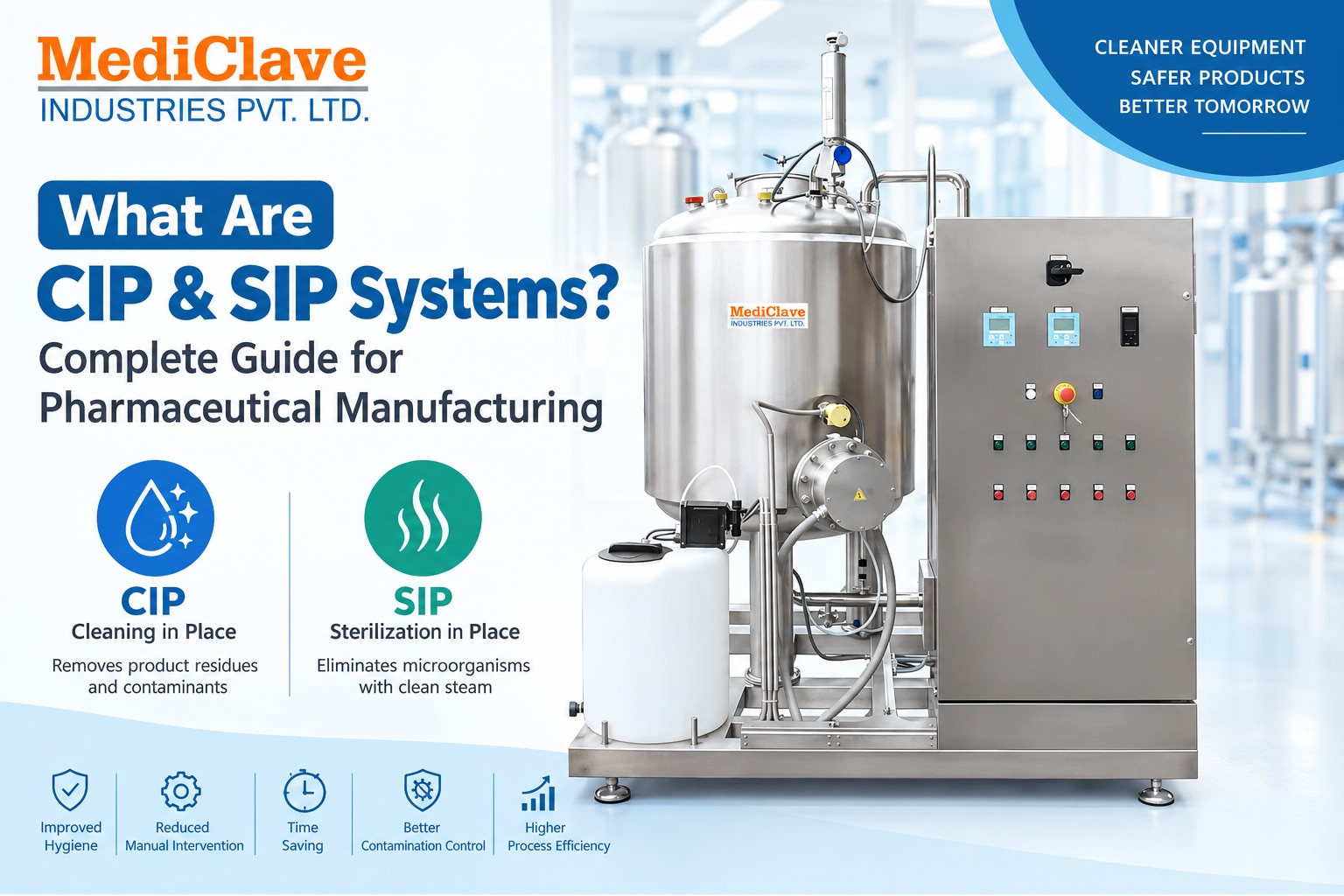
What Are CIP & SIP Systems? Complete Guide for Pharmaceutical Manufacturing
In pharmaceutical manufacturing, cleanliness and sterility are extremely important. Manufacturing vessels, pipelines, tanks, filling equipment, and process systems must be cleaned and sterilized properly to prevent contamination and maintain product quality. This is where CIP & SIP Systems play an important role.
CIP stands for Cleaning in Place, while SIP stands for Sterilization in Place. These systems are designed to clean and sterilize process equipment without requiring complete dismantling of the equipment.
Modern pharmaceutical, biotechnology, food, dairy, and chemical industries use CIP and SIP systems to improve hygiene, reduce manual cleaning, save time, and support consistent manufacturing processes.
What Is a CIP System?
CIP (Cleaning in Place) is a cleaning method in which the internal surfaces of equipment, tanks, vessels, and pipelines are cleaned without physically removing or dismantling the equipment.
A CIP system circulates cleaning solutions through the process equipment at controlled temperature, pressure, flow rate, and concentration. The cleaning process removes product residues, dirt, oils, powders, and other contaminants.
A typical CIP cycle may include:
Pre-rinsing with water
Caustic or alkaline cleaning
Intermediate rinsing
Acid cleaning, when required
Final rinsing
Drainage
Optional sanitization
The exact cleaning cycle depends on the product, equipment design, process requirements, and validation strategy.
What Is an SIP System?
SIP (Sterilization in Place) is a sterilization process performed directly inside process equipment and connected piping without dismantling the system.
In pharmaceutical manufacturing, SIP commonly uses clean steam or pure steam to sterilize product-contact surfaces. The steam is circulated through vessels, pipelines, filters, and other components to achieve the required sterilization conditions.
The objective of SIP is to eliminate viable microorganisms and create a sterile processing environment before production begins.
A typical SIP cycle may involve:
Equipment preparation
Steam introduction
Air removal
Controlled temperature and pressure conditions
Sterilization holding period
Steam exhaust
Cooling or drying, depending on the process
SIP parameters must be established, monitored, and validated according to the specific application.
CIP vs SIP: What Is the Difference?
Although CIP and SIP are often integrated into one process system, they perform different functions.
| Feature | CIP | SIP |
|---|---|---|
| Full Form | Cleaning in Place | Sterilization in Place |
| Main Purpose | Removes contamination and product residues | Eliminates microorganisms |
| Typical Medium | Water and cleaning chemicals | Clean/pure steam |
| Process | Cleaning | Sterilization |
| Dismantling | Normally not required | Normally not required |
| Main Application | Tanks, vessels, pipelines and equipment | Sterile process equipment and piping |
| Key Parameters | Flow, temperature, concentration, time | Temperature, pressure, time, steam quality |
In simple terms, CIP cleans the equipment, while SIP sterilizes it.
Why Are CIP & SIP Systems Important?
Pharmaceutical manufacturing requires a high level of contamination control. Manual cleaning and sterilization can be time-consuming and may introduce variability.
CIP & SIP systems provide a controlled and repeatable method for cleaning and sterilizing equipment.
1. Reduced Manual Intervention
Because the equipment can be cleaned and sterilized in place, operators do not need to dismantle every component for routine cleaning and sterilization.
This reduces manual handling and helps minimize contamination risks.
2. Improved Cleaning Consistency
Automated CIP systems can control important parameters such as cleaning solution temperature, flow rate, concentration, and cycle time.
This helps create a more repeatable cleaning process.
3. Effective Sterilization
SIP systems provide controlled sterilization of suitable process equipment using steam. Properly designed and validated SIP cycles help achieve the required sterilization conditions.
4. Time Saving
Cleaning and sterilization can be integrated into the production workflow. This can reduce equipment turnaround time compared with extensive manual procedures.
5. Reduced Water and Chemical Consumption
A properly engineered CIP system can use programmed cleaning cycles and optimized solution circulation, helping manufacturers manage water, chemicals, energy, and cleaning resources efficiently.
6. Better Contamination Control
Closed-loop cleaning and sterilization can reduce unnecessary exposure of product-contact surfaces to the surrounding environment.
Main Components of a CIP System
A CIP system can be customized according to the manufacturing application. Common components include:
CIP solution storage tanks
Water storage or supply system
CIP circulation pump
Heat exchanger
Spray balls or rotary spray devices
Process piping
Valves
Temperature sensors
Pressure sensors
Flow measurement devices
Conductivity monitoring
Chemical dosing system
Control panel
PLC/HMI automation system
Return and drainage system
The design depends on the number of circuits, equipment volume, cleaning chemistry, required automation level, and process requirements.
Main Components of an SIP System
An SIP system generally includes components designed to safely distribute and control steam throughout the equipment.
Typical components can include:
Clean steam supply
Steam distribution piping
Automated valves
Temperature sensors
Pressure sensors
Steam traps
Condensate drainage system
Sterile air or gas connections
Control system
PLC/HMI
Recording and monitoring instruments
Proper piping slope, drainability, valve arrangement, and condensate management are important considerations in SIP system design.
How Does a CIP System Work?
The CIP process generally follows a programmed sequence.
Step 1: Pre-Rinse
The equipment is initially rinsed with water to remove loose product residues.
Step 2: Alkaline Cleaning
An alkaline cleaning solution may be circulated to remove organic residues such as oils, fats, proteins, or product deposits.
Step 3: Intermediate Rinse
Water is circulated to remove remaining cleaning chemicals and loosened contaminants.
Step 4: Acid Cleaning
Where required, an acidic cleaning solution can be used to remove mineral deposits and other inorganic residues.
Step 5: Final Rinse
The equipment is rinsed until the required cleanliness conditions are achieved.
Step 6: Drainage
The system is properly drained to minimize residual water and prepare the equipment for the next stage.
The actual CIP recipe should be developed based on the product and equipment and then verified through an appropriate cleaning validation program.
How Does an SIP System Work?
SIP generally starts after the equipment has completed its cleaning cycle.
Steam Introduction
Clean or pure steam is introduced into the equipment and connected piping.
Air Removal
Air must be effectively displaced because trapped air can interfere with achieving uniform sterilization conditions.
Heating
The equipment is brought to the required sterilization temperature.
Sterilization Hold
The system maintains the defined sterilization conditions for the validated holding period.
Condensate Removal
Condensate is continuously managed through suitable drain points and steam traps.
Cooling
After sterilization, the system may be cooled under controlled conditions, depending on the equipment and manufacturing process.
The SIP cycle must be designed and validated for the specific equipment configuration.
Applications of CIP & SIP Systems
CIP & SIP systems are widely used in industries where hygienic and sterile processing is required.
Pharmaceutical Industry
CIP and SIP are commonly used for:
Manufacturing vessels
Formulation tanks
Storage vessels
Product transfer pipelines
Sterile processing systems
Bioreactors
Fermenters
Filling systems
Process filters
Biotechnology Industry
Biotechnology processes often require controlled cleaning and sterilization of bioreactors, vessels, transfer lines, and associated equipment.
Food & Beverage Industry
CIP is widely used for cleaning:
Milk processing systems
Beverage production lines
Storage tanks
Filling equipment
Product pipelines
Dairy Industry
Automated CIP systems are particularly useful for cleaning milk and dairy processing equipment where frequent cleaning cycles are required.
Cosmetics Industry
CIP systems can help clean manufacturing vessels and pipelines used for creams, lotions, gels, shampoos, and other cosmetic products.
Important Design Considerations for CIP & SIP Systems
Selecting or designing a CIP & SIP system requires careful consideration of the complete process.
Equipment Geometry
The equipment should be designed so that cleaning solutions can reach all relevant product-contact surfaces.
Drainability
Proper drainage is important to prevent liquid accumulation and support effective cleaning and sterilization.
Flow Rate
CIP cleaning performance depends on achieving suitable flow conditions through the system.
Temperature
Cleaning temperature has a significant effect on the performance of many cleaning solutions.
Chemical Concentration
Where chemicals are used, their concentration must be controlled within the validated process range.
Steam Distribution
SIP piping should be designed to support effective steam distribution and condensate removal.
Instrumentation
Temperature, pressure, flow, conductivity, and other relevant parameters may need to be monitored and recorded.
Automation
PLC/HMI-based automation can help operators manage recipes, sequences, alarms, interlocks, and process records.
Benefits of Automated CIP & SIP Systems
An integrated CIP & SIP system can provide several operational benefits:
Reduced manual cleaning
Consistent cleaning cycles
Controlled sterilization
Reduced contamination risk
Improved equipment utilization
Better process repeatability
Reduced cleaning time
Improved operator safety
Reduced manual intervention
Automated process monitoring
Easier documentation and data recording
However, these benefits depend on proper engineering, installation, operation, and validation.
CIP & SIP System Validation
For pharmaceutical applications, cleaning and sterilization processes should be appropriately qualified and validated.
Important activities may include:
Equipment qualification
Cleaning validation
SIP cycle development
Temperature mapping
Instrument calibration
Cycle monitoring
Microbiological assessment where applicable
Documentation and batch records
Periodic review and requalification
Validation should demonstrate that the selected process consistently achieves its intended result.
How to Choose the Right CIP & SIP System?
Before selecting a CIP & SIP system, manufacturers should evaluate:
Type of product being manufactured
Equipment and vessel capacity
Number of cleaning circuits
Number of equipment units
Cleaning chemicals required
Water quality requirements
Pure/clean steam availability
Required automation level
Process temperature requirements
Drainage and piping arrangement
Monitoring and documentation requirements
Future production expansion
A customized system is generally preferable to a one-size-fits-all solution because every manufacturing facility has different process requirements.
CIP & SIP Systems from Mediclave Industries
Mediclave Industries provides pharmaceutical process equipment and solutions designed for applications where controlled cleaning and sterilization are important.
Our CIP & SIP Systems can be engineered according to equipment configuration and process requirements, with suitable automation, piping, instrumentation, tanks, pumps, valves, and control arrangements.
For more information about pharmaceutical process equipment and CIP & SIP solutions, visit the Mediclave Industries website:
https://www.mediclaveindustries.in/
Conclusion
CIP and SIP systems are important technologies for modern pharmaceutical and hygienic manufacturing. CIP provides controlled cleaning without dismantling equipment, while SIP provides in-place sterilization of suitable process systems.
When properly designed, installed, operated, and validated, CIP & SIP systems can improve cleaning consistency, reduce manual intervention, support contamination control, and improve manufacturing efficiency.
For pharmaceutical manufacturers looking to upgrade their process equipment or develop an automated cleaning and sterilization solution, selecting the right CIP & SIP system is an important step toward reliable and hygienic production.
Frequently Asked Questions
1. What does CIP stand for?
CIP stands for Cleaning in Place. It is a method of cleaning equipment and pipelines without dismantling them.
2. What does SIP stand for?
SIP stands for Sterilization in Place. It is used to sterilize suitable equipment and process piping without dismantling the system.
3. What is the difference between CIP and SIP?
CIP removes product residues and contaminants, while SIP is intended to eliminate microorganisms through a validated sterilization process.
4. What is normally used for SIP?
Clean or pure steam is commonly used for SIP in pharmaceutical applications, depending on the process requirements.
5. Are CIP and SIP systems automated?
Yes. CIP and SIP systems can be manually operated, semi-automated, or fully automated using PLC/HMI control systems.
6. Where are CIP & SIP systems used?
They are commonly used in pharmaceutical, biotechnology, food, dairy, cosmetics, and other hygienic manufacturing industries.
7. Does CIP require equipment dismantling?
A properly designed CIP system allows routine cleaning of designated internal surfaces without complete equipment dismantling.
8. Why is CIP important in pharmaceutical manufacturing?
CIP helps provide a controlled and repeatable method for cleaning product-contact equipment and reducing contamination risks.
9. Why is SIP important?
SIP helps sterilize suitable process equipment and piping after cleaning and before sterile processing.
10. Can CIP & SIP systems be customized?
Yes. Systems can be engineered according to equipment size, process requirements, number of circuits, automation requirements, cleaning chemistry, and sterilization requirements.
Get in Touch
Looking for a CIP & SIP System for pharmaceutical manufacturing?
Contact Mediclave Industries for customized pharmaceutical process equipment and CIP & SIP solutions.
Website: https://www.mediclaveindustries.in/
Keywords: CIP System, SIP System, CIP & SIP System, Cleaning in Place System, Sterilization in Place System, Pharmaceutical CIP System, Pharmaceutical SIP System, CIP SIP Equipment, Automated CIP System, Pharmaceutical Process Equipment.
