

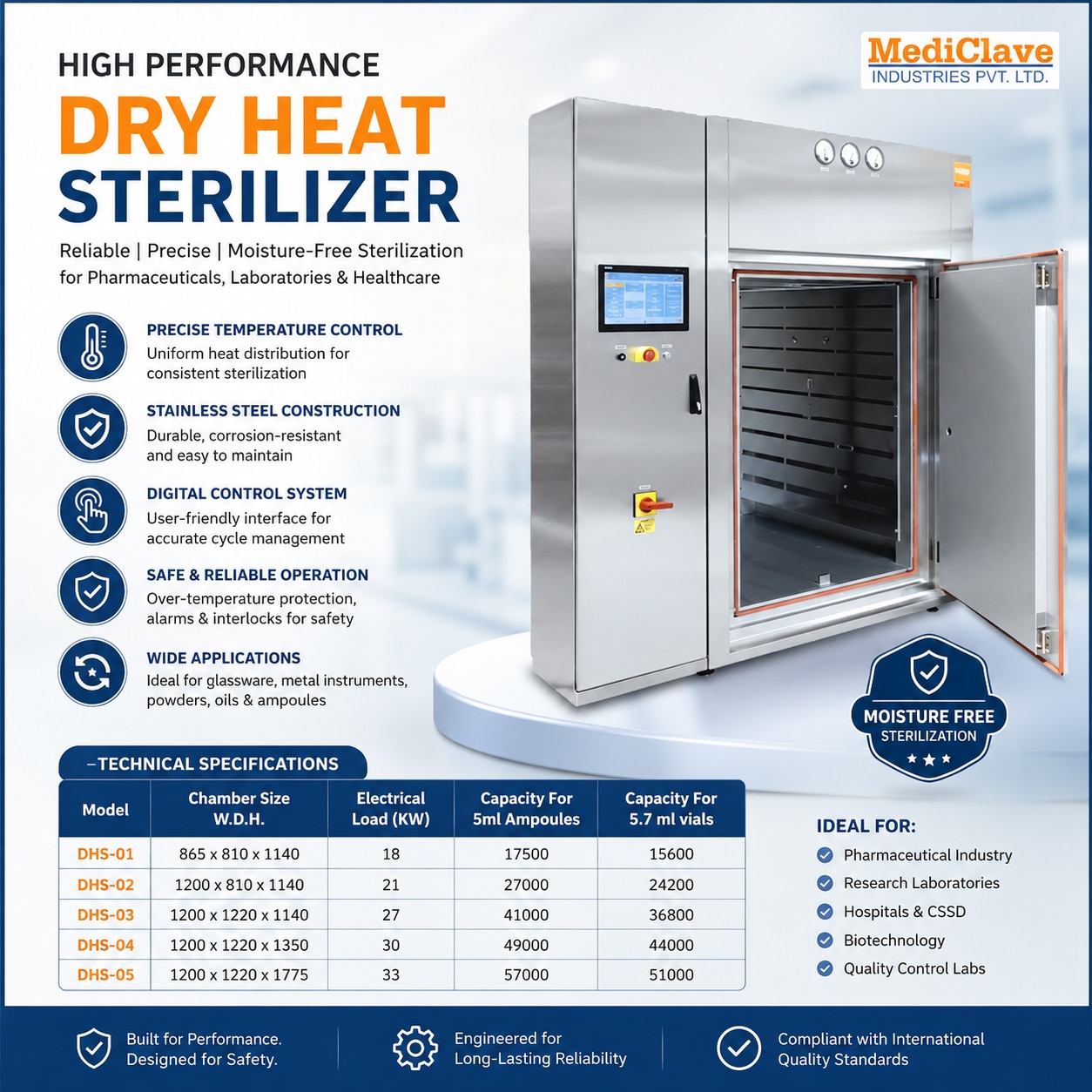
Breakthrough Dry Heat Sterilizer Technology: A Practical Guide for Modern
Pharmaceutical and Healthcare Facilities
Sterilization is not simply about exposing a product or instrument to high temperature. In pharmaceutical manufacturing, healthcare, laboratories, biotechnology, and medical-device production, the sterilization method must match the material, process, contamination risk, and required level of sterility assurance. This is why choosing the right sterilization technology is an important part of facility planning.
Among the different technologies available today, the Dry Heat Sterilizer has a special role. It uses controlled hot air rather than steam or chemical agents, making it particularly useful for materials where moisture can create problems. Glassware, metal components, empty containers, pharmaceutical accessories, powders, oils, and other heat-resistant materials can often benefit from dry heat processing.
For facilities looking for dependable pharmaceutical sterilization equipment, the challenge is not only finding a machine that reaches a high temperature. The equipment should provide controlled heating, uniform temperature distribution, reliable air circulation, appropriate safety systems, repeatable cycles, and a design suitable for the intended application.
Mediclave Industries Pvt. Ltd. provides sterilization and pharmaceutical process equipment designed for hospitals, pharmaceutical manufacturers, laboratories, biotechnology facilities, and other industrial applications. Its product range includes dry heat, steam, ETO, process, water, and cleaning-in-place solutions, allowing customers to consider sterilization as part of a complete manufacturing or healthcare workflow.
What Is a Dry Heat Sterilizer?
A Dry Heat Sterilizer is a sterilization system that uses heated air at elevated temperatures to destroy microorganisms. Instead of using moisture, pressurized steam, or sterilizing gas, the process relies on carefully controlled dry heat.
During a typical cycle, the chamber is heated to a programmed temperature. Hot air circulates around the load, allowing heat to reach the surfaces of the materials being processed. The load is then maintained at the required temperature for a validated holding period before controlled cooling.
The exact temperature and exposure time depend on the material, load configuration, equipment design, and validated sterilization cycle. Common dry heat cycles may include temperatures such as 160°C, 170°C, or 180°C, but the correct cycle should always be established through appropriate process validation rather than selected simply because it is commonly used.
A modern Dry Heat Sterilizer can therefore be viewed as a controlled thermal processing system rather than simply a high-temperature oven.
Why Dry Heat Sterilization Is Different
The biggest difference between dry heat and steam sterilization is the sterilizing medium.
Steam sterilization uses moist heat under pressure. Dry heat sterilization uses hot air without moisture. Because steam transfers heat very efficiently, steam sterilization is generally faster for materials that can tolerate moisture. Dry heat, however, becomes extremely valuable when moisture must be avoided.
For example, pharmaceutical glass containers may require treatment without introducing moisture into the process. Similarly, certain powders, oils, metal components, and heat-resistant materials may be better suited to dry heat.
Dry heat can also be used for high-temperature depyrogenation applications when the process has been properly designed and validated. This is particularly relevant in pharmaceutical manufacturing, where controlling endotoxin or pyrogen contamination can be an important part of sterile production.
How Does a Dry Heat Sterilizer Work?
Although equipment designs can differ, the overall process normally follows a controlled sequence.
1. Loading the Chamber
The material is placed inside the sterilization chamber according to the validated loading pattern. Correct loading is extremely important because tightly packed materials can interfere with hot-air circulation.
Items should be positioned so that heated air can move around them effectively.
2. Heating
The heating system raises the chamber temperature according to the programmed cycle.
High-quality insulation helps reduce heat loss and allows the equipment to maintain stable operating conditions. Temperature sensors continuously monitor the chamber and provide feedback to the control system.
3. Hot-Air Circulation
Uniform air circulation is one of the most important characteristics of a dry heat system.
Simply increasing the temperature is not enough. Different areas of the chamber must receive appropriate heat exposure. Forced circulation helps distribute heated air throughout the chamber and reduces the possibility of temperature variation.
4. Sterilization or Depyrogenation Hold
Once the required temperature has been reached and the system has stabilized, the process enters the holding stage.
The load remains at the validated temperature for the required time. The objective is to achieve the necessary microbial reduction throughout the load rather than merely heating the chamber.
5. Cooling
After the exposure stage, the equipment enters the cooling phase. Depending on the design and application, cooling may be controlled to protect the load and maintain the required process conditions.
The cycle should only be considered complete when the validated process requirements have been achieved.
Which Materials Can Be Sterilized Using Dry Heat?
One of the biggest advantages of dry heat technology is its suitability for materials that are adversely affected by moisture.
Common applications include:
Pharmaceutical glassware
Empty glass containers
Vials and ampoules
Metal instruments
Stainless steel components
Laboratory glassware
Heat-resistant pharmaceutical accessories
Certain powders
Certain oils
Metal trays
Heat-resistant laboratory equipment
Pharmaceutical containers
However, not every heat-resistant material is automatically suitable for dry heat. Material compatibility, temperature tolerance, packaging, load configuration, and the validated process must always be considered.
Plastic, rubber, latex, moisture-containing materials, and temperature-sensitive components may require alternative sterilization technologies.
For heat-sensitive healthcare products, an ETO Sterilizer may be more appropriate because ethylene oxide sterilization operates at much lower temperatures and can be used for certain delicate materials that cannot withstand dry heat.
Dry Heat Sterilizer Applications in the Pharmaceutical Industry
Pharmaceutical manufacturing is one of the major areas where dry heat technology can provide value.
A pharmaceutical facility may need to process glass containers, metal components, laboratory accessories, production materials, and other heat-resistant items. Moisture may not always be desirable because it can interfere with the material or downstream manufacturing process.
Dry heat systems can therefore support several pharmaceutical operations, including:
Sterilization of pharmaceutical glassware
Sterilization of empty containers
Treatment of metal components
Depyrogenation applications
Laboratory sterilization
Preparation of sterile production accessories
Microbiology and quality-control operations
Research and development activities
The equipment should be selected according to the actual production process rather than based only on chamber capacity.
For example, a facility processing small laboratory loads may require a very different configuration from a large pharmaceutical plant processing high volumes of glass containers.
Dry Heat Sterilizer for Laboratories
Laboratories frequently handle glassware, metal instruments, testing accessories, and other heat-resistant materials.
A dependable dry heat system can help laboratories establish a repeatable thermal sterilization process. Temperature monitoring and controlled cycles are particularly useful where different operators may otherwise follow inconsistent manual heating procedures.
Research laboratories, pharmaceutical quality-control laboratories, microbiology laboratories, biotechnology facilities, and educational institutions can all have applications for dry heat technology.
The key is to establish suitable loading patterns and validated cycles for the materials being processed.
Dry Heat Sterilizer vs Autoclave: Which One Should You Choose?
This is one of the most common questions customers ask when selecting sterilization equipment.
An autoclave uses saturated steam under pressure. A dry heat sterilizer uses hot air without moisture.
A steam system is generally preferred for materials such as surgical instruments, culture media, dressings, and other products that can tolerate moisture. Mediclave's range includes Vertical Autoclave models designed for steam sterilization applications in hospitals, laboratories, pharmaceutical facilities, and research centers.
Dry heat is generally more suitable when moisture must be avoided or when high-temperature treatment is required.
The choice should therefore be based on:
Material compatibility
Moisture sensitivity
Required sterilization temperature
Required cycle duration
Load size
Depyrogenation requirements
Production volume
Validation requirements
Available utilities
Facility layout
There is no single sterilization method that is best for every application. The correct technology depends on the process.
Key Features to Look for in a Dry Heat Sterilizer
When evaluating a dry heat system, buyers should look beyond the basic chamber size and maximum temperature.
Uniform Temperature Distribution
Uniformity is critical. The chamber should be designed to distribute hot air effectively throughout the load.
Accurate Temperature Monitoring
Reliable temperature sensors and a suitable control system help operators monitor the sterilization cycle accurately.
Programmable Controls
PLC-based control systems can allow users to program sterilization cycles according to process requirements and monitor important parameters.
High-Quality Chamber Construction
The chamber should be manufactured from suitable materials capable of handling repeated high-temperature operation.
Effective Insulation
Good insulation reduces heat loss, improves energy efficiency, and helps maintain stable chamber conditions.
Safety Systems
High-temperature equipment should include appropriate safety features to protect operators and equipment. These may include alarms, over-temperature protection, door safety arrangements, and electrical protection.
Documentation and Validation Support
For pharmaceutical applications, process documentation and validation can be extremely important. Facilities should consider whether the supplier can support the required qualification and documentation requirements.
Why Temperature Uniformity Matters More Than Maximum Temperature
A common mistake when purchasing sterilization equipment is to focus only on the highest temperature the machine can reach.
For sterilization, temperature uniformity across the load is often more important than simply achieving a very high chamber temperature.
Imagine a chamber reaching the required temperature near the heating element while another part of the load remains significantly cooler. In that situation, the displayed chamber temperature alone may not represent the actual conditions experienced by every item.
This is why proper air circulation, sensor placement, chamber design, insulation, loading pattern, and validation are important.
A well-engineered Dry Heat Sterilizer should be selected and validated around the actual load—not just an empty chamber.
How Dry Heat Sterilization Supports Quality Control
Sterilization is closely connected to quality assurance.
In pharmaceutical manufacturing, contamination can result in rejected batches, production delays, investigations, and financial losses. A controlled sterilization process can help reduce these risks when it is correctly designed, operated, and validated.
The equipment itself is only one part of the overall system. Operators must follow approved procedures, maintain appropriate loading patterns, monitor cycles, document results, and carry out preventive maintenance.
Regular calibration of temperature sensors and verification of process performance are also important for maintaining confidence in the equipment.
How to Choose the Right Capacity
Choosing the right chamber size requires more than estimating today's workload.
Before purchasing a Dry Heat Sterilizer, consider:
Current load: How much material needs to be processed per cycle?
Future expansion: Is production expected to increase?
Load dimensions: What are the size and shape of the largest items?
Loading arrangement: Will products be placed on trays, racks, shelves, or specialized carriers?
Cycle duration: How many cycles are expected during a working day?
Available floor space: Can the proposed equipment fit comfortably into the designated area?
Utilities: What electrical and other utility requirements are available?
Process requirements: Is the primary objective sterilization, depyrogenation, or another validated thermal process?
A supplier with engineering expertise can help convert these requirements into an appropriate equipment configuration.
Dry Heat Sterilization as Part of a Larger Pharmaceutical System
Modern pharmaceutical plants rarely operate with a single piece of equipment.
Sterilization, cleaning, water treatment, steam generation, manufacturing, filling, and storage are interconnected. The performance of one system can influence another.
For example, pharmaceutical facilities using steam-based sterilization and SIP processes may require a reliable Pure Steam Generator to produce suitable high-purity steam for pharmaceutical applications.
Similarly, automated cleaning and sterilization of process vessels and pipelines can be supported by a CIP & SIP System. CIP enables equipment to be cleaned without dismantling, while SIP uses steam to sterilize internal surfaces.
For facilities using multiple sterilization technologies, this broader approach can make equipment planning more efficient.
When Steam Sterilization Is the Better Option
Dry heat is highly useful, but it should not replace steam sterilization where steam is the better technology.
For materials that tolerate moisture, steam often provides faster and efficient heat transfer. Hospitals, CSSDs, laboratories, and pharmaceutical facilities commonly use steam sterilizers for instruments, glassware, culture media, textiles, and other compatible materials.
Mediclave also manufactures Horizontal Rectangular High-Pressure Steam Sterilizers, designed for applications requiring larger-capacity steam sterilization.
The important point is to match the sterilization method to the product.
Common Mistakes to Avoid
Even a high-quality sterilizer can produce poor results if it is incorrectly operated.
Some common mistakes include:
Overloading the chamber: Excessive loading can restrict hot-air circulation.
Incorrect loading patterns: Blocking air pathways can create temperature differences.
Using unvalidated cycles: A commonly used temperature/time combination should not automatically be assumed to be suitable for every load.
Ignoring calibration: Temperature sensors and monitoring instruments require appropriate calibration and verification.
Skipping preventive maintenance: Heating systems, fans, controls, seals, sensors, and other components should be maintained according to the equipment's requirements.
Opening the chamber too early: Premature opening can interfere with the cooling process and product handling.
Ignoring material compatibility: Every material should be assessed for its ability to withstand the selected temperature and exposure time.
Treating chamber temperature as the only parameter: Process performance depends on the entire load and validated cycle.
Why Choose Mediclave Industries for Sterilization Equipment?
Selecting sterilization equipment is a long-term investment. Customers need more than a machine—they need a solution that matches their application and operating environment.
Mediclave Industries Pvt. Ltd. manufactures and supplies sterilization and pharmaceutical process equipment for healthcare, pharmaceutical, laboratory, biotechnology, and related industries. Its portfolio covers multiple sterilization technologies, including Dry Heat Sterilizers, ETO Sterilizers, steam sterilizers, and supporting pharmaceutical utility systems.
The company also offers equipment such as Saturated Steam Sterilizer, allowing customers to evaluate different sterilization approaches according to their process requirements.
The right supplier should be able to understand your application, load requirements, capacity expectations, available utilities, automation needs, installation conditions, and validation requirements before recommending a system.
Final Thoughts
A Dry Heat Sterilizer can be an important solution for pharmaceutical companies, laboratories, healthcare organizations, biotechnology facilities, and other industries that need reliable high-temperature sterilization without moisture.
Its value goes beyond simply reaching a high temperature. Effective dry heat processing depends on controlled heating, uniform air circulation, accurate monitoring, suitable loading, validated exposure conditions, safe operation, and regular maintenance.
For moisture-sensitive or high-temperature applications, dry heat can provide advantages that conventional steam sterilization cannot always deliver. At the same time, steam sterilizers and ETO systems remain important when their respective technologies are better suited to the material being processed.
The best investment is therefore not necessarily the machine with the highest temperature, largest chamber, or most automation. It is the system that is correctly matched to your actual application and supported by sound engineering and process understanding.
If your pharmaceutical plant, hospital, laboratory, or healthcare facility is planning to install or upgrade sterilization equipment, Mediclave Industries can help you evaluate the appropriate solution based on your process, capacity, material, and operational requirements.
For enquiries and customized Dry Heat Sterilizer solutions:
Mediclave Industries Pvt. Ltd.
Email: info@mediclaveindustries.com
Phone: 08042755106
Location: Ahmedabad, Gujarat, India
Website: https://www.mediclaveindustries.in/
Speak with the Mediclave team to discuss your sterilization requirements and identify a suitable equipment configuration for your facility.
