

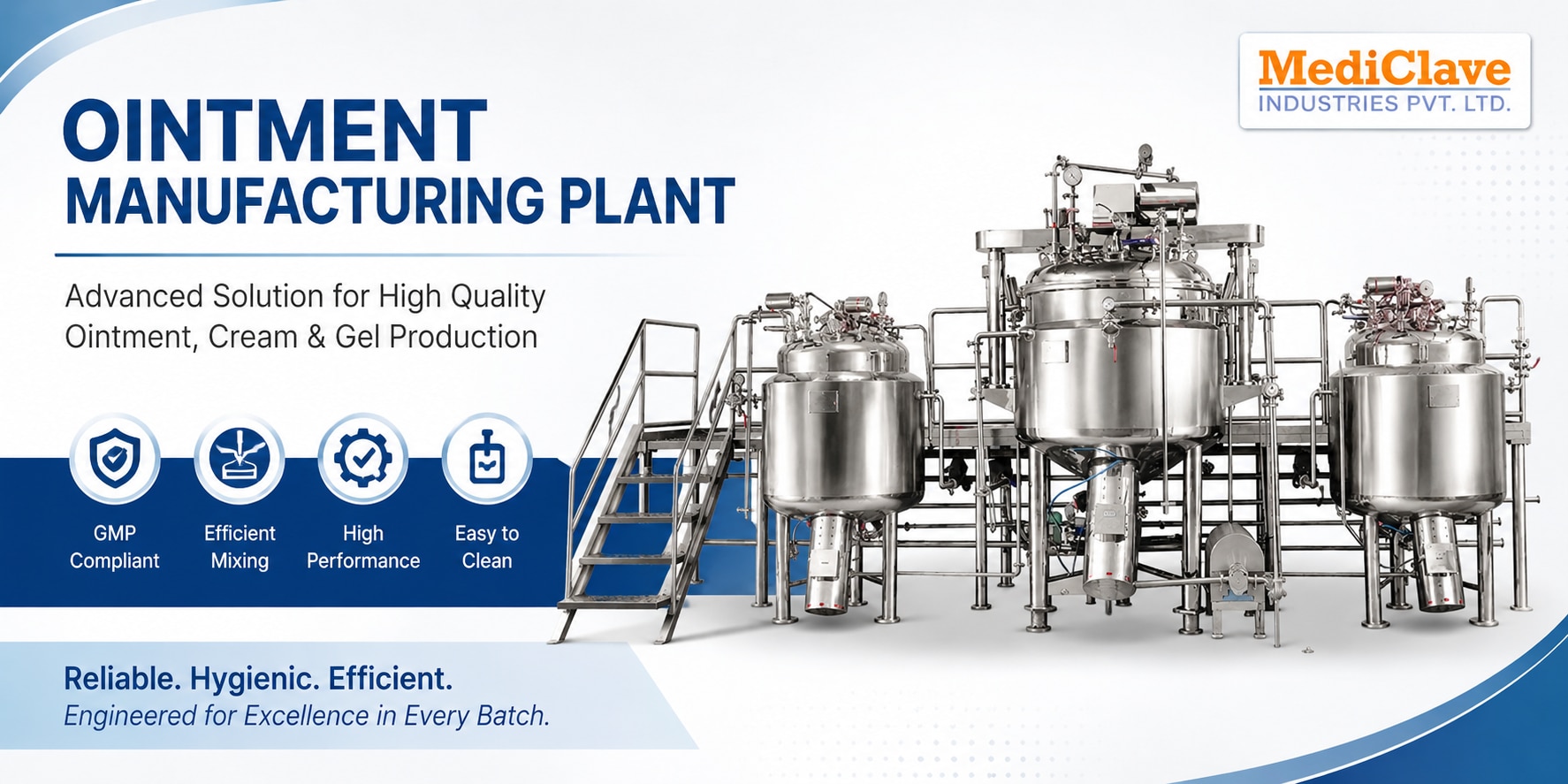
The Complete Guide to Efficient Pharmaceutical Ointment Production
The pharmaceutical industry depends on precision, quality, and consistency to produce medicines that improve lives. Among the many dosage forms manufactured today, ointments play a vital role in treating skin conditions, wounds, burns, infections, and various dermatological disorders. As demand for high-quality topical medicines continues to rise worldwide, pharmaceutical companies need advanced manufacturing systems that ensure hygienic production, accurate mixing, and compliance with international quality standards.
Choosing the right Ointment Manufacturing Plant Manufacturer is one of the most important decisions for pharmaceutical manufacturers. A modern ointment manufacturing plant not only increases production capacity but also ensures product consistency, minimizes contamination risks, reduces manual intervention, and improves overall operational efficiency.
Mediclave Industries is one of India's trusted manufacturers of pharmaceutical process equipment, offering reliable and high-performance Ointment Manufacturing Plants designed to meet the demanding requirements of pharmaceutical, cosmetic, personal care, herbal, and veterinary industries. With advanced engineering, robust stainless-steel construction, and user-friendly automation, Mediclave helps manufacturers produce superior-quality ointments while maintaining GMP compliance.
In this comprehensive guide, you'll learn everything about ointment manufacturing plants, their working principles, components, advantages, applications, selection criteria, maintenance, industry trends, and why Mediclave Industries is a preferred manufacturing partner.
What is an Ointment Manufacturing Plant?
An Ointment Manufacturing Plant is an integrated pharmaceutical processing system used for manufacturing semi-solid products such as:
- Pharmaceutical ointments
- Creams
- Lotions
- Gels
- Petroleum jelly
- Cosmetic creams
- Moisturizers
- Herbal formulations
- Medicated creams
- Toothpaste
- Veterinary ointments
The plant combines several processing operations into one efficient system including:
- Heating
- Melting
- Mixing
- Homogenization
- Vacuum processing
- Cooling
- Product transfer
- Storage
The result is a smooth, uniform, stable, contamination-free product that meets pharmaceutical quality standards.
Why Modern Pharmaceutical Companies Need Advanced Ointment Manufacturing Plants
Today's pharmaceutical market is highly competitive. Customers expect consistent quality, regulatory compliance, and reliable product performance. Traditional mixing methods are no longer sufficient for large-scale production.
Modern manufacturing plants offer:
- Faster production
- Higher batch consistency
- Improved hygiene
- Lower manpower requirements
- Better product stability
- Reduced production losses
- Easy cleaning
- Automated controls
- Accurate temperature regulation
- Better emulsification
These advantages directly contribute to improved profitability and customer satisfaction.
Major Components of an Ointment Manufacturing Plant
A complete ointment manufacturing system consists of several interconnected units.
Manufacturing Vessel
The manufacturing vessel is the heart of the entire system.
It is generally constructed using pharmaceutical-grade stainless steel (SS316L for product contact parts) and includes:
- Jacketed construction
- Vacuum capability
- Agitator
- Anchor stirrer
- Scraper blades
- Bottom homogenizer
- Temperature sensors
- Pressure gauges
This vessel ensures proper blending and homogenization of ingredients.
Oil Phase Vessel
The oil phase vessel is used to prepare oil-based ingredients before they are transferred into the main manufacturing vessel.
Typical ingredients include:
- Mineral oils
- Waxes
- Emulsifiers
- Fatty alcohols
- Petroleum jelly
Controlled heating ensures complete melting before mixing.
Water Phase Vessel
The water phase vessel prepares water-soluble ingredients such as:
- Purified water
- Preservatives
- Stabilizers
- Active pharmaceutical ingredients
- Buffers
Maintaining precise temperatures ensures optimal mixing.
Vacuum System
Vacuum technology is one of the most important features.
Benefits include:
- Bubble-free products
- Improved texture
- Better product appearance
- Faster mixing
- Reduced oxidation
- Longer shelf life
Vacuum processing significantly improves product quality.
Homogenizer
A high-speed homogenizer breaks particles into microscopic sizes, producing:
- Smooth creams
- Uniform gels
- Stable emulsions
- Better absorption
- Enhanced product appearance
High-quality homogenization directly impacts product performance.
Transfer Pump
After manufacturing, the finished ointment is transferred hygienically to storage tanks or filling machines using sanitary transfer pumps.
This reduces contamination risks and minimizes product loss.
Control Panel
Modern systems include PLC or HMI-based control panels for:
- Temperature control
- Mixing speed adjustment
- Batch timing
- Vacuum monitoring
- Alarm systems
- Recipe management
Automation improves productivity while reducing operator error.
Working Principle of an Ointment Manufacturing Plant
The production process follows several carefully controlled stages.
Step 1: Raw Material Preparation
Raw materials are accurately weighed according to the formulation.
Ingredients include:
- Oils
- Waxes
- Active pharmaceutical ingredients
- Water
- Preservatives
- Emulsifiers
- Stabilizers
Quality checks ensure compliance before processing.
Step 2: Oil Phase Preparation
Oil-based ingredients are transferred into the oil phase vessel.
Heating melts waxes and oils to the desired temperature.
Continuous stirring prevents localized overheating.
Step 3: Water Phase Preparation
Water-soluble ingredients are processed separately.
Temperature control ensures complete dissolution.
Step 4: Mixing
Both phases are transferred into the manufacturing vessel.
Controlled mixing produces a stable emulsion.
Step 5: Homogenization
The homogenizer reduces particle size.
This creates:
- Smooth texture
- Uniform consistency
- Stable formulation
Step 6: Vacuum Processing
Air trapped during mixing is removed.
This improves:
- Appearance
- Shelf life
- Product stability
Step 7: Cooling
The jacketed vessel gradually cools the product.
Proper cooling preserves formulation quality.
Step 8: Product Transfer
The finished ointment is transferred hygienically to the filling line.
Types of Products Manufactured
An ointment manufacturing plant is extremely versatile.
Common products include:
Pharmaceutical Products
- Antibiotic ointments
- Antifungal creams
- Pain relief gels
- Burn creams
- Antiseptic ointments
- Steroid creams
- Dermatological creams
- Anti-inflammatory ointments
Cosmetic Products
- Face creams
- Moisturizers
- Beauty creams
- Sunscreens
- Body lotions
- Cold creams
- Fairness creams
- Night creams
Personal Care Products
- Hand creams
- Foot creams
- Lip balms
- Hair gels
- Aloe vera gels
Herbal Products
- Ayurvedic creams
- Herbal gels
- Pain relief ointments
- Natural moisturizers
Veterinary Products
- Animal wound creams
- Veterinary gels
- Veterinary ointments
Industries That Use Ointment Manufacturing Plants
Several industries depend on these advanced systems.
These include:
- Pharmaceutical manufacturers
- Cosmetic manufacturers
- Ayurvedic medicine companies
- Herbal product manufacturers
- Personal care companies
- Veterinary medicine manufacturers
- Research laboratories
- Contract manufacturing companies
Key Features of Mediclave Ointment Manufacturing Plants
Mediclave Industries designs every plant with modern pharmaceutical manufacturing requirements in mind.
Some notable features include:
- GMP-compliant construction
- SS304 & SS316L stainless steel
- Mirror finish surfaces
- Vacuum processing
- Bottom homogenizer
- Anchor agitator
- Variable speed control
- PLC automation
- CIP compatibility
- Easy maintenance
- Low power consumption
- Compact footprint
- User-friendly operation
- High production efficiency
These features help manufacturers achieve reliable and repeatable production.
Advantages of Using an Advanced Ointment Manufacturing Plant
Superior Product Quality
Uniform mixing ensures every batch maintains identical consistency.
Higher Productivity
Automation shortens batch processing time and increases daily production capacity.
Reduced Human Error
Programmable controls improve manufacturing accuracy.
Hygienic Production
Closed processing systems reduce contamination risks.
For manufacturers building a complete pharmaceutical production facility, integrating an ointment manufacturing plant with a Liquid Syrup Manufacturing Process Plant creates a highly efficient production environment for multiple dosage forms. Explore Mediclave's Liquid Syrup Manufacturing Process Plant here:
https://www.mediclaveindustries.in/liquid-syrup-manufacturing-process-plant/
Better Product Stability
Vacuum homogenization produces stable emulsions with longer shelf life.
Lower Operational Costs
Efficient designs reduce:
- Energy consumption
- Product wastage
- Cleaning time
- Maintenance costs
Easy Cleaning
CIP-compatible systems reduce downtime between batches.
Scalable Production
Plants are available in different capacities suitable for:
- Startups
- Medium-scale manufacturers
- Large pharmaceutical companies
Importance of Stainless Steel in Pharmaceutical Manufacturing
Pharmaceutical manufacturing demands extremely hygienic equipment.
Stainless steel provides:
- Corrosion resistance
- Easy cleaning
- Long service life
- Chemical resistance
- Smooth finish
- Low contamination risk
SS316L is widely preferred because it meets international pharmaceutical standards.
Quality Standards Followed
Reliable manufacturers design equipment according to recognized industry requirements, including:
- GMP Guidelines
- WHO Recommendations
- FDA Manufacturing Practices
- cGMP Standards
- Pharmaceutical Hygiene Standards
Compliance improves inspection readiness and customer confidence.
Automation in Modern Ointment Manufacturing Plants
Automation has transformed pharmaceutical production.
Modern PLC systems allow operators to:
- Store recipes
- Monitor production
- Control temperatures
- Adjust mixing speed
- Record batch history
- Generate reports
- Improve traceability
These capabilities reduce operational complexity while improving quality assurance.
Capacity Options Available
Different pharmaceutical companies require different production capacities.
Common manufacturing capacities include:
- 25 Liters
- 50 Liters
- 100 Liters
- 200 Liters
- 300 Liters
- 500 Liters
- 1000 Liters
- 2000 Liters
- Custom-built systems
Manufacturers can choose equipment based on present production needs while planning for future expansion.
Integration with Other Pharmaceutical Equipment
An ointment manufacturing plant works even more efficiently when integrated with other pharmaceutical process systems. For example, purified water is an essential ingredient in many formulations, making a reliable Multi Column Distillation Plant a valuable addition for producing high-purity water used in pharmaceutical manufacturing.
Mediclave Industries also manufactures Multi Column Distillation Plants designed for pharmaceutical-grade water production:
https://www.mediclaveindustries.in/multi-column-distillation-plant/
Likewise, maintaining hygienic manufacturing pipelines is essential for preventing cross-contamination. Many pharmaceutical companies integrate CIP & SIP Systems with their production lines to automate cleaning and sterilization processes, improving productivity while ensuring compliance with GMP standards.
https://www.mediclaveindustries.in/cip-sip-system/
