

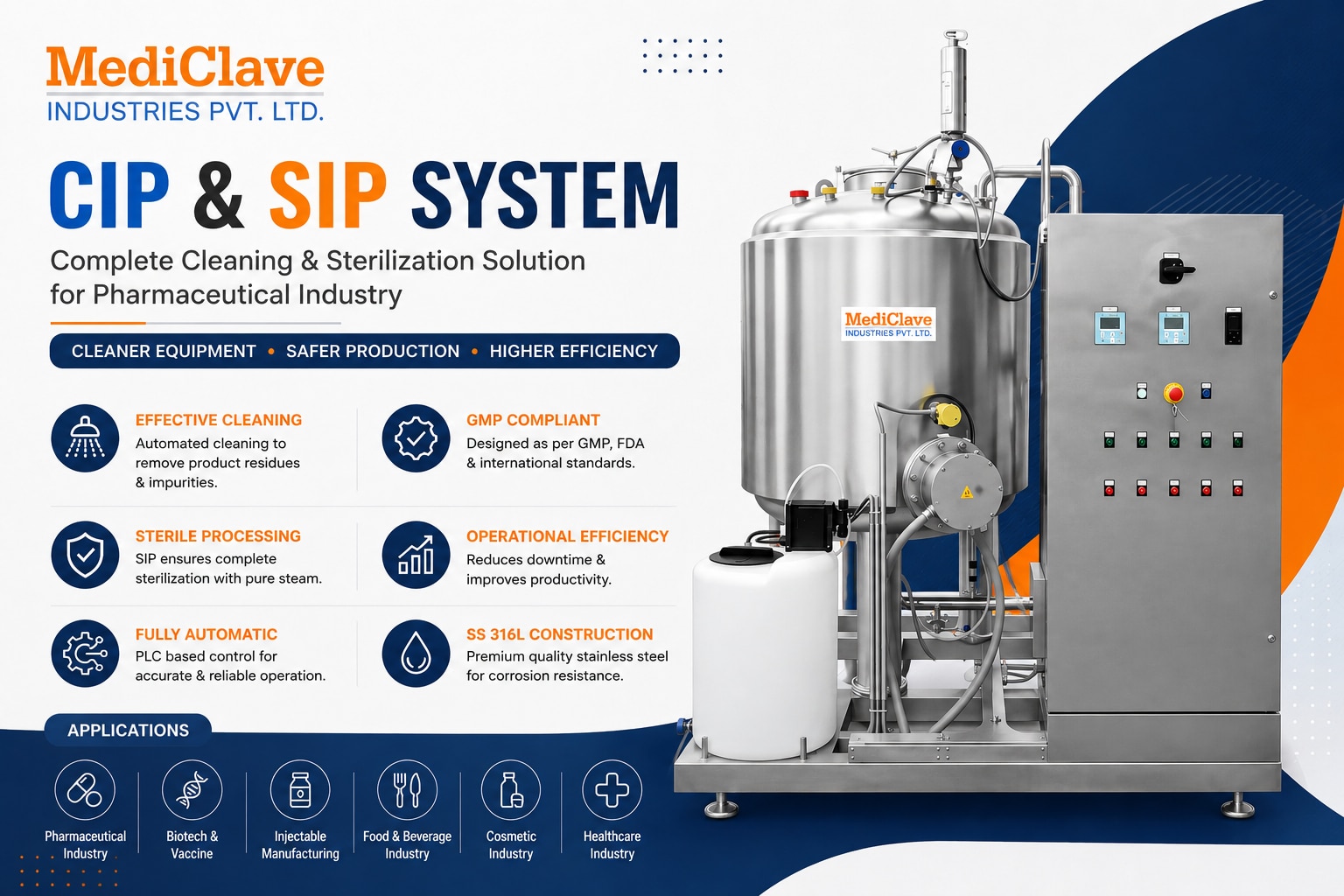
CIP & SIP Systems: The Complete Guide to Hygienic Pharmaceutical Cleaning and Sterilization
In today's pharmaceutical, biotechnology, food, beverage, and healthcare industries, maintaining the highest level of cleanliness is not just a recommendation—it is a regulatory requirement. Every piece of equipment that comes into contact with products must remain free from contamination, microorganisms, residues, and impurities. Even the smallest amount of contamination can compromise product quality, delay production, increase operating costs, and lead to regulatory issues.
This is where CIP (Clean-In-Place) and SIP (Sterilize-In-Place) Systems play a vital role. These advanced automated systems allow manufacturers to clean and sterilize equipment without dismantling pipelines, tanks, reactors, vessels, or process equipment. By reducing manual intervention, improving cleaning consistency, and minimizing downtime, CIP & SIP Systems have become an essential part of modern pharmaceutical manufacturing facilities.
At Mediclave Industries, we manufacture high-performance CIP & SIP Systems designed to meet stringent pharmaceutical and biotechnology industry requirements. Our systems are engineered for reliability, efficiency, automation, and compliance with GMP and international manufacturing standards, helping customers maintain the highest levels of product quality while reducing operational costs. (Mediclave Industries)
What is a CIP & SIP System?
A CIP (Clean-In-Place) System is an automated cleaning solution that removes product residues, contaminants, oils, chemicals, microorganisms, and process deposits from equipment without requiring dismantling. Cleaning solutions such as purified water, detergents, acids, alkalis, and sanitizing agents circulate through tanks, pipelines, valves, heat exchangers, reactors, and process vessels to achieve complete cleaning.
A SIP (Sterilize-In-Place) System follows the cleaning process by sterilizing the equipment using clean or pure steam. This eliminates bacteria, fungi, viruses, spores, and other microorganisms that could affect product quality.
Together, these two systems create a fully hygienic production environment where every production cycle begins with clean and sterile equipment.
Unlike traditional manual cleaning methods, automated CIP & SIP technology provides repeatable cleaning results, minimizes human error, and significantly improves manufacturing efficiency.
Why Modern Pharmaceutical Plants Depend on CIP & SIP Systems
As pharmaceutical manufacturing continues to become more regulated, manufacturers are expected to demonstrate validated cleaning procedures, traceability, and contamination control. Manual cleaning methods often struggle to meet these expectations because they require significant labor, consume more time, and may produce inconsistent results.
Automated CIP & SIP Systems eliminate these challenges by delivering programmable cleaning cycles that maintain consistent cleaning quality regardless of the production schedule. They also reduce operator exposure to hazardous cleaning chemicals and high-temperature environments.
Because cleaning is performed without dismantling equipment, production downtime is reduced considerably, allowing facilities to increase productivity while lowering maintenance costs. (Mediclave Industries)
How Does a CIP & SIP System Work?
The operation of a CIP & SIP System follows a carefully designed sequence.
The process usually begins with a pre-rinse using purified water to remove loose product residues. Once the initial rinse is complete, the system circulates cleaning chemicals such as alkaline or acidic solutions through the equipment. These chemicals dissolve stubborn deposits, proteins, oils, sugars, and process residues.
After chemical cleaning, the equipment undergoes multiple rinsing cycles until all cleaning agents have been removed. Many advanced systems monitor conductivity and pH values to ensure complete rinsing.
Following cleaning, the SIP cycle begins. High-quality clean steam or pure steam is introduced into the equipment for a predefined time and temperature. This sterilization process destroys microorganisms and prepares the equipment for the next production batch.
Once sterilization is complete, the equipment is ready for safe manufacturing without requiring manual intervention.
Major Components of a CIP & SIP System
A modern CIP & SIP System consists of several precision-engineered components working together.
These include:
Stainless Steel 316L CIP tanks
High-efficiency circulation pumps
Hygienic sanitary valves
Automated piping network
PLC and HMI control systems
Temperature sensors
Flow meters
Conductivity monitoring
Steam supply lines
Spray devices
Flexible sanitary hoses
Automation software
Safety interlocks
SCADA integration
Data logging and validation support
These components ensure accurate cleaning cycles while maintaining pharmaceutical-grade hygiene standards. Mediclave's systems are available in single-tank as well as multi-tank configurations depending on customer process requirements. (Mediclave Industries)
Key Features of Mediclave CIP & SIP Systems
Mediclave Industries designs its systems with a strong focus on pharmaceutical process reliability.
Some of the major features include:
Fully automatic PLC-controlled operation
User-friendly HMI touchscreen
GMP and cGMP compliant design
SS 316L product contact parts
ASME BPE-inspired hygienic construction
Custom tank capacities
Online monitoring of process parameters
Conductivity and pH monitoring
Acid, alkali and detergent dosing
Fault indication and alarm system
Password-protected operator access
Reduced water consumption
Reduced steam usage
Faster batch changeover
Lower maintenance costs
Easy validation support
Customized system configurations
These features help pharmaceutical manufacturers improve productivity while ensuring regulatory compliance. (Mediclave Industries)
Industries That Use CIP & SIP Systems
Although CIP & SIP Systems are widely recognized in pharmaceutical manufacturing, their applications extend across numerous industries.
These systems are commonly installed in:
Pharmaceutical manufacturing plants
Injectable medicine production
Vaccine manufacturing facilities
Biotechnology laboratories
API manufacturing plants
Cosmetic manufacturing
Food processing industries
Dairy processing plants
Beverage production units
Nutraceutical industries
Research laboratories
Chemical processing plants
Any industry requiring hygienic processing can benefit from automated cleaning and sterilization.
Benefits of Installing a CIP & SIP System
Investing in an automated cleaning solution provides both immediate and long-term advantages.
One of the biggest benefits is reduced production downtime. Since equipment does not need to be dismantled for cleaning, production resumes much faster.
Automation also reduces labor requirements because operators no longer perform extensive manual cleaning.
Cleaning consistency improves dramatically, resulting in better product quality and reduced contamination risks.
Additional advantages include:
Higher production efficiency
Lower operating costs
Improved product safety
Reduced water usage
Lower chemical consumption
Improved employee safety
Easier regulatory compliance
Better documentation
Simplified validation
Increased equipment lifespan
Lower maintenance requirements
Consistent cleaning quality
These benefits make CIP & SIP Systems an excellent long-term investment for growing pharmaceutical facilities.
Importance of Pure Steam During SIP
The effectiveness of Sterilize-In-Place depends largely on the quality of steam used during sterilization.
For pharmaceutical applications, pure steam is essential because ordinary industrial steam may contain impurities that can contaminate sterile equipment.
A Pure Steam Generator produces pharmaceutical-grade steam suitable for sterilization of reactors, tanks, vessels, pipelines, autoclaves, and process equipment. Mediclave manufactures advanced Pure Steam Generators that integrate seamlessly with SIP operations, ensuring sterile manufacturing throughout the production process. (Mediclave Industries)
Internal Product Link:
https://www.mediclaveindustries.in/product/pure-steam-generator
The Role of High-Purity Water in CIP Operations
Effective cleaning begins with high-quality purified water.
Many pharmaceutical manufacturers combine CIP Systems with a Multi Column Distillation Plant to produce Water for Injection (WFI) and high-purity water required for pharmaceutical cleaning and manufacturing.
This combination ensures that cleaning itself does not introduce contaminants into the production process while supporting regulatory compliance and product quality. (Mediclave Industries)
Internal Product Link:
https://www.mediclaveindustries.in/product/multi-column-distillation-plant
Supporting Sterile Manufacturing with WFI Storage & Distribution Systems
After producing Water for Injection, pharmaceutical plants require hygienic storage and continuous circulation.
A WFI Storage & Distribution System maintains water quality until it reaches process equipment for cleaning or production. Integrating this system with a CIP & SIP installation helps maintain consistent pharmaceutical-grade water quality across the facility.
Internal Product Link:
https://www.mediclaveindustries.in/product/wfi-storage-distribution-system
How Saturated Steam Sterilizers Complement CIP & SIP Systems
While CIP & SIP Systems sterilize process equipment, many pharmaceutical components still require batch sterilization.
A Saturated Steam Sterilizer (Autoclave) provides validated sterilization for instruments, containers, glassware, filters, machine components, and pharmaceutical accessories. Together, these systems create a complete sterilization solution for pharmaceutical manufacturing.
Internal Product Link:
https://www.mediclaveindustries.in/product/saturated-steam-sterilizer
Injectable Manufacturing Equipment and CIP Integration
Modern injectable manufacturing facilities rely heavily on automated cleaning because contamination control is extremely critical.
Mediclave's Injectable Liquid Manufacturing Vessel with Magnetic Stirrer is designed for integration with automated CIP & SIP Systems, reducing manual cleaning while maintaining sterile processing conditions.
Internal Product Link:
https://www.mediclaveindustries.in/product/injectable-liquid-manufacturing-vessel-with-magnetic-stirrer
Factors to Consider Before Purchasing a CIP & SIP System
Every pharmaceutical manufacturing process is unique. Before selecting a system, manufacturers should carefully evaluate several technical factors.
These include production capacity, cleaning frequency, type of products manufactured, automation requirements, regulatory compliance, available utilities, validation documentation, future expansion plans, and integration with existing equipment.
Selecting a system designed specifically for your production requirements ensures better long-term performance and lower operating costs.
Why Choose Mediclave Industries?
Mediclave Industries has established itself as a trusted manufacturer of pharmaceutical process equipment by focusing on engineering excellence, product quality, and customer satisfaction.
Our solutions are designed for pharmaceutical, biotechnology, healthcare, and life science industries that demand reliable, hygienic, and GMP-compliant equipment.
Customers choose Mediclave because of:
Customized engineering solutions
Premium stainless steel construction
Automated PLC-based systems
GMP-compliant manufacturing
Strong technical expertise
Complete validation support
Energy-efficient designs
Reliable after-sales service
Competitive pricing
High-quality workmanship
Whether you require a standalone CIP unit or a fully integrated pharmaceutical utility system, our engineering team can deliver a solution tailored to your manufacturing process. (Mediclave Industries)
Maintenance Tips for Long-Term Performance
To maximize equipment life and maintain consistent cleaning efficiency, regular maintenance is essential.
Operators should periodically inspect pumps, valves, spray devices, steam lines, sensors, and piping. Cleaning chemicals should be monitored carefully, while calibration of flow meters, conductivity sensors, and temperature instruments should be performed according to validation schedules.
Routine preventive maintenance minimizes unexpected downtime and extends equipment life.
Conclusion
In today's highly regulated pharmaceutical industry, maintaining sterile manufacturing conditions is essential for ensuring product quality, patient safety, and regulatory compliance. Manual cleaning methods are no longer sufficient for facilities seeking high productivity, consistent results, and validated cleaning processes.
A modern CIP & SIP System provides automated, reliable, and repeatable cleaning and sterilization that reduces downtime, improves operational efficiency, minimizes contamination risks, and supports GMP compliance. When integrated with complementary solutions such as Pure Steam Generators, Multi Column Distillation Plants, WFI Storage & Distribution Systems, Saturated Steam Sterilizers, and Injectable Liquid Manufacturing Vessels, manufacturers can build a complete sterile processing ecosystem that supports long-term business growth.
If you are planning to upgrade your pharmaceutical facility with advanced cleaning and sterilization technology, Mediclave Industries offers engineered solutions designed to meet the highest industry standards while delivering dependable performance for years to come. (Mediclave Industries)
 & SIP (Sterilize-In-Place))