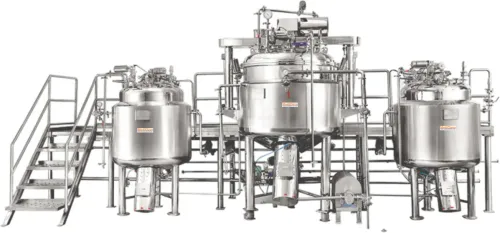
In modern pharmaceutical and cosmetic manufacturing, producing high-quality ointments, creams, gels, and other semi-solid formulations requires more than just basic mixing equipment. Manufacturers need a reliable, hygienic, and efficient production system that can deliver consistent results from batch to batch. An Ointment Manufacturing Plant is designed to meet these requirements by integrating mixing, heating, emulsification, homogenization, vacuum processing, cooling, storage, and product transfer into one efficient production solution. An Ointment Manufacturing Plant is widely used for manufacturing pharmaceutical ointments, dermatological creams, antiseptic creams, cosmetic creams, herbal formulations, lotions, gels, petroleum jelly, pain-relief products, and other topical formulations. Modern systems can incorporate pharmaceutical-grade stainless-steel construction, automated controls, temperature monitoring, vacuum systems, and hygienic piping to support efficient and controlled production. >> How Does an Ointment Manufacturing Plant Work? The manufacturing process generally starts with the preparation of the oil and water phases. Ingredients are charged into dedicated vessels and heated to the required temperature. The phases are then combined under controlled mixing conditions. Once the ingredients are combined, high-speed homogenization helps create a smooth and uniform formulation. Vacuum processing can be used to minimize trapped air and improve the appearance and consistency of the finished product. Controlled cooling follows the homogenization stage, allowing the formulation to achieve its required viscosity and stability. The processed ointment or cream can then be transferred to a storage vessel before filling and packaging. The exact process configuration depends on the formulation, production capacity, viscosity, and manufacturing requirements. >> Key Features of a Modern Ointment Manufacturing Plant A well-designed plant may include a manufacturing vessel, preparation vessels, vacuum emulsifying system, homogenizer, heating and cooling arrangement, transfer pumps, storage vessels, sanitary pipelines, valves, and PLC-based control systems. One of the most important advantages is uniform product quality. Controlled agitation and homogenization help distribute ingredients evenly, resulting in consistent texture, viscosity, and appearance. Vacuum processing is another useful feature. It helps reduce air entrapment during manufacturing, which can improve product appearance and support better processing consistency. Hygiene is equally important in pharmaceutical production. High-quality stainless-steel construction and sanitary product-contact surfaces make the equipment easier to clean and maintain. For facilities requiring automated cleaning and sterilization, Mediclave also offers CIP & SIP Systems designed for pharmaceutical processing equipment, vessels, and pipelines. >> Why Is an Ointment Manufacturing Plant Important? Manual or poorly integrated production processes can increase operator involvement, processing time, product variation, and contamination risks. An integrated manufacturing plant helps reduce these challenges by providing better process control and repeatability. Automation can also help operators monitor important parameters such as temperature, mixing speed, vacuum level, and processing time. This improves batch consistency and can reduce unnecessary manual intervention. For pharmaceutical manufacturers, the plant can also be configured according to applicable GMP and hygiene requirements. The design should always be selected according to the specific formulation, validation requirements, production scale, and applicable regulations. >> Supporting Equipment for Pharmaceutical Manufacturing An ointment production facility often requires more than the main manufacturing plant. Depending on the facility and products being manufactured, additional pharmaceutical process and utility equipment may be required. For example, manufacturers producing liquid formulations can explore Mediclave's Liquid Syrup Manufacturing Process Plant, which is designed for hygienic preparation, mixing, processing, and transfer of pharmaceutical liquid products. For sterile liquid applications, an Injectable Liquid Manufacturing Vessel provides controlled processing for injectable formulations and can incorporate features such as advanced agitation and CIP/SIP compatibility. Water and steam quality are also essential in pharmaceutical manufacturing. A Multi Column Distillation Plant can be used for high-purity pharmaceutical water and Water for Injection applications, while a Pure Steam Generator can provide pharmaceutical-grade steam for sterilization and SIP applications. Together, these systems can form part of a broader pharmaceutical manufacturing infrastructure where process equipment, water systems, cleaning systems, and sterilization utilities work together

Ahmedabad
08042755106
+917041232204
 Chat with us
 Chat with us