
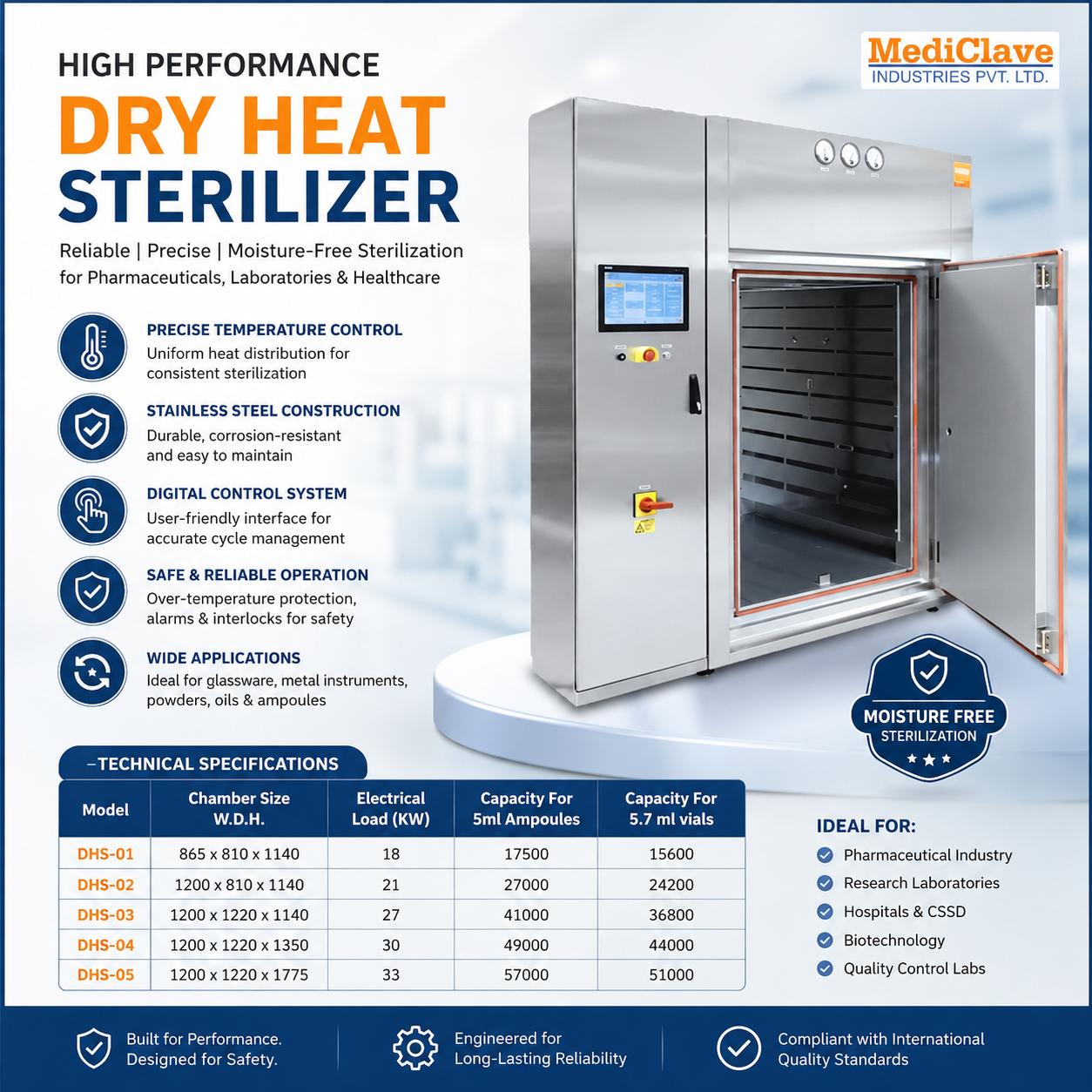
In industries where contamination can compromise product quality, patient safety, and regulatory compliance, choosing the right sterilization technology is critical. While steam sterilization is widely used, it is not always suitable for heat-sensitive metals, powders, oils, or glassware. This is where a Dry Heat Sterilizer becomes an indispensable solution.
A dry heat sterilizer offers a highly effective, moisture-free sterilization process that destroys bacteria, viruses, fungi, and bacterial spores using controlled high temperatures. It is widely used across pharmaceutical manufacturing, microbiology laboratories, research institutions, hospitals, medical device production, and quality control laboratories.
If you are searching for a dependable sterilization solution designed for precision, durability, and regulatory compliance, explore the advanced sterilization equipment offered by Mediclave Industries at https://www.mediclaveindustries.in/. Their solutions are engineered to meet the demanding requirements of modern healthcare and pharmaceutical environments.
What Is a Dry Heat Sterilizer?
A Dry Heat Sterilizer is a laboratory and industrial sterilization system that eliminates microorganisms through the application of hot air without using steam, chemicals, or moisture.
Unlike steam autoclaves that sterilize through saturated steam under pressure, dry heat sterilizers circulate heated air at carefully controlled temperatures to achieve complete sterilization.
The process works by:
Oxidizing microbial cell components
Destroying proteins and enzymes
Eliminating bacterial spores
Preventing microbial survival
Because no moisture is involved, dry heat sterilization is particularly suitable for materials that may rust, corrode, dull, or become damaged when exposed to steam.
Why Dry Heat Sterilization Matters
Many pharmaceutical and laboratory materials cannot tolerate moisture. Steam may alter chemical compositions, damage precision instruments, or leave unwanted residues.
Dry heat sterilization solves these challenges by providing:
Moisture-free sterilization
Excellent temperature uniformity
Reliable microbial destruction
Longer equipment lifespan
Reduced maintenance
Minimal risk of corrosion
For organizations focused on product quality and regulatory compliance, dry heat sterilization delivers consistent and repeatable results.
How Does a Dry Heat Sterilizer Work?
The operating principle is simple but highly precise.
First, the chamber is preheated to the required sterilization temperature.
High-performance heating elements then generate dry hot air, while forced air circulation distributes heat evenly throughout the chamber.
The materials remain inside the chamber for a validated holding time until sterilization is complete.
Typical sterilization cycles include:
| Temperature | Sterilization Time |
|---|---|
| 160°C | 120 minutes |
| 170°C | 60 minutes |
| 180°C | 30 minutes |
The exact cycle depends on product type, load size, validation requirements, and industry standards.
Key Features of a Modern Dry Heat Sterilizer
Modern pharmaceutical-grade dry heat sterilizers incorporate advanced engineering features to maximize efficiency and process reliability.
Precision Temperature Control
Advanced PID controllers maintain accurate temperatures throughout the sterilization cycle.
Uniform Hot Air Distribution
Forced air circulation ensures every item receives identical heat exposure.
Stainless Steel Construction
High-quality stainless steel chambers provide excellent durability, corrosion resistance, and easy cleaning.
Digital Touchscreen Interface
Modern HMI systems simplify operation while reducing human error.
Data Recording
Many systems include batch recording and process documentation to satisfy GMP requirements.
Safety Systems
Advanced models include:
Over-temperature protection
Door interlocks
Alarm systems
Emergency shutdown
Temperature sensors
Cycle validation support
Applications of Dry Heat Sterilizers
One of the biggest advantages of dry heat sterilization is its versatility.
It serves numerous industries where moisture-sensitive materials require dependable sterilization.
Pharmaceutical Industry
Dry heat sterilizers are widely used for:
Glass ampoules
Glass bottles
Stainless steel containers
Metal instruments
Powder sterilization
Depyrogenation applications
Hospitals & CSSD
Healthcare facilities rely on dry heat sterilizers for:
Surgical instruments
Metal trays
Forceps
Needles
Stainless steel tools
Research Laboratories
Research facilities sterilize:
Glass beakers
Pipettes
Petri dishes
Laboratory instruments
Scientific equipment
Biotechnology Industry
Biotech laboratories require sterile environments for:
Research samples
Laboratory glassware
Analytical instruments
Production equipment
Medical Device Manufacturing
Medical device manufacturers sterilize:
Metallic components
Surgical accessories
Stainless steel assemblies
Precision manufacturing tools
Benefits of Using a Dry Heat Sterilizer
Moisture-Free Process
No steam means there is zero risk of moisture damage.
Corrosion Prevention
Metal instruments remain rust-free, extending their operational life.
Chemical-Free Sterilization
No toxic gases or chemical residues remain after sterilization.
High Reliability
Properly validated cycles consistently destroy microorganisms, including resistant bacterial spores.
Low Operating Cost
After installation, operating expenses remain relatively low due to the absence of consumable sterilizing chemicals.
Long Equipment Life
Industrial-grade construction ensures years of dependable operation.
Dry Heat Sterilizer vs Steam Autoclave
Choosing between dry heat and steam sterilization depends on the application.
| Feature | Dry Heat Sterilizer | Steam Autoclave |
|---|---|---|
| Moisture | No | Yes |
| Suitable for Powders | Yes | No |
| Suitable for Oils | Yes | No |
| Glassware | Excellent | Good |
| Metal Instruments | Excellent | Excellent |
| Cycle Speed | Moderate | Faster |
| Corrosion Risk | Very Low | Possible |
| Residue | None | Moisture |
Both technologies are valuable, but dry heat sterilization remains the preferred choice whenever moisture could negatively impact the product.
Industries That Benefit Most
Organizations investing in dry heat sterilization include:
Pharmaceutical manufacturers
Vaccine manufacturers
Medical colleges
Universities
Hospitals
Biotechnology companies
Food testing laboratories
Research institutes
Medical device manufacturers
Quality control laboratories
How to Choose the Right Dry Heat Sterilizer
Purchasing the right sterilizer requires more than comparing prices.
Consider these factors:
Chamber Capacity
Select a chamber size that matches your production or laboratory requirements.
Temperature Range
Ensure the equipment provides the temperatures required for your validated processes.
Uniform Heat Distribution
Temperature consistency is essential for successful sterilization.
Automation
Programmable cycles improve productivity while reducing operator intervention.
Compliance
Choose equipment designed to support GMP, GLP, ISO, and pharmaceutical validation requirements.
Build Quality
High-grade stainless steel construction ensures durability and easier maintenance.
Service Support
Reliable technical assistance and spare part availability reduce downtime and improve long-term value.
Why Quality Manufacturing Matters
A sterilizer is a long-term investment. Poor temperature control or uneven heating can compromise sterilization effectiveness, resulting in failed validation, product rejection, or increased operational risks.
Choosing a trusted manufacturer ensures:
Consistent product quality
Advanced engineering
Energy-efficient operation
Reliable after-sales support
Long service life
Compliance with industry standards
Companies looking for dependable sterilization equipment can explore the comprehensive range available from Mediclave Industries, a trusted manufacturer serving pharmaceutical, healthcare, and laboratory sectors through https://www.mediclaveindustries.in/.
Future Trends in Dry Heat Sterilization
Sterilization technology continues to evolve with the demands of Industry 4.0 and pharmaceutical automation.
Emerging innovations include:
PLC-based automation
IoT-enabled monitoring
Remote diagnostics
Energy-efficient heating systems
Digital batch recording
Real-time process validation
Smart preventive maintenance
These advancements help organizations improve productivity while ensuring consistent regulatory compliance.
Frequently Asked Questions (FAQs)
1. What is a Dry Heat Sterilizer used for?
It is used to sterilize glassware, metal instruments, powders, oils, pharmaceutical containers, laboratory equipment, and other moisture-sensitive materials.
2. How does dry heat sterilization kill microorganisms?
It destroys microorganisms through oxidation and protein denaturation using high-temperature hot air.
3. Is dry heat sterilization better than steam sterilization?
Neither is universally better. Dry heat is ideal for moisture-sensitive items, while steam is preferred for many general medical instruments and fabrics.
4. Can bacterial spores be destroyed by dry heat?
Yes. When operated at validated temperatures and exposure times, dry heat sterilization effectively destroys bacterial spores.
5. Which industries commonly use Dry Heat Sterilizers?
Pharmaceutical manufacturing, hospitals, microbiology laboratories, biotechnology facilities, research institutes, universities, and medical device manufacturers all use dry heat sterilizers.
6. What materials should not be sterilized using steam?
Oils, powders, certain metals susceptible to corrosion, and moisture-sensitive materials are better suited for dry heat sterilization.
7. What temperature is commonly used in a Dry Heat Sterilizer?
Typical validated temperatures include 160°C, 170°C, and 180°C, depending on the required sterilization cycle.
8. How long does a sterilization cycle take?
Cycle duration depends on temperature, product load, chamber size, and validation requirements, generally ranging from 30 to 120 minutes.
Conclusion
A Dry Heat Sterilizer remains one of the most dependable solutions for sterilizing moisture-sensitive materials in pharmaceutical, laboratory, healthcare, and industrial environments. Its ability to deliver precise, chemical-free, and corrosion-free sterilization makes it an essential investment for organizations committed to product quality, operational efficiency, and regulatory compliance.
By selecting a high-quality sterilizer from an experienced manufacturer, businesses can enhance process reliability, extend equipment lifespan, and maintain the highest standards of sterility. Whether you operate a pharmaceutical production facility, research laboratory, or hospital CSSD, a well-designed dry heat sterilizer provides long-term value and dependable performance.
Contact Mediclave Industries
Looking for a high-performance Dry Heat Sterilizer tailored to your operational requirements?
Get in touch with the experts at Mediclave Industries to discuss your application and find the ideal sterilization solution.
Website: https://www.mediclaveindustries.in/
Email: info@mediclaveindustries.com
Phone: 08042755106