

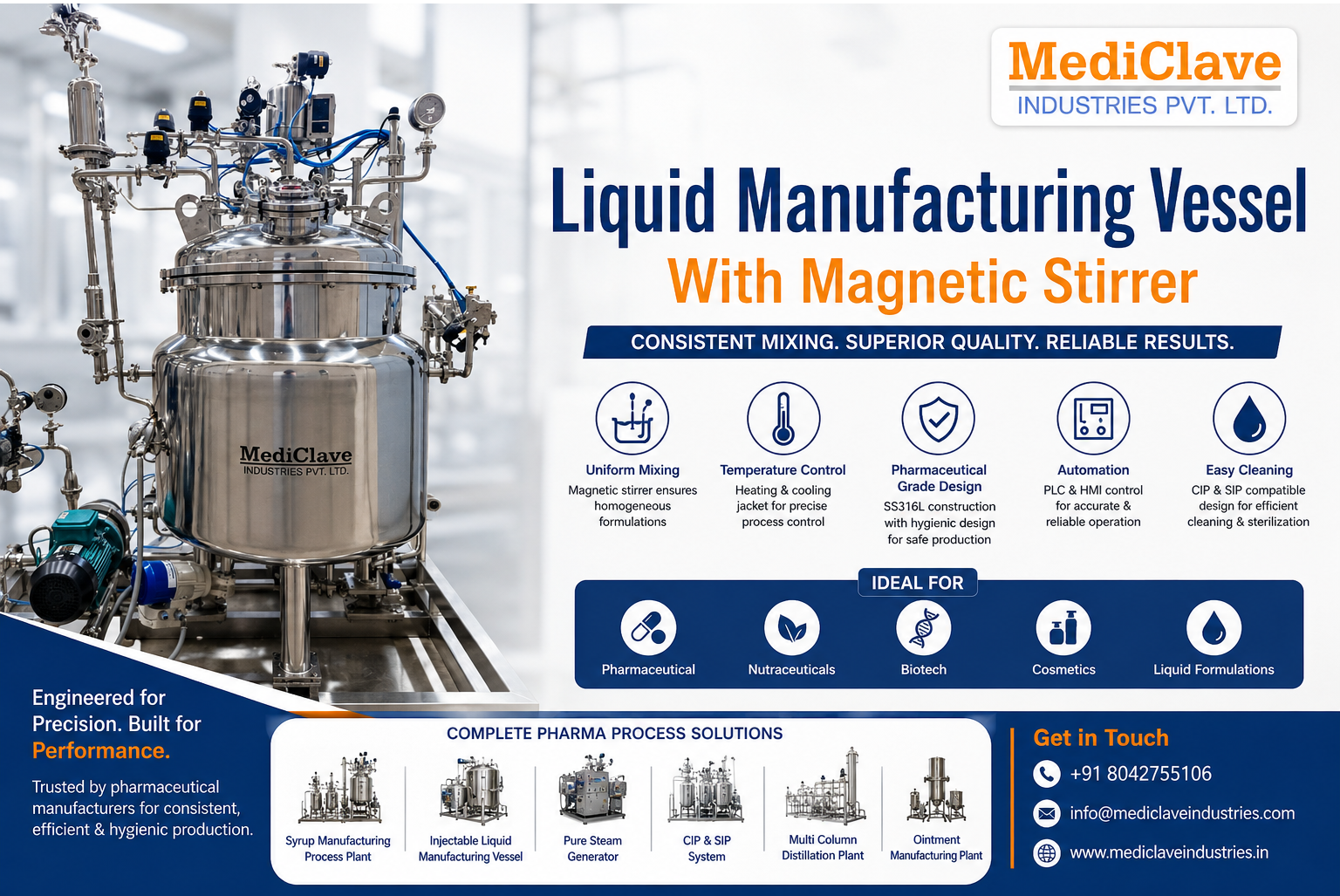
In pharmaceutical manufacturing, consistency is not optional. Every batch of liquid medicine must be prepared with the right ingredients, the right concentration, the right temperature, and the right mixing conditions. Even a small variation in the manufacturing process can affect product quality, stability, appearance, and performance. This is why modern pharmaceutical companies depend on specially engineered process equipment such as the Liquid Manufacturing Vessel With Magnetic Stirrer.
A liquid manufacturing vessel with magnetic stirring is designed to provide controlled, uniform, and hygienic mixing of pharmaceutical liquid formulations. It can support processes where ingredients need to be dissolved, blended, heated, cooled, or maintained under controlled conditions before filtration and filling. For pharmaceutical manufacturers, nutraceutical companies, cosmetic manufacturers, biotechnology facilities, and healthcare product manufacturers, the right vessel can make the production process more reliable and easier to control.
The importance of this equipment becomes even greater when manufacturers are producing products in larger batches. Manual mixing may work for small-scale operations, but it becomes difficult to maintain the same level of accuracy and consistency as production volumes increase. A properly designed manufacturing vessel provides a controlled environment in which ingredients can be processed systematically, reducing unnecessary manual handling and helping operators achieve repeatable results.
What Is a Liquid Manufacturing Vessel With Magnetic Stirrer?
A Liquid Manufacturing Vessel With Magnetic Stirrer is a pharmaceutical process vessel designed for preparing and mixing liquid formulations. The vessel provides a controlled chamber for charging raw materials and processing them according to the formulation requirements, while the magnetic stirring arrangement helps maintain uniform mixing.
Depending on the application, the vessel can be designed with features such as temperature control, heating or cooling arrangements, sanitary connections, controlled agitation, instrumentation, and automated process monitoring. The exact configuration depends on the product, batch size, viscosity, processing temperature, mixing requirements, and manufacturing standards.
The primary purpose is simple: to provide controlled and homogeneous liquid processing in a hygienic pharmaceutical environment.
Liquid formulations may contain several ingredients, including active pharmaceutical ingredients, purified water, solvents, preservatives, stabilizers, sweeteners, flavors, or other excipients. These ingredients need to be distributed properly throughout the batch. Effective mixing helps prevent concentration differences and supports consistent product quality from one batch to another.
For applications involving sterile or highly sensitive products, equipment design becomes even more important. Product-contact surfaces, drainability, cleaning arrangements, connections, and process controls must all be considered carefully.
Mediclave Industries provides pharmaceutical process equipment designed for different production requirements. Manufacturers looking for related equipment can also explore the company’s Injectable Liquid Manufacturing Vessel With Magnetic Stirrer, particularly when the production process involves sterile injectable formulations.
Why Is This Vessel Important for Pharmaceutical Manufacturing?
Liquid pharmaceutical products require controlled processing because their quality depends on accurate formulation and uniform distribution of ingredients. A manufacturing vessel is therefore much more than a simple stainless-steel tank.
A properly engineered vessel helps control several important manufacturing factors.
Uniform mixing: The stirring system helps distribute ingredients throughout the liquid and minimizes concentration differences.
Controlled processing: Heating, cooling, mixing, and other process conditions can be managed according to the formulation.
Hygienic production: Pharmaceutical-grade vessel designs can minimize contamination risks and make cleaning easier.
Reduced manual handling: A controlled vessel reduces the need for repeated manual mixing and transfers.
Batch consistency: Repeatable processing conditions can support more consistent results between production batches.
Improved productivity: Better process control can help manufacturers reduce unnecessary processing time and improve production efficiency.
These advantages are particularly valuable for manufacturers that need to produce multiple batches every day while maintaining consistent quality.
How Does a Liquid Manufacturing Vessel With Magnetic Stirrer Work?
The working process begins with preparation of the raw materials. Ingredients are checked, weighed, and prepared according to the approved formulation. The vessel is then cleaned and prepared for production.
The required liquid base, often purified water or another approved processing liquid, is charged into the vessel. Ingredients are added according to the defined manufacturing sequence.
Once the ingredients enter the vessel, the magnetic stirring system provides controlled agitation. The objective is to promote uniform distribution throughout the batch. Depending on the formulation, mixing may be performed at a controlled speed for a defined period.
If the formulation requires heating, the vessel can be configured with an appropriate heating arrangement. Temperature control is important for processes where ingredients dissolve more effectively at elevated temperatures. Similarly, cooling arrangements may be required after heating or when the final product needs to be maintained within a particular temperature range.
After the mixing and processing stages are complete, the finished liquid can be transferred through hygienic piping to a filtration system, holding vessel, or filling line.
The exact process sequence depends on the formulation. A simple liquid may only require charging and mixing, while a more complex pharmaceutical product may require controlled temperature changes, filtration, sampling, holding, and transfer.
Magnetic Stirring and Its Role in Liquid Processing
Mixing is one of the most important functions of a liquid manufacturing vessel. If ingredients are not properly distributed, the final product may not have the required uniformity.
Magnetic stirring provides controlled agitation within the vessel. The mixing arrangement should be selected according to the product characteristics rather than simply choosing the highest possible stirring speed.
For example, low-viscosity liquids may require different mixing conditions compared with thicker formulations. Some products can also be sensitive to excessive agitation, foaming, or air incorporation. Therefore, the mixer and vessel configuration should be selected according to the formulation and manufacturing process.
The objective is to achieve effective mixing without unnecessarily disturbing the product.
This makes process engineering particularly important. Factors such as vessel geometry, batch volume, liquid properties, mixing speed, temperature, and ingredient addition sequence can influence the final result.
Key Features to Consider
When purchasing a Liquid Manufacturing Vessel With Magnetic Stirrer, manufacturers should look beyond vessel capacity and consider the complete process requirement.
Pharmaceutical-Grade Construction
The product-contact portion of a pharmaceutical vessel is commonly designed using stainless steel suitable for hygienic processing, such as SS316L, depending on the application. The material should provide corrosion resistance and compatibility with the formulation.
Controlled Agitation
The stirring system should provide appropriate mixing performance for the product. Variable-speed control can be valuable when different formulations or process stages require different mixing conditions.
Temperature Control
Some liquid formulations require heating during dissolution and cooling after processing. A suitable jacket or temperature-control arrangement can provide better process stability.
Hygienic Design
Smooth internal surfaces, appropriate sanitary connections, proper drainability, and minimized dead zones are important considerations for pharmaceutical equipment.
Automation
PLC and HMI-based controls can help operators monitor and control key process parameters. Automation can also improve repeatability and reduce dependence on manual intervention.
Easy Cleaning
Cleaning is essential in pharmaceutical production, particularly when the same equipment is used for different products. A vessel designed for efficient cleaning can reduce downtime and contamination risks.
For larger pharmaceutical facilities, integrating the vessel with a CIP & SIP System can provide an efficient approach to cleaning and sterilization of process equipment without repeatedly dismantling the system.
Applications of Liquid Manufacturing Vessels
The versatility of liquid manufacturing vessels makes them suitable for many industries and products.
In pharmaceutical manufacturing, they can be used for liquid formulations, oral solutions, pharmaceutical preparations, and other controlled liquid processes.
In the nutraceutical industry, vessels can support the preparation of vitamin liquids, nutritional formulations, herbal products, and health supplements.
In the cosmetic industry, liquid processing equipment can be used for products such as lotions, liquid skincare formulations, and other personal-care products.
Biotechnology and research facilities may also use specialized manufacturing vessels for controlled liquid preparation and processing.
The final equipment configuration should always be based on the product formulation, process requirements, production capacity, and applicable quality standards.
Liquid Manufacturing Vessel vs. Ordinary Mixing Tank
At first glance, a pharmaceutical manufacturing vessel may look similar to a conventional industrial mixing tank. However, the difference lies in the design requirements.
An ordinary industrial tank may focus primarily on holding or mixing a material. Pharmaceutical equipment must consider additional factors such as hygiene, cleanability, material compatibility, process control, traceability, and contamination prevention.
A pharmaceutical manufacturing vessel may therefore incorporate sanitary connections, controlled agitation, temperature management, specialized instrumentation, and integration with cleaning and sterilization systems.
This makes it particularly suitable for environments where product quality and manufacturing consistency are critical.
Importance of Purified Water in Liquid Manufacturing
Water is often one of the most important ingredients in pharmaceutical liquid formulations. Its quality can directly influence the quality and safety of the final product.
For applications requiring pharmaceutical-grade water, manufacturers may integrate their process equipment with dedicated pharmaceutical water systems.
A Multi-Column Distillation Plant can be used in pharmaceutical water-generation applications where high-purity Water for Injection is required. Such systems use multiple-effect distillation to produce high-purity water for critical pharmaceutical processes.
This creates an important connection between process equipment and utility systems. A manufacturing vessel cannot be considered independently from the quality of the water, steam, cleaning system, and other utilities supporting the production process.
Role of Pure Steam in Pharmaceutical Processing
For facilities manufacturing sterile products, clean and pure steam can also become an important part of the overall production infrastructure.
A Pure Steam Generator is designed to generate high-purity steam for applications such as sterilization and Sterilize-In-Place processes. Pure steam can be particularly important when steam comes into contact with pharmaceutical equipment or product-contact surfaces.
When a liquid manufacturing vessel is part of a larger sterile production system, integration with appropriate cleaning and sterilization utilities can improve overall process control.
Liquid Manufacturing Vessel for Syrup Production
One of the most common applications of liquid manufacturing equipment is oral liquid and syrup production.
A modern Liquid Syrup Manufacturing Process Plant can integrate preparation vessels, manufacturing vessels, storage vessels, filtration systems, transfer pumps, and control systems.
The manufacturing vessel acts as a central processing point where ingredients can be mixed under controlled conditions. Depending on the formulation, the process may involve sugar dissolution, ingredient addition, mixing, filtration, storage, and transfer to the filling line.
This type of integrated approach can reduce manual handling and help pharmaceutical manufacturers maintain more consistent production conditions.
Connection With Injectable Manufacturing
Injectable manufacturing requires even greater attention to hygiene, sterility, and process control because injectable products are intended for administration directly into the body.
A specialized Injectable Liquid Manufacturing Vessel can be configured for sterile liquid preparation, including features such as controlled mixing, heating and cooling, sanitary design, sterile filtration compatibility, and CIP/SIP integration.
For injectable production, the vessel should be considered as one part of the complete sterile manufacturing system rather than as an isolated piece of equipment.
Water quality, sterilization, filtration, environmental controls, transfer systems, and filling operations all contribute to the final product quality.
Can Similar Equipment Be Used for Creams and Gels?
Liquid manufacturing vessels are primarily intended for liquid processing, while creams, ointments, and gels often require different mixing and homogenization technologies.
For semi-solid products, a dedicated Ointment Manufacturing Plant may be more appropriate. These plants can incorporate preparation vessels, vacuum processing, homogenization, heating, cooling, mixing, storage, and transfer arrangements designed for semi-solid formulations.
This distinction is important when selecting pharmaceutical process equipment. The best equipment is not necessarily the most powerful equipment—it is the equipment correctly matched to the product and manufacturing process.
How to Select the Right Liquid Manufacturing Vessel
Before purchasing a vessel, manufacturers should evaluate several factors.
1. Determine the batch capacity.
Calculate the required working volume and consider future production growth. The vessel should provide adequate headspace and should not be selected solely on nominal capacity.
2. Understand the product characteristics.
Viscosity, density, foaming tendency, temperature sensitivity, and ingredient solubility can influence the vessel and stirring-system design.
3. Select appropriate material of construction.
Product-contact material should be compatible with the formulation and suitable for pharmaceutical processing.
4. Define the heating and cooling requirements.
If the formulation requires controlled temperature changes, the vessel should be equipped with an appropriate temperature-control arrangement.
5. Consider automation.
PLC/HMI control can simplify monitoring of temperature, mixing, time, and other process parameters.
6. Evaluate cleaning requirements.
For frequent product changes, efficient cleaning can have a major impact on production downtime.
7. Check integration requirements.
The vessel may need to connect with filtration systems, transfer pumps, storage vessels, filling lines, CIP/SIP systems, or pharmaceutical water systems.
8. Consider validation and documentation.
Pharmaceutical manufacturers should discuss documentation, testing, installation, commissioning, and qualification requirements with the equipment manufacturer before finalizing the project.
Why Choose Mediclave Industries?
Mediclave Industries Pvt. Ltd. provides pharmaceutical process equipment and related manufacturing solutions for pharmaceutical, healthcare, biotechnology, nutraceutical, and other industries.
The company’s product range covers pharmaceutical process equipment as well as supporting utility and sterilization systems. This broader product portfolio can be useful for manufacturers looking to develop an integrated production facility instead of sourcing every equipment category separately.
From liquid processing and injectable manufacturing vessels to syrup manufacturing systems, ointment plants, pharmaceutical water systems, and CIP/SIP solutions, the equipment can be selected according to the individual process requirements.
The focus should always remain on hygienic construction, reliable operation, appropriate process control, ease of maintenance, and long-term production performance.
Final Thoughts
A Liquid Manufacturing Vessel With Magnetic Stirrer is an important component for pharmaceutical manufacturers seeking consistent, controlled, and hygienic liquid processing. By combining a suitable manufacturing vessel with controlled stirring, temperature management, sanitary construction, and appropriate automation, manufacturers can create a more reliable production environment.
The vessel becomes even more valuable when it is integrated into a complete manufacturing system that includes pharmaceutical water generation, filtration, storage, transfer, cleaning, sterilization, and filling.
For companies planning a new pharmaceutical production facility, upgrading an existing line, or developing a customized liquid manufacturing process, equipment selection should begin with a clear understanding of the formulation and production requirements.
Mediclave Industries Pvt. Ltd. can help manufacturers evaluate suitable pharmaceutical process equipment according to their batch size, formulation, automation requirements, utility availability, and production goals.
For enquiries about a Liquid Manufacturing Vessel With Magnetic Stirrer and related pharmaceutical process equipment, contact Mediclave Industries Pvt. Ltd.
Email: info@mediclaveindustries.com
Phone: +91 8042755106
Website: https://www.mediclaveindustries.in/
A well-designed manufacturing vessel is more than a production tank—it is a foundation for consistent processing, improved hygiene, better batch control, and efficient pharmaceutical manufacturing.



