Thank you for writing to us. One of our executive will reach back to you through your submitted medium. In case there’s an urgency, feel free to connect over WhatsApp for faster response.
Prefer calling? Dial +917041232204 (International callers) or +917041232204 (Indian callers).
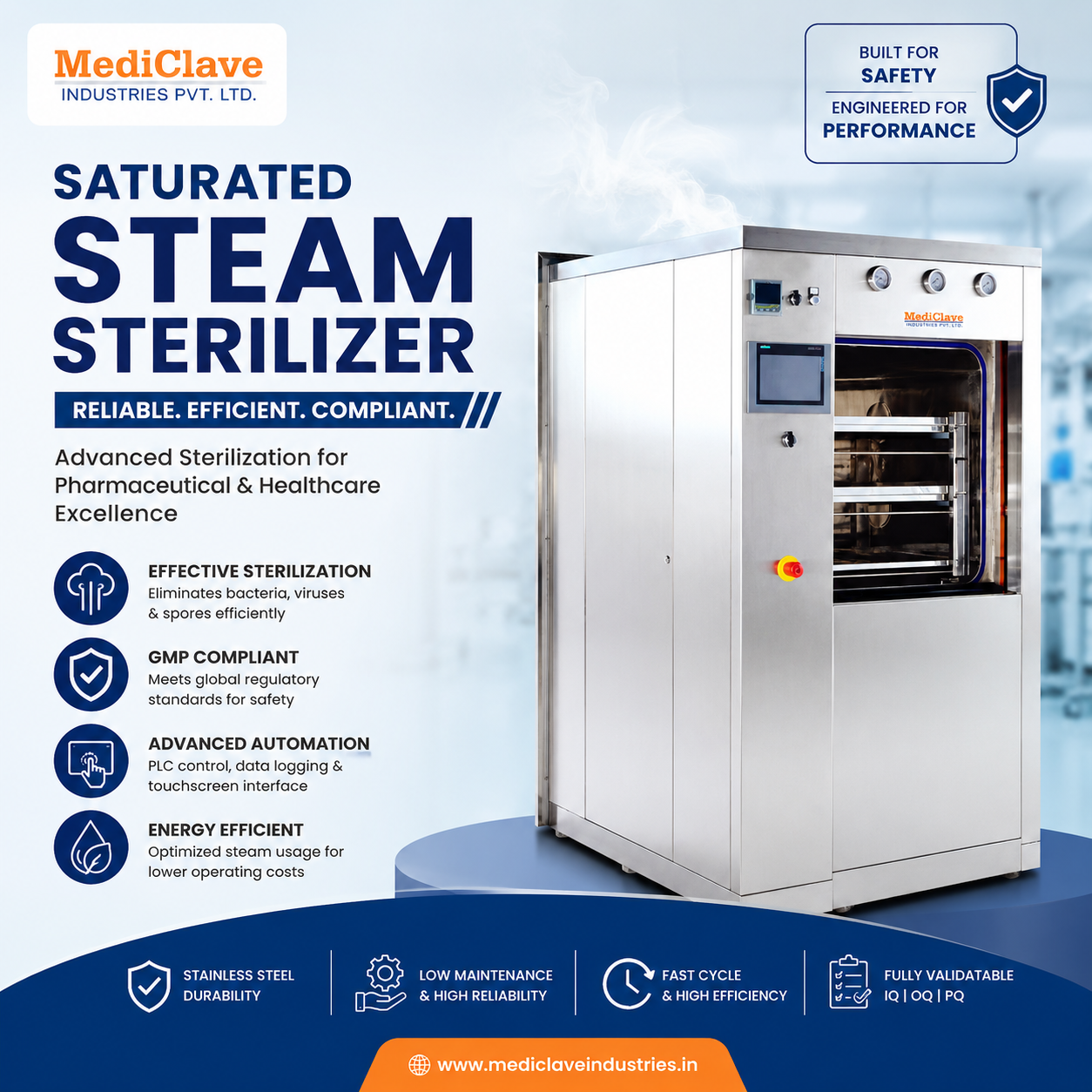
Saturated Steam Sterilizer The Complete Guide to Reliable Sterilization for Pharmaceutical
6a6b0981a314484e03b7b6e7"
Sterility is the backbone of pharmaceutical manufacturing, biotechnology, hospitals, and research laboratories. Every product that comes into contact with patients must be free from harmful microorganisms to ensure safety, regulatory compliance, and product quality. Among the many sterilization technologies available today, the Saturated Steam Sterilizer remains the industry's gold standard because of its efficiency, reliability, and cost-effectiveness.
Whether you're a pharmaceutical manufacturer, hospital administrator, quality assurance professional, or production manager, understanding how saturated steam sterilization works can help you improve productivity while maintaining the highest hygiene standards.
Modern manufacturers such as Mediclave Industries have developed advanced saturated steam sterilizers that meet the demanding requirements of GMP-compliant pharmaceutical facilities and healthcare organizations. You can explore their complete range of pharmaceutical sterilization solutions by visiting https://www.mediclaveindustries.in/.
What is a Saturated Steam Sterilizer?
A Saturated Steam Sterilizer is a highly specialized sterilization system that uses pure saturated steam under controlled pressure and temperature to destroy bacteria, viruses, fungi, spores, and other microorganisms.
Unlike dry heat sterilization, saturated steam transfers heat much faster because moisture carries thermal energy efficiently. This enables rapid sterilization while preserving the quality of heat-resistant materials.
These sterilizers are widely used in:
Pharmaceutical manufacturing plants
Injectable drug production facilities
Biotechnology laboratories
Hospitals and CSSD departments
Medical device manufacturing
Research institutions
Vaccine manufacturing facilities
Food processing industries
Their ability to deliver consistent sterilization cycles makes them indispensable for industries operating under strict quality standards.
Why Saturated Steam Sterilization is Considered the Gold Standard
Many sterilization methods exist today, including dry heat, ethylene oxide (ETO), hydrogen peroxide, and radiation. However, saturated steam remains the preferred choice for most heat-resistant products.
Its popularity comes from several advantages:
Excellent heat penetration
Faster sterilization cycles
Environmentally friendly process
No toxic chemical residues
Lower operational costs
High validation reliability
Proven regulatory acceptance worldwide
Because steam naturally penetrates porous materials and complex instruments, it provides complete sterilization even in difficult-to-reach areas.
Understanding the Science Behind Saturated Steam
The effectiveness of saturated steam comes from latent heat.
When saturated steam contacts a cooler surface, it condenses into water and instantly releases a large amount of heat energy. This rapid heat transfer destroys microorganisms by:
Denaturing proteins
Damaging cell membranes
Destroying enzymes
Eliminating bacterial spores
Preventing microbial reproduction
The combination of temperature, pressure, and exposure time creates a highly reliable sterilization environment.
Main Components of a Saturated Steam Sterilizer
Modern pharmaceutical steam sterilizers consist of several precision-engineered components.
1. Sterilization Chamber
Manufactured using high-grade stainless steel, the chamber withstands high pressure while ensuring corrosion resistance.
2. Steam Generator
Produces clean saturated steam with precise temperature control.
3. Vacuum System
Removes trapped air before sterilization begins, allowing complete steam penetration.
4. PLC Control System
Advanced automation enables operators to monitor:
Temperature
Pressure
Cycle time
Vacuum level
Sterilization parameters
5. Safety Interlocks
Multiple safety systems protect both operators and equipment.
6. Data Recording System
Modern sterilizers include digital recording for complete batch documentation and audit compliance.
Working Process of a Saturated Steam Sterilizer
The sterilization cycle generally includes the following stages.
Loading
Products are arranged to allow unrestricted steam circulation.
Air Removal
Vacuum pumps eliminate air pockets from the chamber.
Steam Admission
Pure saturated steam enters the chamber.
Sterilization Hold
Products remain at the required temperature for the validated exposure period.
Exhaust
Steam is safely released.
Drying
Vacuum drying removes moisture from the load.
Cooling
The chamber returns to a safe unloading temperature.
Each step is monitored automatically to maintain process consistency.
Applications Across Industries
A saturated steam sterilizer serves multiple industrial applications.
Pharmaceutical Industry
Injectable medicines
IV fluids
Glass bottles
Rubber closures
Stainless steel vessels
Production equipment
Manufacturing accessories
Healthcare Industry
Hospitals rely on saturated steam sterilizers for:
Surgical instruments
Dressing materials
Stainless steel trays
Linen
Reusable medical devices
Biotechnology
Biotech laboratories sterilize:
Culture media
Glassware
Laboratory tools
Production equipment
Medical Device Manufacturing
Manufacturers sterilize products before packaging and shipment.
Advantages of Saturated Steam Sterilizers
Fast Sterilization
Steam transfers heat much faster than hot air.
Outstanding Penetration
Steam reaches narrow channels and complex equipment.
Lower Operating Costs
Water and steam are significantly more economical than chemical sterilization.
Eco-Friendly Process
No harmful gases or toxic residues are produced.
Reliable Validation
Steam sterilization is easier to validate according to GMP guidelines.
High Productivity
Shorter cycles improve production efficiency.
Long Equipment Life
Properly designed stainless steel systems provide years of dependable operation.
Selecting the right manufacturer is as important as choosing the right equipment.
Mediclave Industries offers advanced sterilization solutions engineered for pharmaceutical and healthcare applications. Their systems emphasize precision, durability, automation, and regulatory compliance, helping organizations maintain consistent sterilization performance while meeting industry standards.
Sterilization technology continues to evolve with Industry 4.0 innovations.
Future systems are expected to include:
AI-assisted monitoring
Predictive maintenance
Cloud-based reporting
Remote diagnostics
IoT-enabled monitoring
Energy optimization
Advanced cycle analytics
Enhanced validation software
These developments will further improve efficiency, traceability, and operational reliability.
Frequently Asked Questions (FAQs)
1. What is a Saturated Steam Sterilizer?
A saturated steam sterilizer is equipment that uses pressurized saturated steam to eliminate microorganisms from medical, pharmaceutical, and laboratory materials.
2. How is a Saturated Steam Sterilizer different from a Dry Heat Sterilizer?
A saturated steam sterilizer uses moist heat for faster heat transfer and shorter sterilization cycles, while a dry heat sterilizer relies on hot air and generally requires higher temperatures and longer exposure times.
3. Which industries use saturated steam sterilizers?
They are widely used in pharmaceutical manufacturing, hospitals, biotechnology, medical device production, research laboratories, and food processing.
4. What materials can be sterilized?
Suitable materials include stainless steel instruments, glassware, culture media, rubber components, surgical instruments, textiles, and other heat-resistant items.
5. Why is saturated steam more effective than dry heat?
Steam transfers heat more efficiently because condensation releases a large amount of energy directly onto the surface being sterilized, resulting in faster and more uniform microbial destruction.
6. Is saturated steam sterilization environmentally friendly?
Yes. It uses water and steam rather than hazardous chemicals, producing no toxic residues and making it an environmentally responsible sterilization method.
7. How often should a saturated steam sterilizer be maintained?
Routine inspections, calibration, preventive maintenance, and validation should be performed according to the manufacturer's recommendations and applicable regulatory requirements to ensure consistent performance.
8. Can saturated steam sterilizers meet pharmaceutical regulations?
Yes. Modern systems are designed to support compliance with GMP, cGMP, FDA, WHO, ISO, and other relevant regulatory standards when properly installed, validated, and maintained.
Conclusion
A Saturated Steam Sterilizer remains one of the most dependable, efficient, and widely accepted sterilization solutions for pharmaceutical, healthcare, and laboratory environments. Its ability to deliver rapid, uniform, and validated sterilization makes it an essential investment for organizations focused on product quality, patient safety, and regulatory compliance.
By choosing a high-quality, well-engineered sterilizer and following proper maintenance and validation practices, businesses can improve operational efficiency while ensuring every sterilization cycle meets the highest industry standards.
Contact Mediclave Industries
Looking for a reliable Saturated Steam Sterilizer for your pharmaceutical, healthcare, or laboratory facility? The experts at Mediclave Industries can help you select the right solution tailored to your operational needs.
Contact the team today to discuss your sterilization requirements and discover solutions designed for long-term performance, compliance, and reliability.

 Chat with us
 Chat with us